sump clean

Bosunofforth

New Member
Joined
20 Jan 2021
Messages
10
Visit site
Changing oil in my old Bukh dv36. Out comes the old oil using the lift pump. However, my concern is that I may have left some sludge in the sump.
How can I get it out... there is no sump drain. Can anyone suggest how best to flush out any muck in the sump, please?
 
I suggest after pumping out the oil from a warm engine and leaving the engine to stand overnight try pumping out again, I get more oil out that way (not the same engine but same principle may apply to all).
Then put a litre of fresh oil in and again leave it to drain down to the sump and pump out.
Pumping cold oil is slow but it gets there eventually.

Not guaranteed to remove crud by any means but probably the best that can be done .
 
Petrol was used in aeroplane engines to dilute the oil in cold weather to allow start up. The theory was that the petrol would evaporate with engine heat. You might try diluting the sludge with petrol then suck it out. Any remaining petrol will not matter too much. (comment from experts?) ol'will
 
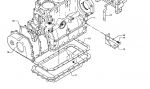
In the DV36 Parts Manual it shows that the sump itself is attached by 24 set screws* up into the crankcase, but I guess it's unlikely that access would be good enough with the engine in situ to be able to drop the whole sump.

The Parts Manual has a hexagon headed plug* (with washer) shown horizontal at the front (not underside) of the sump, but the front of the sump itself cannot be seen to check there is a corresponding hole in it. It does look like there could be a horizontal hole in the centre of the rear of the sump in the drawing, but that could be misleading, or something to do with another part of the oil system (which is shown on other pages and difficult to match up together).

I don't have access to my DV36 at present to check.

Personally, I would not be too worried about getting out every last bit of 'sludge' - these engines have been in continuous production for 40 years without any reputation I'm aware of for lubrication problems. You could, however, easily clean the worst out with some flushing oil, which I believe is specifically designed to help clean out sludge and other debris.

p.s.
* These items are not shown in the version of the drawing posted by Poignard at post #9.
 
Last edited:
Petrol was used in aeroplane engines to dilute the oil in cold weather to allow start up. The theory was that the petrol would evaporate with engine heat. You might try diluting the sludge with petrol then suck it out. Any remaining petrol will not matter too much. (comment from experts?) ol'will

I seem to recall an engineer many years ago refilling with diesel and running for a couple of minutes before draining and refilling with new oil.

W.
 
Changing oil in my old Bukh dv36. Out comes the old oil using the lift pump. However, my concern is that I may have left some sludge in the sump.
How can I get it out... there is no sump drain. Can anyone suggest how best to flush out any muck in the sump, please?
Welcome to the forum

What did the oil filter look like?

If worried about any residue, do an oil change, run for a few hours then do another oil change.
 
Changing oil in my old Bukh dv36. Out comes the old oil using the lift pump. However, my concern is that I may have left some sludge in the sump.
How can I get it out... there is no sump drain. Can anyone suggest how best to flush out any muck in the sump, please?

Why have you been putting muck in your engine ?

If you stop putting muck in, all you need to do is follow the instructions in the user manual.
 
Looks to me like there is a sump drain at the rear of the sump.

I would waste my time using it though, just follow the instruction, run till hot and pump out.
Looks like it could be but,if so, getting at it would be awkward.

I assumed it was where the sump pump suction pipe was connected.
 
If there is one at the rear (as there is on the DV20) then it can be used to fit a drain pipe and pump. I know because I have one fitted by a buddy of mine. Apparently it has the same thread as a Peugeot wheel nut! (Who knew)
I run a fuel line off it into a brass oil pump’
If required I have pictures somewhere

PS some years ago I had this conversation with Al or Norm at Bukh. They were fully aware that it was impossible to remove all the contents of the sump using suction.
 
If there is one at the rear (as there is on the DV20) then it can be used to fit a drain pipe and pump. I know because I have one fitted by a buddy of mine. Apparently it has the same thread as a Peugeot wheel nut! (Who knew)
I run a fuel line off it into a brass oil pump’
If required I have pictures somewhere

I realise it's terribly unfashionable to read previous posts ( :)) but take a peek at post #9 :)
 
Well, thank you all. I knew I wasn't alone but also it seems that even Bukh don't have the answer.
I hope you all are doing well and preparing to set to as soon as we are allowed or vaccinated.
 
Seems though you have the answer, but to cover some 'housekeeping' and good practice.
  1. Oil should be pumped out when it is warm (not hot simply due to the obvious risk of burns), as soon as possible after running the engine. Doing this will circulate the oil and suspend anything light allowing it to be extracted with the pump. Any larger particles will be caught by the filter. Warm oil is also much easier to extract.
  2. Always change the filter at the same time as the oil, especially on older or indirect injection diesels.
  3. Never put diesel in the engine to 'flush' it unless you really, really know what you are doing. Best case you will waste some diesel and have an engine that now burns more oil than previously. Worst case is irreversible damage.
Looking at the posts above, it appears Bukh place the drain point in a sensible place for marine applications - at the rear centre of the sump, where one would expect the oil and any 'undesirables' to naturally gather based on the orientation of most marine engines. In this case, using the sump pump would probably give you optimal results. On our own engine, the drain pump pipe is not optimally situated so I use a vacuum extractor down the dipstick tube to get to the bottom of the sump.

If you have any quantity of sludge or debris in the sump then it's a sign of neglected maintenance or a bigger issue, as mentioned above. If you are on top of your oil & filter changes / general maintenance then there should not be anything of consequence to cause problems in the sump.

As a point of note, engine manufacturers assume a >95% exchange when performing oil changes - that is to say that they assume a small amount of 'old' oil will be left in the engine (pumps, bearings, galleries, pipes, tensioners, etc) and this is factored in when calculating maintenance intervals. So no need to get out every last drop, just make sure you change the oil often enough. (y)
 
+1 for not 'flushing' and just pumping out as per manufacturer's instructions.

The risk of moving crud around the engine, potentially blocking oil galleries etc. is just too great. If there really is 'sludge' in the sump - that's the right place for it.

A few years ago, while I was arranging some work on an ageing Mercedes car I was custodian of, I queried why a highly-rated local independent mechanic was vacuuming oil out during their services. He replied "that's how they do it at the main dealers". I gave it a try next time I changed the oil on the 3.2 V6 petrol and, sure enough, after sucking it out I removed the sump plug and barely a cupful came out (it held something like 9L of oil).

Admittedly, vacuum may be a bit more effective than a hand pump as fitted on our engines, but only barely. And you can always try a DIY vacuum extractor pump down the dipstick tube and see if it picks up any more of the alleged sludge.
 
Top