Suffolk Sailing - River Orwell - Deep Draft Keel vs Shoal Draft Keel

There are times when I see a boat tucked up cozily in a tiny creek that I can only approach in my dinghy, and then I remember that I may want to beat up the Wallet against anything up to F6 or so, taking an hour or two less than a shoal-draft boat, and I realise that I have made my choice and may as well enjoy it.

The Orwell is a good place to start one’s East Coast experience from. The river is interesting in itself and it is possible to sail in the buoyed channels without having to worry about pilotage, with the exception of the area off Felixstowe docks where one should follow the yacht track, but even this has the cardinal buoy to protect one from the shallow patch. The adjacent places such as the Deben and Backwaters can fairly simply be approached and left on a rising tide, though both need to be treated with some respect.
 
My partner has a twin keel Hunter Horizon that draws about 3ft, or perhaps best viewed as 4ft less than I'm used to.

I can honestly say I've never run a boat aground as much as hers unintentionally. The confidence of twin keels and the ability to stay upright mean I can't help but take shortcuts I wouldn't normally!

Worth noting OP that not all of the East Coast is soft forgiving mud as mentioned earlier. Some of it is rock hard and if unlucky enough to get caught in a bit of weather, dangerous.
 
with the exception of the area off Felixstowe docks where one should** follow the yacht track,

?

We draw 1.9m and are based out of Shotley, and like many here I would put sailing ability above exploring muddy creeks. We love the east coast, and also love venturing further afield, and have never had a problem with our draft with anywhere we have wanted to go locally. We have young kids tho, so beaches are more important than anchoring in creeks.

We've experienced becoming immobilized unintentionally more times in the previous two shallow draft boats we had than our current deep fin, but I think that's because we are not so laissez faire about it as we were with the bilge keels.

It does mean that we are restricted on tidal points more than other boats, but it hasn't really caused us a problem.

** If there is anything big moving about. If in doubt just sail in the channel until VTS shouts at you ?
 
I’ve recently traded up from a shallow draft (swing keel) boat drawing 0.75m keel up, to a fin keel drawing 1.6m. Based in the Medway / Swale area. I never did much actual drying out apart from in soft mud berths, so I wouldn’t say I’ve noticed a huge difference apart from that it narrows the window you can leave or arrive in said drying mud berths. The larger boat means I have explored far more of the East coast though. ?
 
To get back to the OP's question, I learned my sailing on the river Deben 60 years ago, beyond dinghies the first big boat was my Uncle's Dragon replaced by a Stella, both fin keeled and the latter drawing a mighty 4'6". Of course, we took care to get the tide right at the Deben bar and occasionally went aground in various muddy corners of Suffolk and Essex - I remember one night sleeping with the Stella lying on her side in Maldon. As years progressed we moved to Suffolk Yacht Harbour in the 1970's and the boats grew - the current one is 42' LOA and 6' draft sailed out of SYH. A friend in SYH, who also learned his yachting in a Stella on the Deben in the 1960's sails an Elan 333 with 2m draft. I have to say I don't find the draft a problem, we anchor in various rivers and backwaters, but choose not to dry out.

I'm a lazy so and so and, while quite capable of tidal calculations, I find them boring, so I dreamed up the half tide rule as many of our local ports have shallow entrances with plenty of water inside. The depth of water available at half tide is much the same from neaps to springs. If that depth will allow a 6' draft boat to enter or lravesafely then I class that as a half tide port abd there are many. For all of those ports, I might elect to go a bit above half tide if there is a big sea running to avoid bumping in the troughs - you really don't want to do that when the bottom is hard sand - in my youth I saw a Dutch yacht bang her keel right up through her bottom getting the Deben bar wrong in an early spring gale, but with soft mud no harm will be done.

Yes the East Coast offers all sorts of fine sailing from the open N sea to the deep estuaries, to the muddy creeks and backwaters, with plenty of scope to enjoy them in a bilge keeler or fin keeler. Folk seem to have forgotten that the J-class yachts had an annual fixture at Harwich, which many owners recorded as the best of each year, and they're hardly shallow draft models. These are God's own waters for sailing but Shhh! don't repeat that outside this forum or all the Solent boats will be up here.

Peter.
 
Might venture to suggest that one can go anywher a Fin Keel boat can, if a Shallow Draft boat like most Bilge Keelers or even Centre Boarders go

It might just take a little longer in a Bilge Keeler but one can always stop off or take a break , stretch ones legs etc , enjoy the scenerey
 
Last edited:
There are times when I see a boat tucked up cozily in a tiny creek that I can only approach in my dinghy, and then I remember that I may want to beat up the Wallet against anything up to F6 or so, taking an hour or two less than a shoal-draft boat, and I realise that I have made my choice and may as well enjoy it.

The Orwell is a good place to start one’s East Coast experience from. The river is interesting in itself and it is possible to sail in the buoyed channels without having to worry about pilotage, with the exception of the area off Felixstowe docks where one should follow the yacht track, but even this has the cardinal buoy to protect one from the shallow patch. The adjacent places such as the Deben and Backwaters can fairly simply be approached and left on a rising tide, though both need to be treated with some respect.

Yes well might suggest tha most sound Boats /Yachts also have an Engine to do the battles with a head wind , sod all that work sailing in those conditions

So a good Bilge Keel or Centrboard can get there under its own power , all;beit not under sail alone ?

I recall reading in these pages a few years ago Skippers saying that they can sometimes leave the Mill harbour as soon as is possible then sail out of the Deben in one haul , yea well if thats whats wanted or desired , then so be it ; but others just might want to enjoy the Deben and other EC rivers

Might suggest the Poster should search for the 'Keep turning left' videos on UTube and view the earlier videos based upon the Essex and Suffolk rivers in order to experience the leisurely journies that can be made
 
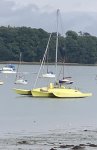
This is the only boat on the east coast (yes, she lives on the Orwell) that can do both. Her owner, who is a very nice chap, built her many years ago and she isn’t for sale….

… she’s floating in about two feet of water, here…
 

Attachments

  • 0C26C127-6BA4-4518-A1F2-DD34D6E0788C.jpeg
    0C26C127-6BA4-4518-A1F2-DD34D6E0788C.jpeg
    854.6 KB · Views: 30
Yes well might suggest tha most sound Boats /Yachts also have an Engine to do the battles with a head wind , sod all that work sailing in those conditions

So a good Bilge Keel or Centrboard can get there under its own power , all;beit not under sail alone ?
The noise is the sound of Des Sleightholme turning in his grave.
 
Surprised nobody has mentioned Maurice Griffiths in the what's best for the East Coast debate as he defined that nearly 100 years ago. I have owned 2 of his designs, the ultra shallow Eventide 26 which I rebuilt with 9" greater draft and removed the bilge plates. I did this after 10 years in Poole when I realised I had only dried out about half a dozen times, mostly in Studland Bay (which one is not allowed to do now!). Along with a new rudder vastly improved the boat's handling and never had a problem with draft. I now have a Golden Hind, its big sister which is same long keel and bilge plates but 1.3m. Somewhat surprisingly for a design that started life on the east coast it was built in Plymouth and biggest market was offshore cruising - boat of choice for the adventurers of the day.

But times have moved on and shallow draft plus ability to dry out becomes less attractive once you get above 30'. There are too many compromises, either deeper draft to maintain sailing ability (think boats like the Seahawk and its variants) or complications of centreplates. Add to that the changes in style of sailing brought about by marinas and deep water moorings in harbours and shallow draft is no longer the attraction it was.
 
Due South. Having sailed, cruised and raced on the East Coast for over half a century in a range of different sized boats, rarely have I even considered ditch crawling worth doing. As long as there is sufficient rise of tide to enter places like the Deben or Alde, either keel depth will be fine. If you do not want to go in a marina or harbour, then there are plenty of quiet places to watch the wild life either on a mooring or at anchor. If you want to go further into shallower water, then use your dinghy. The deeper keel may limit your access, but will not stop your enjoyment of the Essex and Suffolk rivers, it will certainly improve your sailing performance and allow more sailing miles in a day.

Then you can stretch your sailing area to come down into the Medway or up the Thames or cross the sands to Ramsgate or to foreign lands. The deep keel will be a bonus then. My fin keel requires 1.6m and there are few places I want to visit that causes any problems. My big dislike is settling into a mud berth as I hate the residue left on the hull as once back to my home berth I find weed grows on it as the antifouling is covered. So I avoid anywhere that stops me staying afloat and there are plenty of those to choose from.
 
Surprised nobody has mentioned Maurice Griffiths in the what's best for the East Coast debate as he defined that nearly 100 years ago. I have owned 2 of his designs, the ultra shallow Eventide 26 which I rebuilt with 9" greater draft and removed the bilge plates. I did this after 10 years in Poole when I realised I had only dried out about half a dozen times, mostly in Studland Bay (which one is not allowed to do now!). Along with a new rudder vastly improved the boat's handling and never had a problem with draft. I now have a Golden Hind, its big sister which is same long keel and bilge plates but 1.3m. Somewhat surprisingly for a design that started life on the east coast it was built in Plymouth and biggest market was offshore cruising - boat of choice for the adventurers of the day.

But times have moved on and shallow draft plus ability to dry out becomes less attractive once you get above 30'. There are too many compromises, either deeper draft to maintain sailing ability (think boats like the Seahawk and its variants) or complications of centreplates. Add to that the changes in style of sailing brought about by marinas and deep water moorings in harbours and shallow draft is no longer the attraction it was.
My neighbour had a Maurice Griffiths boat a few years ago, a Waterwitch I think. On one occasion we joined them for a downwind sail up the Colne. As we were going a bit fast for them I dropped the main. As we we still going too fast I part-furled the jib. We ended up leaving them behind under bare poles.
 
This is the only boat on the east coast (yes, she lives on the Orwell) that can do both. Her owner, who is a very nice chap, built her many years ago and she isn’t for sale….

… she’s floating in about two feet of water, here…

The only boat that’ll do both? There’s a fair few trimarans other than that one on the east coast. My lifting keel boat will float in two foot of water with the keel up, and will point higher than many a similar length fin keel boat. She draws 1.8m with the keel down and has a tonne of lead at the bottom of the keel. You can have your cake and eat it. Sadler 290 another good example of this.
 
I moved from a bought drawing 1.2m to one drawing 1.8m about 20 yearsa ago. The extra sailing ability makes it very worthwhile.
There are a few things I miss, For examply, being able to lay afloat off Iken Cliff and a being able to anchor close inshore in some places, but you soon get used to that. Generally speaking it's not much of a handicap.
My deeper draught is a bit restrictive when visiting Friesland lakes but it makes for interesting navigation.
 
My neighbour had a Maurice Griffiths boat a few years ago, a Waterwitch I think. On one occasion we joined them for a downwind sail up the Colne. As we were going a bit fast for them I dropped the main. As we we still going too fast I part-furled the jib. We ended up leaving them behind under bare poles.

When an owner is unable to claim speed, handiness or beauty for his yacht, he calls her a magnificent sea boat.

Always worked for me . :)
 
My neighbour had a Maurice Griffiths boat a few years ago, a Waterwitch I think. On one occasion we joined them for a downwind sail up the Colne. As we were going a bit fast for them I dropped the main. As we we still going too fast I part-furled the jib. We ended up leaving them behind under bare poles.

Oh dear Mr J ; might suggest that you do play down your Sailing skills /ability a good bit , I assume {:-)#
 
When an owner is unable to claim speed, handiness or beauty for his yacht, he calls her a magnificent sea boat.

Always worked for me . :)

Yes quite so quite so ; had to smile when viewing one of the KTL videos the other day , an American asked Dylan why he kept calling his Mirror Offshore 'The Slug' , well replied Dylan , she is very 'Sea Worthy'
 
My neighbour had a Maurice Griffiths boat a few years ago, a Waterwitch I think. On one occasion we joined them for a downwind sail up the Colne. As we were going a bit fast for them I dropped the main. As we we still going too fast I part-furled the jib. We ended up leaving them behind under bare poles.
Yes, many Waterwitches were slugs - too much weight and not enough sail. On the other hand, between 1970 and 1980, around 35 Golden Hinds crossed the Atlantic and no doubt many more since. More to sailing than speed.
 
Top