Suddenly...the battery isolater won't isolate

salar

Well-Known Member
Joined
5 May 2009
Messages
990
Location
Hampshire, UK
harley25refit.blogspot.co.uk
Today I went down to my boat to fit a new capstan winch. I thought it best to test it worked before installing it so I took the negative off the starter battery to isolate it and touched the two capstan cables to the battery terminals. The winch worked fine so I reconnected the negative, started and ran the engine for a while then shut down. Strangely, the power to the house circuit remained on even though the battery switch was off! Other than the capstan test, nothing has been touched since it last worked fine. Do battery switches ever fail and remain open? Puzzled...
 
Today I went down to my boat to fit a new capstan winch. I thought it best to test it worked before installing it so I took the negative off the starter battery to isolate it and touched the two capstan cables to the battery terminals. The winch worked fine so I reconnected the negative, started and ran the engine for a while then shut down. Strangely, the power to the house circuit remained on even though the battery switch was off! Other than the capstan test, nothing has been touched since it last worked fine. Do battery switches ever fail and remain open? Puzzled...

They do, but yours has failed close. They do that too :)

What sort of switches do you have ?
 
Today I went down to my boat to fit a new capstan winch. I thought it best to test it worked before installing it so I took the negative off the starter battery to isolate it and touched the two capstan cables to the battery terminals. The winch worked fine so I reconnected the negative, started and ran the engine for a while then shut down. Strangely, the power to the house circuit remained on even though the battery switch was off! Other than the capstan test, nothing has been touched since it last worked fine. Do battery switches ever fail and remain open? Puzzled...

Yeah, they do as Paul said. That's why you have a main switch to power off if anything fails.
 
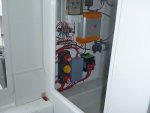
Yes, in switch terms it remains closed! This is the set-up: top isolates the domestic battery, bottom isolates starter battery, middle is the emergency bridge. I can't remember the manufacturer but you can build lines or blocks with the switch units.

domesticswitches.jpg
 
First thing to do is to feel the action of the switch. Does it feel loose or stiff compared to the other switches? This would indicate mechanical failure inside. Then remove wires off one terminal of the isolator switch and confirm that isolation does occur. So no other circuit interacting. Use a multimeter on ohms scale to check the switch for conduction and importantly non conduction when off. If all points to switch being permanently "made' then remove and look for ways to dismantle the switch. If that all fails 'ave a noo one. ol'will
 
Yes, in switch terms it remains closed! This is the set-up: top isolates the domestic battery, bottom isolates starter battery, middle is the emergency bridge. I can't remember the manufacturer but you can build lines or blocks with the switch units.

View attachment 75391

Those are BEP switches. Unusual for them to fail. Would be worth checking, as Will said.
 
Last edited:
Don't you have a key switch as main switch? or use simply the battery Isolators? I did assume you had one.
Yeah sadly switches do fail. Not a lot and mostly the close the circuits but you do get the odd one out that turns on the lights.

Hmmmm

Those "switches" are 275a battery switches, as good a switch as you'll find for the typical leisure boat. Vastly superior to cheap "key switches".

What do you mean "mostly the close the circuits but you do get the odd one out that turns on the lights" If a switch fails closed it will turn the lights on.

Good luck with wiring your two boats up :encouragement:
 
Hmmmm

Those "switches" are 275a battery switches, as good a switch as you'll find for the typical leisure boat. Vastly superior to cheap "key switches".

What do you mean "mostly the close the circuits but you do get the odd one out that turns on the lights" If a switch fails closed it will turn the lights on.

Good luck with wiring your two boats up :encouragement:

Good switches, indeed. 275A continuous, 455A for 5 mins, 1250A for 10 seconds cranking!
I imagine the manufacturers would be quite interested in hearing about a failed one.
 
Hmmmm

Those "switches" are 275a battery switches, as good a switch as you'll find for the typical leisure boat. Vastly superior to cheap "key switches".

What do you mean "mostly the close the circuits but you do get the odd one out that turns on the lights" If a switch fails closed it will turn the lights on.

Good luck with wiring your two boats up :encouragement:

Paul, I’ve never worked with, or used one of those specific switches. Switches that I had to repair in my professional life failed closed when they were activated. I’ve only ever encountered one before that failed this way. I would consider it a very rare event. It also surprises me very much that an isolator switch should fail open.
 
Has the OP tried switching the BEPs off in sequence and checking for power to the winch ? A possible confusion in the as-installed circuitry ?
 
Obvious I know, but worth checking whether anything bypasses the isolator that might be causing a short. E.g. auto bilge pump, battery voltmeter, capstan solenoid.
 
Paul, I’ve never worked with, or used one of those specific switches. Switches that I had to repair in my professional life failed closed when they were activated. I’ve only ever encountered one before that failed this way. I would consider it a very rare event. It also surprises me very much that an isolator switch should fail open.

It hasn't failed open circuit.

Most switches do fail open circuit though, due to dirty or pitted contacts.
 
Thanks for all the comments. I tried isolating the obvious things that could have caused an open circuit like the auto bilge pump and remote light switch. Next is to check and isolate the Quick battery charger/conditioner and the split charge relay. The switches themselves are a bit of a pig to get out due the the size of the cables that run to them and I was doubting they would suddenly fail so although it is an obvious check to make, it is low on the probability scale. Having pondered since, the fridge is an auto switching 12V/240V so I'll check that too. The winch isn't cabled up yet.
 
Back on my boat today so before dismantling the master switches I thought I would try disconnecting the split charge relay. Bingo! The master switch now stitches everything off (as it should). The relay is a sealed unit, I wonder what could have caused it to create a bridge in the circuit? As I have two batteries I will need to replace it with something that works. I'm thinking a VSR is the way to go now, something like this?
 
Back on my boat today so before dismantling the master switches I thought I would try disconnecting the split charge relay. Bingo! The master switch now stitches everything off (as it should). The relay is a sealed unit, I wonder what could have caused it to create a bridge in the circuit? As I have two batteries I will need to replace it with something that works. I'm thinking a VSR is the way to go now, something like this?

Whats the black finned thing in your picture with several heavy red wires attached... looks like a diode splitter of some kind ?

If you fit a VSR fit a good one eg Victron Cyrix
 
Yes it's the miscreant - a split charge relay.

Nope, that's a split charge diode Nev. A direct replacement would be the more modern (less voltage drop) FET based unit, suh as the Victron Argofet.

If you fit a VSR you will have to make changes to the wiring.
 
Top