Suddenly...the battery isolater won't isolate

Doh, of course. My bad. Thanks for the tip on the Argo Fet. Big beast though isn't it? Fitting that in will require a bit of reorganising - I have a lot more on that mounting board now.

If you'd rather replace it with another diode i have a used one on the van that you can have for the cost of postage.
 
Doh, of course. My bad. Thanks for the tip on the Argo Fet. Big beast though isn't it? Fitting that in will require a bit of reorganising - I have a lot more on that mounting board now.

Hang on a mo.

A defective split charge relay , or the diode splitter that you in fact seem to have rather than a relay, should not cause the symptoms of a stuck ON ( closed) isolation switch ... at least if correctly wired directly to the batteries.

Perhaps take a little time to work out exactly what you do have and how it is all wired up. Post a diagram of the battery, charge splitting and and isolation switch wiring for comment.
 
Hang on a mo.

A defective split charge relay , or the diode splitter that you in fact seem to have rather than a relay, should not cause the symptoms of a stuck ON ( closed) isolation switch ... at least if correctly wired directly to the batteries.

Perhaps take a little time to work out exactly what you do have and how it is all wired up. Post a diagram of the battery, charge splitting and and isolation switch wiring for comment.

If the diodes have failed closed it will parallel both banks.
 
If the diodes have failed closed it will parallel both banks.
Thats right , but but if the diode splitter is wired directly to the batteries, as below, it wont give the symptons of a failed closed house circuit isolator, as described in #1.

Perhaps it is not wired directly t the batteries which is why i suggested posting a wiring diagram.

Somethings not right. Things dont "add up"

kbaflw.jpg
 
Last edited:
Thats right , but but if the diode splitter is wired directly to the batteries, as below, it wont give the symptons of a failed closed house circuit isolator, as described in #1.

Perhaps it is not wired directly t the batteries which is why i suggested posting a wiring diagram.

Somethings not right. Things dont "add up"

Good point, to give symptoms as described the splitter would need to be wired to the load terminals of the isolators. It does look like that might be the case from the picture. This is obviously not ideal, as the domestic circuits will always be powered when the engine is running, but only from the alternator.

Be interesting to know if the engine was running when the "problem" appeared.
 
Good point, to give symptoms as described the splitter would need to be wired to the load terminals of the isolators. It does look like that might be the case from the picture. This is obviously not ideal, as the domestic circuits will always be powered when the engine is running, but only from the alternator.

Be interesting to know if the engine was running when the "problem" appeared.

He says he ran the engine after testing the winch and reconnecting the starter battery but not whether it was still running when he discovered the house battery isolator was apparently not opening

The splitter looks like a Sterling one but I wonder what is in the grey box between it and the switch cluster or what the cylindrical thing on the right is.

attachment.php
 
He says he ran the engine after testing the winch and reconnecting the starter battery but not whether it was still running when he discovered the house battery isolator was apparently not opening

The splitter looks like a Sterling one but I wonder what is in the grey box between it and the switch cluster or what the cylindrical thing on the right is.

Not sure about the grey box, but the cylindrical thing looks like a water pump.

I have a funny feeling the domestic circuits were on while the engine was running.
 
First up thank you all for your interest and advice, it is much appreciated! To answer questions above: the grey box houses an ammeter shunt. The cylinder is the water pump to the galley above. I always have the domestic circuits on when the engine is running, because they power all the electronics and as I use the boat for fishing, electronics are on all the time and I may start the engine repeatedly. If they ran off the starter battery, the extra load on starting simply shuts them all down which is not desirable. The problem of a closed open switch became apparent when I was switching off to go home and switched both master switches to OFF but the domestic circuit remained live. The diode is wired slightly oddly by the marine engineer that set the engine up for me at the start of the refit. He wired the alternator cable and the starter battery cable to the starter battery post as you can probably just see in the picture. He gave me a reason for this which I can't remember now, but everything has worked fine up to the point where I couldn't isolate the domestic circuit. Many thanks for the offer Paul, I don't mind paying for the "right" solution so if the Argo FET is the better option I will go for that but if the difference is marginal I would gladly accept your diode.
 
First up thank you all for your interest and advice, it is much appreciated! To answer questions above: the grey box houses an ammeter shunt. The cylinder is the water pump to the galley above. I always have the domestic circuits on when the engine is running, because they power all the electronics and as I use the boat for fishing, electronics are on all the time and I may start the engine repeatedly. If they ran off the starter battery, the extra load on starting simply shuts them all down which is not desirable. The problem of a closed open switch became apparent when I was switching off to go home and switched both master switches to OFF but the domestic circuit remained live. The diode is wired slightly oddly by the marine engineer that set the engine up for me at the start of the refit. He wired the alternator cable and the starter battery cable to the starter battery post as you can probably just see in the picture. He gave me a reason for this which I can't remember now, but everything has worked fine up to the point where I couldn't isolate the domestic circuit. Many thanks for the offer Paul, I don't mind paying for the "right" solution so if the Argo FET is the better option I will go for that but if the difference is marginal I would gladly accept your diode.

Something is a little odd, a sketch of the batteries, switches and diode would help. It's OK to connect the alternator to the starter, then to the switch and on to the diode, i imagine he said it would help with voltage drop.

I suspect though that the output cables from the diode are connected wrong, sounds like they are connected to the load terminals of the switches. It's OK to connect to the switches, very often do, but you need to connect to the battery terminals.

You are more than welcome to a diode, but the Argofet would be an upgrade, it's very low loss, whereas the diode could be costing you up to 0.7v drop.
 
Something is a little odd, a sketch of the batteries, switches and diode would help. It's OK to connect the alternator to the starter, then to the switch and on to the diode, i imagine he said it would help with voltage drop.

I suspect though that the output cables from the diode are connected wrong, sounds like they are connected to the load terminals of the switches.
Next visit I will take a good look and trace the cables to their connection points and draw it up. You could well be right about the diode being connected to the load terminal of the switches, they have been taken off a few times during the refit and may not have been put back correctly. In any event I assume the diode is stuffed and needs replacing (plus connecting up correctly). Sorry for a numpty question but what will the effect of a .7v voltage drop be, in charging terms?
 
Next visit I will take a good look and trace the cables to their connection points and draw it up. You could well be right about the diode being connected to the load terminal of the switches, they have been taken off a few times during the refit and may not have been put back correctly. In any event I assume the diode is stuffed and needs replacing (plus connecting up correctly). Sorry for a numpty question but what will the effect of a .7v voltage drop be, in charging terms?

Just make sure that the input to the diode goes straight to the alternator, it can do that by using the starter cable. Also make sure the output cables go to the battery terminals of the isolators, that way you can isolate individual banks and you also don't have to worry about turning any isolators off with the engine running.

0.7v drop would mean a really good alternator, putting out 14.2-14.4v, would be down to 13.5-13.7v at the batteries, that's a float voltage, so the batteries will take a very long time to charge.
 
PaulRainbow;6682706[COLOR="#FF0000" said:
]Just make sure that the input to the diode goes straight to the alternator, it can do that by using the starter cable. [/COLOR]Also make sure the output cables go to the battery terminals of the isolators, that way you can isolate individual banks and you also don't have to worry about turning any isolators off with the engine running.

0.7v drop would mean a really good alternator, putting out 14.2-14.4v, would be down to 13.5-13.7v at the batteries, that's a float voltage, so the batteries will take a very long time to charge.

If you use the main battery cable that comes from the stater solenoid and connect it to the diode splitter input terminal you wont get any starting power because you would be trying to draw current backwards through the diode.

The alternator output must be separated from the main battery to stater solenoid cable and taken to the diode input terminal. The man battery to starter cable then connects to the switched terminal of the engine battery isolator switch.

11vtetl.jpg
 
Last edited:
If you use the main battery cable that comes from the stater solenoid and connect it to the diode splitter input terminal you wont get any starting power because you would be trying to draw current backwards through the diode.

Not what i said.

The alternator output must be separated from the main battery to stater solenoid cable and taken to the diode input terminal. The man battery to starter cable then connects to the switched terminal of the engine battery isolator switch.

That's how i do mine, but the person that did the OPs has done it differently and there is no reason for it not to work, it's worked since the job was done.

Edit ; Just did a quick sketch of how i think the current wiring is, and although it will work, there is a way for the engine battery to be discharged to the domestic circuits, if the engine isolator is left on with the engine stopped.

Will await the OPs sketch.
 
Last edited:
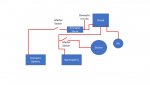
Very simplified diagram ignoring emergency switch and other circuits:
RR Circuit.jpg

The starter battery is wired as recommended on the battery side of the switch but the diode is connected to the load side of the domestic battery. I have bought an Argo FET to replace the diode but if I connect to the domestic switch on the battery side how will that affect the ammeter reading?
 
Very simplified diagram ignoring emergency switch and other circuits:
View attachment 75730

The starter battery is wired as recommended on the battery side of the switch but the diode is connected to the load side of the domestic battery. I have bought an Argo FET to replace the diode but if I connect to the domestic switch on the battery side how will that affect the ammeter reading?
If wired as in your diagram the ammeter will always show the net charge or discharge current
If you move the diode connection to the battery side of the isolator as below the ammeter will not see the the charge current . It will only indicate the total load current.
258s508.jpg
 
Last edited:
What do people usually do when they have both an ammeter and a diode? I guess both answers have their downside, but which is worse?

What's the max current the shunt can carry ?

It's common to have a negative shunt for ammeters and battery monitors these days.
 
I understand the difference between a split charge diode and a voltage sensing relay, but what is a FET? How and why does it differ from a VSR?
 
Top