
You are using an out of date browser. It may not display this or other websites correctly.
You should upgrade or use an alternative browser.
You should upgrade or use an alternative browser.
Stuck light bulbs
- Thread starter doraymefa
- Start date

Seashoreman
Well-Known Member
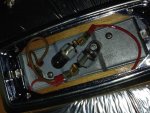
They look like fairly simple fittings and I am suprised the bulbs do not just twist out. I have in the past resorted to a rather brutal resort of breaking glass with large pliers or similar and then gripping metal remains with long nose pliers pushed into 'element' part.

pvb
Well-Known Member
Can't you simply prise the metal bulbholders apart to loosen the bulb? Then squeeze the bulbholders back together before fitting new bulbs.

Leighb
Well-Known Member
They look like fairly simple fittings and I am suprised the bulbs do not just twist out. I have in the past resorted to a rather brutal resort of breaking glass with large pliers or similar and then gripping metal remains with long nose pliers pushed into 'element' part.
After first making sure that the lights are OFF, could be an interesting short else.

Seems to me they are not particularly special or expensive fittings. Couldn't you just disconnect the wires, unscrew the backing plate and dispose of the whole thing, replacing it with something similarly cheap and cheerful, this time applying a squirt of WD40 annually?
hartcjhart
Well-Known Member
disconnect the 'spade' terminals then unscrew the whole unit and work in a clearer area will help.
where the single wire is put a 'dot' with a marker pen so you kno to re-connect 1 wire
where the single wire is put a 'dot' with a marker pen so you kno to re-connect 1 wire

ccscott49
Well-Known Member
They look like fairly simple fittings and I am suprised the bulbs do not just twist out. I have in the past resorted to a rather brutal resort of breaking glass with large pliers or similar and then gripping metal remains with long nose pliers pushed into 'element' part.
+1, I've had the identical problem and used the same technique. In the end I replaced my engine space lights with LED/fluorescent type striplights, excellent lights and very low consumption.
prv
Well-Known Member
Maybe it's just an artifact of the photo, but it looks to me as if there might be some kind of lacquer or varnish over the bulb holder and base of the bulb. Presumably applied for corrosion resistance, but now gluing the bulb in place?
Pete
Pete

Lakesailor
Well-Known Member
Just replace the fittings as suggested. Don't get precious about old parts. They've lasted well, but better are available these days.
prv
Well-Known Member
Just replace the fittings as suggested.
A lot to be said for that. I bought a 5 metre roll of 12v LED strip off eBay for not much money - I wouldn't use it for main cabin lighting as these particular LEDs are bit harsh, but it's great for lighting up odd corners as you can just slice a bit off the roll and wire it up. I have a piece running the length of my engine bay, and one of those cupboard door switches, so that when I open the engine bay doors the whole space is bathed with bright light. Since it's a long strip, my head doesn't cast a shadow on the very bit I'm trying to look at, as a single point source might.
Pete
pvb
Well-Known Member
A lot to be said for that. I bought a 5 metre roll of 12v LED strip off eBay for not much money - I wouldn't use it for main cabin lighting as these particular LEDs are bit harsh, but it's great for lighting up odd corners as you can just slice a bit off the roll and wire it up. I have a piece running the length of my engine bay, and one of those cupboard door switches, so that when I open the engine bay doors the whole space is bathed with bright light. Since it's a long strip, my head doesn't cast a shadow on the very bit I'm trying to look at, as a single point source might.
Top tip!
doraymefa
Well-Known Member
Thanks to all that have responded. pvb suggests pulling the bulb holder apart but prv is right, there is a curious layer of something that has stuck to the bulb. Indeed the bulb holder feels like plastic, not metal that could be squeezed open and shut. As ccscott49 and others suggest this is an exercise in changing to LED. The LED replacement is a bayonet with two wires and a board with nine lights. This gives me the option to reuse the existing fittings if they survive or to cut them away and wire directly without a fitting. The bulbs have their own protection.
I will start by being delicate, but be ready to resort to the pliers!
Thanks for all these useful contributions,
Doraymefa
I will start by being delicate, but be ready to resort to the pliers!
Thanks for all these useful contributions,
Doraymefa
pvb
Well-Known Member
Indeed the bulb holder feels like plastic, not metal that could be squeezed open and shut.
As the bulb holder is part of the circuit, it's much more likely to be metal!
doraymefa
Well-Known Member
So it is - I am never very good at this stuff!

Burnham Bob
Well-Known Member
agree with the bit about breaking the glass - had lots of old bulbs on my boat and that was the easiest way, break the glass and use pliers on the metal stub, gripping the metal with the one end of the long nose of the pliers inside makes it easy to twist the bulb end
Adrian Jones
Well-Known Member
Thanks to all that have responded. pvb suggests pulling the bulb holder apart but prv is right, there is a curious layer of something that has stuck to the bulb. Indeed the bulb holder feels like plastic, not metal that could be squeezed open and shut. As ccscott49 and others suggest this is an exercise in changing to LED. The LED replacement is a bayonet with two wires and a board with nine lights. This gives me the option to reuse the existing fittings if they survive or to cut them away and wire directly without a fitting. The bulbs have their own protection.
I will start by being delicate, but be ready to resort to the pliers!
Thanks for all these useful contributions,
Doraymefa
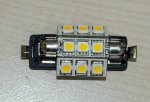
A customer replaced similar lamps using a good quality festoon lamp holder as shown in the picture below. This type of lamp holder is simply fixed by a central recessed self tapping screw to the fixture back plate and the terminal ends connected to +ive and -ive supply. If you use this type of lamp holder and a festoon LED lamp 100% of the light output will be directed onto the subject. I recommend that you select either a 6 or 9SMD LED constant-current lamp in warm white for living areas and cool white for utility areas to give the level of light output you require. The LEDs being protected from excess voltage by electronic controls built into the lamp.
I would caution against using resistor controlled flexible lighting strip on any marine vessel as battery charging voltage will cause cumulative thermal damage to the strip by increasing LED current by 50% compared to current drawn at 12 volts. Lighting strip is designed to be used with constant voltage LED drivers in domestic premises ashore, not on your boat where supply voltage can vary.
Regards
prv
Well-Known Member
Lighting strip is designed to be used with constant voltage LED drivers in domestic premises ashore, not on your boat where supply voltage can vary.
Actually quite a lot of it is sold for blinging up cars - I'm told the Chinese love that kind of thing.
Pete
pvb
Well-Known Member
Actually quite a lot of it is sold for blinging up cars - I'm told the Chinese love that kind of thing.
And lots of lads here, but they write their Corsas off before the LEDs give up the ghost!
prv
Well-Known Member
And lots of lads here, but they write their Corsas off before the LEDs give up the ghost!
Good point - in my day it was green or blue fluorescent tubes mounted under the car, but I suppose they've probably gone to LEDs now.
Pete
Adrian Jones
Well-Known Member
I'm sure that Chinese vendors do supply flexible LED strip for use in cars, I'm not really aware how long it actually lasts in a motor vehicle, or indeed, if, that type of strip is rated specially for use at 13.8 volts. I'm rather too ancient to bling up my own car so I don't have any experience in that area of lighting.Actually quite a lot of it is sold for blinging up cars - I'm told the Chinese love that kind of thing.
Pete
I don't know of any flexible strip sold specifically for use at vehicle battery charging voltage of 13.8 volts which your post infers. I get around 20 sales emails a day from Chinese vendors, many promoting LED strip and none, to my best recollection, have ever offered a 13.8v strip. If it is available, which I doubt, using it at 12 volts will result in very much sub optimal light output compared to using the same strip at 13.8 volts.
All resistor controlled LED strip I have seen for sale, is either for use at 12 or 24 volts.
Some LED strip products hitting the market, in the last 6 months, have constant-current control circuits built onto the strip. The downside is, it's quadruple the price of the standard resistor controlled strip. If a strip looks very expensive the vendor will promote the fact it has constant-current controller on board so there will be little doubt as to what you are buying. As a rule of thumb, if the LED strip is relatively inexpensive, it will be resistor controlled.
If you have a DC power supply you can simply test a sample of strip and see what the current drawn at 12v is, then raise the voltage to say 14.5 volts and see what the new current is. You will find that the operating current has increased by over 50% and the light will be significantly brighter and the strip very much warmer to touch due to power dissipation by the series resistors controlling the LEDs.
If on your boat you use a smart battery charger that kicks in an equalising cycle you can expect in excess of 16v when desulphating and equalising battery cell voltages. At 16v it will actually double the current taken by an LED strip. You will not be able to touch the strip with bare fingers at that current. Excess heat results in cumulative damage and premature failure of the LEDs? You may get better service life out of strip if stuck directly to a metallic heat sink but that's rather hit and miss as the adhesive tape used on most strip is not particularly thermally efficient. Much of the adhesive strip shows the adhesive to be 3M which is generally not the case. In my experience after a few hours use it tends to detach itself from most surfaces, particularly if it is heated by excess current.
I hope that explains why I'm not a fan of using LED flexible strip lighting for use on boats.
Regards
