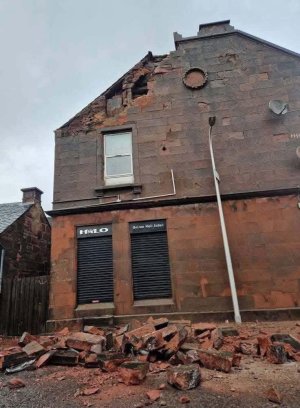
Storm Éowyn

" It's 3 days shy of 51 years since a big storm sank the 'sugar ship' off Helensburgh."

Blimey! That's made me feel old. She wasn't there on the shoal when I first ran up to Finart Oil Terminal with crude from Mena al Ahmadi, Kuwait.
I would like to post a link but the current regime makes that a complete lottery. But googling shipwreck off Helensburgh has a lot of information. All about the storm, the dragging anchor, the collision with a tankers chain which holed it, etc.

I think it was a lesser storm than today's events, but still powerful.
 
I would like to post a link but the current regime makes that a complete lottery. But googling shipwreck off Helensburgh has a lot of information. All about the storm, the dragging anchor, the collision with a tankers chain which holed it, etc.

I think it was a lesser storm than today's events, but still powerful.
The name Captayanis will save you a bit of typing.
 
I got to thinking that I remember a lot of violent storms in January, the first that impressed itself in my memory being in 1968. So I wanted to find when the last one was and it was just last year. Two of them, Isha on the 22nd and Jocelyn on the 27th to hamper the clear-up. They were pretty bad as well, Isha recording a low pressure of 948 hPa and killing several people. Jocelyn was less fierce but caused further damage to alreadt weakened trees and structures.
 
What does this mean? That the atmosphere is only an approximation of itself? ;-) Maybe if you try to measure the position and momentum vector of every molecule you may run into quantum constraints...
I am really trying to put forecasts into perspective. As a sailor, you will be aware of the variability in wind direction and speed. They are never constant. It is meaningless to say that the wind is, say, 275/22. It may be at one moment but quite different the next. Yet some providers of detailed forecasts claim high accuracy.

In reality, another of my truisms is that the weather does not know itself to within one Beaufort force. That might be over simplistic but it puts forecasts or, mor correctly, claims for forecasts into perspective.
 
The Royal Charter storm of 1839 was reported as F12. We have always had such storms. I do not have details at my finger tips but am aware that the likelihood of such storms is increasing. It is an IPCC prediction that weather will become more erratic with increasing likelihood of extreme events.
 
I am really trying to put forecasts into perspective. As a sailor, you will be aware of the variability in wind direction and speed. They are never constant. It is meaningless to say that the wind is, say, 275/22. It may be at one moment but quite different the next. Yet some providers of detailed forecasts claim high accuracy.

In reality, another of my truisms is that the weather does not know itself to within one Beaufort force. That might be over simplistic but it puts forecasts or, mor correctly, claims for forecasts into perspective.

Sailors realise that lift and headers, as well as wind shifts happen. However, if a forecast is SW3, usually it is SW3. You go on as if we experience variable wind all the time. Get a sense of perspective.
 
The Royal Charter storm of 1839 was reported as F12. We have always had such storms. I do not have details at my finger tips but am aware that the likelihood of such storms is increasing. It is an IPCC prediction that weather will become more erratic with increasing likelihood of extreme events.
Last night a scientist on the BBC stated that for every degree rise in temperature due to MMGW, it would have a certain percentage increase (2% iirc) in the jet stream velocity which, amongst other things, would increase speed and risk of depressions rapidly deepening.
 
This morning my son towed his Phantom dinghy 100+ miles to Northampton, for a Phantom open meeting. At 08-00 he sent us a picture showing zero wind. :rolleyes: 🫣:cry:
I do not know how much sailing you have done. Given a forecast of, say F5, I fully expect to see some F6, I accept that there could be a touch of F7. Likewise, there will be some F4, even F3. The forecast could well be correct and F5 a good overall description.
 
I do not know how much sailing you have done. Given a forecast of, say F5, I fully expect to see some F6, I accept that there could be a touch of F7. Likewise, there will be some F4, even F3. The forecast could well be correct and F5 a good overall description.
I do not know how much forecasting you have done, but I was just saying that having driven 100 miles to get there by 08-00 this morning, he was p,,sed off that there was zero wind :cry:
He was hoping things would change pretty soon. Otherwise it would be a day in the bar with his mates :unsure:
 
I do not know how much forecasting you have done, but I was just saying that having driven 100 miles to get there by 08-00 this morning, he was p,,sed off that there was zero wind :cry:
He was hoping things would change pretty soon. Otherwise it would be a day in the bar with his mates :unsure:
All my working life in the Met Office, over 15 years as a forecaster, 10 as a senior forecaster. Over 60,000 miles as a cruising sailor, Channel, Biscay, Mediterranean, Caribbean, 30 years (not very successful) dinghy sailing.
 
Sailors realise that lift and headers, as well as wind shifts happen. However, if a forecast is SW3, usually it is SW3. You go on as if we experience variable wind all the time. Get a sense of perspective.
My memory agrees that's how it used to be but last year particularly it has been anything but. SW3 in the west has been anywhere from E to N varying from 0 to 6 or more. I've gone from 2 reefs and rolled genoa to motoring and then back again too often and, like others I've chatted with, I'm fed up with it.
 
Last edited:
Top