Stern gear squeal and stiff shaft

Drifting an 1,5 inch deformed 1.4 inch hold will not totally make the deformed hole trully round as any metal needs over bending so it remains in the required position.

I would get an 1.5 inch reamer to ensure the hole is the correct size and trully round.

The other way is to reduce the o/d of the cutless bush and fit it with epoxy to ensure it is concentric by fitting the shaft before the eoxy sets fully
That makes sense. I suspected that, but having managed to screw the new bearing into place I assumed it was all good. It might be the cutless bearing being too tight. I hope the shaft will eat away some of the rubber and it will sort itself out with time.

How do you get the cutless bearing out again if you fit it using epoxy?
 
Not sure the shaft can rube on tube if it’s centered properly. You must be able to move it up and down when it’s disconnected from the coupling,
If you have no knock in forward or astern and believe it to be aligned properly and you have a a rubber cutlass bearing then I’d be tempted to let it run for a few hours on tickover to wear it in a tad.
I’ve seen another boat fit a cutlass bearing in to a stearn tube and motor off and it significantly overheated. Lots of smoke. If it has slightly lost its shape when you fitted it it will take some time to wear in.


Just my thoughts though.

Steveeasy
 
Banging a drift through a P-bracket is a very bad idea. The relatively long leverage can do considerable damage to the attachment to the hull.

Good advice: NEVER HAMMER A BOAT. Applies equally to removing props from a shaft - the force is acting on the gearbox output bearing.
 
Banging a drift through a P-bracket is a very bad idea. The relatively long leverage can do considerable damage to the attachment to the hull.

Good advice: NEVER HAMMER A BOAT. Applies equally to removing props from a shaft - the force is acting on the gearbox output bearing.
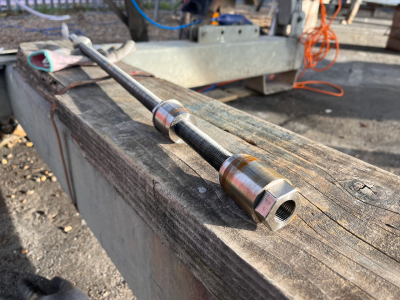
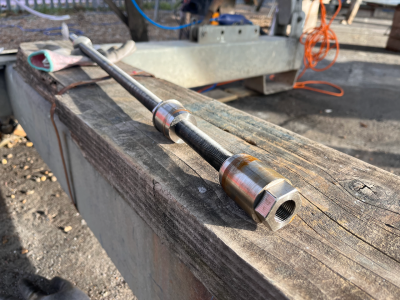
Exactly. Hence I turned a custom-made drift with a threadin it, and screwed that into the p bracket using a threaded rod, cfr photo 2 above.
 
Nomenclature problem. To me a drift always means hammering. What you describe is something else - a broach?
Sorry, I may have not used the correct term. It is really two cylinders with conical tips and a thread in the middle so they can be screwed toward each other and driven into the p-bracket.
 

Attachments

  • IMG_3161.png
    IMG_3161.png
    2 MB · Views: 24
How do you get the cutless bearing out again if you fit it using epoxy?
Heating the P bracket will loosd the cutlass bearing allowing it to be pushed out

You could also us a reamer the size of the shaft to ensure that the cutlass bush has not distorted for any reason
 
Sorry, I may have not used the correct term. It is really two cylinders with conical tips and a thread in the middle so they can be screwed toward each other and driven into the p-bracket.
Bottom line, suspect the noise is coming from the bearing in the P bracket. It should never have been tight when you pushed the shaft through. Thats the issue
 
Bottom line, suspect the noise is coming from the bearing in the P bracket. It should never have been tight when you pushed the shaft through. Thats the issue
Indeed, thank you. This is also the best case scenario, as I am assuming the shaft will gratually abrade the rubber. This might explain the improvement in the noise, too.

Thank you everyone for their comments!
 
Bottom line, suspect the noise is coming from the bearing in the P bracket. It should never have been tight when you pushed the shaft through. Thats the issue

I have to agree ... as a likely suspect.

I also think that driving a rod through the P bracket may have caused a slight change in alignment of the bracket to shaft ... Its ok having shaft stress and odd knock - but impact hammering a rod through ? It only needs a whisker of a change ... just thinking ..
 
Hitting the P bracket could have caused the P bracket to be out of alignment, they aren't really designed to be hit.
We supply bearings for either press fit or clearance fit, they are different sizes as the press fit means the bore closes a small amount so they are made with larger shaft clearance. Clearance fit means you can slide them in by hand and the ID doesn't change. With the clearance fit you can also chock the shaft and have a dry run instalation to see if the P bracket/bearing carrier is aligned. With shaft supported you should be able to slide the bearing up the shaft and into carrier by hand. Then just bed on epoxy. Any bearing shouuld have a running clearance to allow a water film to develop.
 
Hitting the P bracket could have caused the P bracket to be out of alignment, they aren't really designed to be hit.
We supply bearings for either press fit or clearance fit, they are different sizes as the press fit means the bore closes a small amount so they are made with larger shaft clearance. Clearance fit means you can slide them in by hand and the ID doesn't change. With the clearance fit you can also chock the shaft and have a dry run instalation to see if the P bracket/bearing carrier is aligned. With shaft supported you should be able to slide the bearing up the shaft and into carrier by hand. Then just bed on epoxy. Any bearing shouuld have a running clearance to allow a water film to develop.
1687985328335.png
 
Hitting the P bracket could have caused the P bracket to be out of alignment, they aren't really designed to be hit.
We supply bearings for either press fit or clearance fit, they are different sizes as the press fit means the bore closes a small amount so they are made with larger shaft clearance. Clearance fit means you can slide them in by hand and the ID doesn't change. With the clearance fit you can also chock the shaft and have a dry run instalation to see if the P bracket/bearing carrier is aligned. With shaft supported you should be able to slide the bearing up the shaft and into carrier by hand. Then just bed on epoxy. Any bearing shouuld have a running clearance to allow a water film to develop.
Not sure he hit anything. he tried to correct the ovality by using this tool. Is ovality a word? haha.
 
That makes sense. I suspected that, but having managed to screw the new bearing into place I assumed it was all good. It might be the cutless bearing being too tight. I hope the shaft will eat away some of the rubber and it will sort itself out with time.

How do you get the cutless bearing out again if you fit it using epoxy?
It is possible to have the shaft flanges perfectly in line but with the shaft out of centreline in relation to the P bracket. This excessive friction could be the squeal you are hearing.
I suspect you have improved this situation but it might still be worth checking again.

Disconnect the flanged coupling at the gear box and try moving the shaft side to side and up and down. Check the shaft is moving an equal amount in each direction . If not than adjust the mounts accordingly. They usually have slotted holes to help with this. Recheck face to face . Hopefully the shaft will now be free.
 
It does leave the question of what happened to the P bracket to cause the distortion in the 1st place; a significant force must have been applied.
 
Top