Steelboats

Status
Not open for further replies.
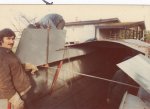
Installing cabin sides, origami style. Make sure it is the right tumble home all along ,and fair, as it is hard to change after the top goes on. Note the tacked on braces to control tumble home, not needed after the top goes on .
You only need 2 beams to camber the top, initially . You can put the rest on from inside. Over camber them slightly, and force the excess out while installing them. A cabin takes about 8 hours to install.
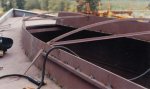
Cabintop beams.jpg
 
Last edited:
Building the wheelhouse, origami style. 1984. Check it from all angles, before putting the top and back on. Tack lots of bracing on, to keep it fair until the top goes on. Cabin sides and wheelhouse sides should be left alone for a couple of days, while you build other things, so you have less chance of rushing past any imperfections, without noticing and correcting them, before the lid goes on.

IMG_20190123_0001.jpg
And Kasten says all the above "Cant be done."
Definitely not a good source of advice on anything to do with steel boats.
Now critics, do tell us about all the time, money and labour saving ideas you have come up with on steel boat building ,and how much hands on experience it is based on.
Yes, if I did things the Kasten way, it would take a huge amount more time. I can see people questioning my building time, based on that assumption, but that is definitely not how I do things. The " assumption" is wrong ,not my times.
 
Last edited:
For 16 days a on a Baja lee shore? Over 300 yards of Fijian coral reef? Different ball of wax from a one time, brief encounter. You do mention this one incident rather a lot. I was referring to the way that you suggest that a GRP yacht is going to hit something and sink sooner or later. The fact is that a well made GRP boat almost certainly isn't going to be holed and sink in the way you keep asserting. It might do, but there's a good chance it might not.
Read more at http://www.ybw.com/forums/showthread.php?498670-Steelboats/page6#q4sAB5qr4TZCfcBL.99

I have never stated that a GRP boat will hit something and sink, only that if it does hit something, the odds of it sinking are exponentially greater than in a steel boat.
16 days on a Baja lee shore, 300 yards over Fijian coral reef , all in big surf?
A GRP boat would have ZERO chance of surviving that . I mention it often, because you keep claiming that origami steel boats are not strong enough. Every time I am forced to mention it ,some slow ones assume it is a different boat each time.
 
I didn't think cruising was a race. I also REALLY don't like living like a bum.
I 'don't like living like a bank slave. I don't like giving up 40 hours a week, to buy things I don't need ,with money I don't have ,to impress people I don't like . I never liked the idea of being woken by an alarm clock most of my life, to be told what to do, for someone else's profit .I never liked living any part of my life in debt ( I have never had a penny of bank debt in my life).
"BUM" is what the enslaved call the free.

A Jamaican fisherman was on the dock with a big bucket, filled to the top with crabs.
A tourist asked him "Aren't you afraid those on top will escape?"
"No Mon"" said the fisherman. "If one tries to escape ,his buddies will drag him back. No way are they going to let him escape their fate."
Kinda like low cost cruising advice.
Works the same way!
 
Last edited:
For 16 days a on a Baja lee shore? Over 300 yards of Fijian coral reef? Different ball of wax from a one time, brief encounter. You do mention this one incident rather a lot. I was referring to the way that you suggest that a GRP yacht is going to hit something and sink sooner or later. The fact is that a well made GRP boat almost certainly isn't going to be holed and sink in the way you keep asserting. It might do, but there's a good chance it might not.
Read more at http://www.ybw.com/forums/showthread.php?498670-Steelboats/page6#q4sAB5qr4TZCfcBL.99

I have never stated that a GRP boat will hit something and sink, only that if it does hit something, the odds of it sinking are exponentially greater than in a steel boat.
16 days on a Baja lee shore, 300 yards over Fijian coral reef , all in big surf?
A GRP boat would have ZERO chance of surviving that . I mention it often, because you keep claiming that origami steel boats are not strong enough. Every time I am forced to mention it ,some slow ones assume it is a different boat each time.
Why do so many of your designs end up on lee shores? Do they struggle to make ground to windward because they sail like bath tubs?
 
Four out of a few hundred boats with lee shore groundings is a big number compared to none for me and most other people IMHO
_____________________________________________
Bull! 35 boats were lost in the Tuamotus in 1975 alone. Check the photos of piles of destroyed boats in hurricane damage photos. The 4 all survived .None would have, had they been plastic .
 
No one is saying they haven't. That has no bearing on what we know about boat design today. With the benefit of tank testing and computer modeling we know far more than they did when they were hacking out their dugouts.

Design in light aircraft is no more complex than boat design. The calculations are about par in complexity. Anyone with rudimentary skills in construction can cobble together a workable craft for either air or water. It might work, it might not. No problems if it's for personal use. IMO, the game changes when you then sell it to members of the public.

And when they have proven to work extremely well, over 350,000 miles, 39 years ,and extreme torture tests, the critics have been conclusively proven dead wrong, time and time again, proving their silliness, beyond all reasonable doubt.
 
I can understand how Brent's style of discourse doesn't go down well with the "Establishment", and he obviously upsets you. But to be fair to him, he is building boats using a relatively cheap and simple method. They float, and apparently sail. There is no evidence of them falling apart or being inherently dangerous to their crews. That being the case, what benefit would be obtained by your much vaunted " calculations", except providing "bread and butter" to a designer?

I can just see the head shaking and tooth sucking that took place when one of our ancestors got fed up hollowing out logs, and instead lashed some planks together in an early form of clinker construction. History repeats itself.

image: http://www.ybw.com/forums/images/smilies/biggrin.png


I have no interest in again building a steel boat, but I have an open mind, and look on projects from a practical, rather than a theoretical viewpoint.

Yes ,I see glaring errors in the book "Skenes Elements of Yacht Design manual of calculations.
For calculating balance, he recommends balancing a cutout of the boats underwater profile, and believing that to be the centre of lateral resistance. That assumes the well rounded forefoot and stern have the same lateral resistance as a flat plate of the same profile. Nice theory, well "CALCULATED"
His weight calculations for anchor gear and personal effects are totally ludicrous.
Any ten year old school boy who has played with model airplanes, knows that the centre of lift is not he centre of a wing ,but about 20% back from it's leading edge.
I found out the hard way the difference between what was "Calculated " by a world famous designer and tested in one of the top tank testing facilities in the world, and practical reality, sailing her single handed from BC to New Zealand. NO , that smooth hull aft did not act like a flat plate of the same profile ,it surfed, trying to pass the bow the whole way.
Turns out what I had visualized as a beginner , 20 years old ,with no cruising or designing experience, was more accurate than the "experts", by a wide margin, when I thought of a separate rudder on a skeg 6 ft further aft, which I ended up doing, with excellent results. They were dead wrong, I was right. Blew any blind faith in "expert calculations" I may have developed. When logic tells to you one thing and experts tell you something different, go with logic .
 
Last edited:
Why do so many of your designs end up on lee shores? Do they struggle to make ground to windward because they sail like bath tubs?

Here is a quote from the origami boats site ,from a friend who has been cruising the South Pacific in one of my 36 footers since the 90's.
As long as I wasn't hard on the wind or on a dead run, I used to sail at 6 knots in 12 knots of wind on my BS 36 foot single keeler. I struggle to do that now with my tired out old mainsail.

I have twice gone over 1000 miles in just over 6 days. This was largely close or beam reaching using a huge over-lapping genoa. This genoa was great on a reach and the reason for some fast passages but very poor to windward. On one of the passages I left a day later but still caught up and passed a 65 footer and beat him to port by night. On the other passage, I was close hauled in a sloppy sea and passed a Fantasia 35 in 12 hours despite them leaving two days before me. The fat and heavy Fantasia was just hobby horsing and couldn't make any progress against the trade wind slop. This has convinced more than anything of the need of having a boat that cut through seas and sail to windward.

I have hit 8 to 9 knots under sail many times. The max speed I have ever seen is 11 knots but I had some waves and probably some current helping me. Those ideal conditions only lasted a few hours.

If I can generalize, I normally sail up with the typically heavily loaded 42 to 45 foot cruisers. I am loaded down too with a 90 gallon fuel tank and a 120 gallon water tank and plenty of books so I think this is excellent. The wind is never like you read about in the books. It seems all I get is either El-Nino or La-Nina. I think anyone who thinks it is all downwind has never been offshore in the Pacific. When I sailed from Canada to Fiji in 96-97, I had only 8 days with the wind aft of the beam. I am still waiting for a classic downwind trip in the trades to see what she can really do.

I think performance under sail has a lot to do with how well a boat steers. The windvane self steering gear keeps the boat on a rail, with the tell-tales hardly flickering. I use the windvane most of the time but sometimes I find that a electronic pilot does better. A windvane may not hold you to the wind but if the wind is variable it is better to just go straight at a slower speed and follow a compass rather than follow every wind shift and add to the distance sailed. I met one guy who arrived in tears in Samoa.....his boat yawed 20 to 30 degrees all across the Pacific. He had almost totally given up on his windvane and was mentally and physically exhausted from having to handsteer.
None of my boats has hit the beach while beating off a lee shore.
Search Silas Crosby and Tagish for more passage times in my designs.
I have twice sailed from Hawaii to BC in 23 days the first 1,000 miles hard on the wind against 22 knot trade winds, not bad for a heavily loaded 31 ft twin keeler.
 
Last edited:
" Periodically someone will just decide that the transverse framing is not necessary. They always come up with great sounding verbal rationalizations but have never actually done the math.
The amount of weight you can save by tailoring construction to save the absolute maximum in weight, including custom spacing the transverse frames and other transverse members is so minimal and the mathematics necessary to properly predict where you can reduce transverse framing is so complex that I am certain that no one advocating the elimination of transverse framing has actually done the math.

They are just building cheap, weaker boats.
{Quote]

Boy, this guys inability to understand basic geometry is abysmal. And people pay him to pass that problem on to them? His calculations are based on the assumption that all surfaces on a sailboat are flat surfaces, and all seams and chines, centrelines, etc are straight lines, giving no consideration to the huge factor of their being curved. No Tom, a curved topside meeting a curved bottom plate is not the same structurally as a flat plate meeting another flat plate . If there were any flexing, then the cheap brittle filler I used on my interior would have cracked and fallen out decades ago. It hasn't, in over 34 years of cruising, proving there has been zero flexing in my hull or decks ( the exact opposite of what you would get in any plastic boat).

Bob Perry attacked and ridiculed my designs for being too heavy, under 20,000 lbs for a 36 footer. Then I encountered one of his 36 ft designs which he said was calculated at 27,000 lbs but the owner said was 36,000 lbs. Yes it was a fully framed boat with lighter plate than mine, as McNaughton advocates for less weight.I once saw an article on a 30 ft Tahiti ketch with over 3,500 lbs of framing and 1/8th inch plate. That is as heavy as 3/8th inch plate and no framing.
McNaughton says a boat which can survive all mine have, is weak? How dense is that? Designers have been designing frameless boats for decades with no structural problems of any kind due to lack of frames. (Chicken little McNaughton?)
As he knows, my boats are longitudinally framed . If you put pressure on a hull, on a frame on a hard chine hull, you put a simple bending load on the frame. If you hit it between frames , the frames hard point increases the chance of denting or holing it.
If you put pressure on a longitudinal, running along the curve of the hull ,you put a compression load on it. Its far easier to bend a straight flat bar than to compress an angle iron on end, especially if it is held in place by 2 inch welds every 6 inches, to a huge plate, and thus cant go anywhere. I weld the longitudinals in while the plate is flat on the ground. After pulling the hull together , there is a huge outward pressure from them being forced into the curve, huge resistance to any inward pressure.
The deck, structurally ,is the equivalent of a fully welded, longitudinal steel bulkhead, as are the chines , centreline ,keel ,skeg and tank top. These strong points are less widely spaced than most frames are. McNaughton has been told this, but it went completely over his head.
You can take 6 square plates and weld them corner to corner, and they will all be identical and square cubes . It is geometrically impossible for them to be otherwise. The same is geometrically true of more complex shapes. If you take very accurate plate shapes off any hard chine hull, and pull them together origami style, the finished hull will be of an identical shape .It is geometrically impossible for them to be other wise. This is completely above and beyond the capability of McNaughton to comprehend.
I remember first taking geometry in school. I never paid much attention to the teacher, but got straight A's on my exams. It all seemed so obvious and self explanatory. I couldn't understand others having to struggle with such clear, obvious logic. Some minds can visualize shapes , and how they work others cant .McNaughtons clearly cant. Having him make decisions on shape and structure, without that ability, inevitably means doing things the long tedious and expensive way wasting a lot of time and money , with much lesser results.

Definition :
Elephant :
A mouse designed by a numbers cruncher!
 
Last edited:
5 boats out of 200 , in over 350,000 miles of ocean cruising, over 40 years, is a high number?

Only 5 losses. I thought any Pacific reef that hadn't been hit by one of your boats was looked down upon. A bit like a Prussian Officer without a duelling scar.

Not to mention the thousands of tugboats and barges littering the western seaboard of North America having been bested in a collision.
 
Only one loss, when the owner abandoned her on a surf beach . All the rest were pulled off with no serious damage. They would have broken up in minutes, in the same conditions, had they been plastic.
 
Here is an email from a friend who has done several trips to the South Pacific and back to Alaska in one of my 36 footers.
(Quote)

"When a true genius appears, you can know him by this sign: that all
the dunces are in a confederacy against him."

Jonathan Swift

I also like:

"Just because everybody says you're wrong, doesn't necessarily mean
you're right - but it's a good indication."

Unknown author.

Anyway, apparently it's a prerequisite to kow-tow to the entrenched
establishment and generally be politically correct in order to build a
good boat.

Those of us who've built and sailed your designs, of course, know
better. I, for one, have REALLY appreciated all the help and great
ideas you've provided, not to mention living on one of your designs
for nearly two decades and sailing many tens of thousands of fun,
inexpensive, trouble free miles with it. And I tell anyone about it
who's interested.
I just sold him a set of plans for another 36, this time a twin keeler with a fish hold for Alaska living.
 
From Wiki
Origami (折り紙, from ori meaning "folding", and kami meaning "paper" (kami changes to gami due to rendaku)) is the art of paper folding, which is often associated with Japanese culture. In modern usage, the word "origami" is used as an inclusive term for all folding practices, regardless of their culture of origin. The goal is to transform a flat square sheet of paper into a finished sculpture through folding and sculpting techniques. Modern origami practitioners generally discourage the use of cuts, glue, or markings on the paper. Origami folders often use the Japanese word kirigami to refer to designs which use cuts, although cutting is more characteristic of Chinese papercraft

While you might consider the pulling together of the hull as 'Origami' The rest of your photos are just plain old fabrication, which is what Kasten was talking about, not as you misquoted him above.
 
Here is the direct quote, from his website, not a misquote.

Further, it must be kept in mind that just as with the "pre-cut-plate" method, the "Folded-Plate" or Origami method is generally only applicable to the hull plating itself, and not to the keel, rudder, deck, superstructure.
{Quote]
What he is clearly saying is, my methods cant be used on decks etc, a deliberate and transparent lie.
Yes , this has been standard practice in sheet metal work since ancient times. I have often told people that, if you went far enough inland, far from boats, and asked a sheet metal worker to make you a hull shape, this is how he would do it. If you told him it is a boat, he would read the books and do it the hard,expensive , time consuming, way Kasten advocates.
When they first started building boats out of metal, they simply copied wooden boat building methods, ignoring the huge potential advantages metal offers, resulting in extremely money consuming and time wasting building methods which , sadly, dogma has kept metal boat building methods frozen in time ever since. That is what has kept steel boats in the minority ever since, along with a myth based lack of understanding of how tough, forgiving ,and safe a metal boat is.
Unless you want a boat building project to last as long as possible, and cost as much as possible ,with no resulting benefits in the finished product, you would be unwise to hire anyone who opposes all progress and innovation in building methods.
It's not as if I have kept info on my methods top secret.
Anyone can do it.
They are some of the most well proven, over decades of any.
 
Last edited:
More rubbish, you actually agreed with him, then wandered off into your usuall self congratulatory ramblings.
Your methods are not special, apart from the hull forming. The rest is simple fabrication.
 
More rubbish, you actually agreed with him, then wandered off into your usuall self congratulatory ramblings.
Your methods are not special, apart from the hull forming. The rest is simple fabrication.

Agreed with him on what, specifically?
As I mentioned in my post, origami has been standard sheet metal fabricating for centuries .
However, go read a book on building small steel craft, any book on the subject, and they will tell you to set up and brace deck beams , cabin top beams, , rudder and skeg spacers ,then fit plate onto it, working overhead, in the case of decks and cabin tops. That is the Kasten way. None but mine will mention making them on a bench, working at waist level, doing all your would be overhead welding and fitting that way.
It is assuming I use such slow , awkward , hair brained building methods, which causes some to question my times. I also do keels , rudders and skegs using sheet metal origami methods , rather than Kasten boat building ways.

Now how about giving us a rundown on all the time, money and labour labour saving ideas you have posted, along with some pictures of the many steel boats you have built with your own hands, and your ,no doubt ,extensive ocean cruising in steel boats you have designed and built with your own hands?
 
Last edited:
Status
Not open for further replies.
Top