Steelboats

Status
Not open for further replies.
I'm not so sure there. The extraordinarily high accident rate he reports makes me wonder whether there are handling issues. In general, it's going to windward where the number crunchers have shown themselves to best advantage.

I was always informed that gentlemen don't beat to windward. :D
 
This is the issue when the lawyers get involved when you start to "sell" the information to money.

If something goes wrong as a "professional" or charted Engineer you can be held personally accountable to any fault that causes loss of life or property.

You need to back up your designs with proper calculations once yo go into the "professional business of supplying designs. If you don't you open yourself up to big claims of compensation.

Brent may get away with it as he seems to have no assets to claim.

This is why I don't supply anything for money as I am not supplying anything now for money.

I once had a lawyer draw up a builder's contract for me. When he mentioned liability, I told him of the extreme torture tests they had survived over decades, which very few stock boats would stand any chance of surviving, and he said that covers me completely.
 
Not massively relevant though, these are cruising boats and the majority rarely go to windward. There was a survey by Evans Starzinger showing this but can't find it now. Also the calcs fall apart a bit once you add good few tonnes above the design weight to go cruising and have a load of stuff on deck.

That is what makes the numbers nit pickers calculations ,irrelevant. No one can predict exactly how much stuff any owner will put on board. In the chapter on "a manual of calculations" in the book "Skene's Elements of Yacht Design" they calculate the weight of a galley pump and its effect on trim, ludicrous, compared to scuba gear, tools, spare anchors, etc, none of which they calculate.
 
I'm not so sure there. The extraordinarily high accident rate he reports makes me wonder whether there are handling issues. In general, it's going to windward where the number crunchers have shown themselves to best advantage.

5 boats out of 200 , in over 350,000 miles of ocean cruising, over 40 years, is a high number?
 
Yes, he does, but you missed out the bit where he runs down other materials as not fit for purpose. Routinely calls designers, builders and sellers incompetant, crooks, or worse, just because they cater for the majority of boat users.
Good for him, doing it on the cheap. But he has to rely on some one else paying full price before he gets a second hand bargine mast, or sail. So don't critisize that first buyer.
It would also help if he engaged in discussions, instead of trotting out the same old stories as 'proof' of his ideas.
His methods might build a basic hull in slightly shorter time than other ones. But that is only part of the story. The rig and fitting out are much the same for any boat. The vids show people who don't bother with fitting out. Fine, but not to most peoples tastes.
Backyard builders seeing one of my boats go together, said it would have knocked a year off their project time. Definitely not 'Slightly shorter."
I asked John Morris to post pictures of the steel boat he had maintenance problems with, and where he had the problems, so we could discuss solutions.
No response.
First buyers had the option of buying used. Their choice.
My criticism are statements of fact . Cruisers have the right to the facts. Lives are at stake on it .
 
Very few, if any, boats are built without calculations now. Simply because the cost of getting it wrong is disproportionate. Boats and yachts ARE like planes and cars. Crunching the numbers is not costly. Getting it wrong IS.
Racing rules do produce shapes and rigs that are copied in the general production world. A cetrain amount of 'Fashion' is involved, as yacht ownership is discretionary funded. Any body wanting to get somewhere fast, would not buy one.

I have read articles where racing boats too slow to accelerate after tacking, are said to have "Too much directional stability. " On an ocean cruiser, there is no such thing as " to much directional stability" a completely different set of priorities. Yet people continue to emulate what is a big mistake in a cruiser.
 
When I built a steel yacht, it involved lofting out full scale from a table of offsets, making frames from the lofting, setting up the frames upsidedown on a base, fitting chine bars, plating the hull, then forming and welding a couple of rings to the hull, in order to rotate it the right way up. If I had known of Brent's origami method, I would definitely have been interested. I'm not sure why some people here are so set against innovation, but then again, how many of them have actual "hands on" experience?
 
For me it is not the way BS designs and builds his boats but the fact that everybody else is wrong and he is to quick to condemn others as inept or corrupt.

He states that steel boats do not sink after collisions but the most famous steel boat to have sunk after a collision does not count.

He states that it only takes a few minutes a year to maintain one of his boats but does not allow any time to completely removed to cabin. This is to get to the inside of the hull to remove all the foam and Epoxy (Plastic) to stop it rusting from the inside out.

I could go on but he has already put me off purchasing any steel boat.
I mentioned a while back about a friend who bought a Colvin design which had been spray foamed over rusty steel inside, a big and common mistake, resulting in lots of rust under the foam. The boat came with a garage full of new gear, so was a deal. He bought it and cut the foam out, blasted it, and re -epoxied and foamed the inside.
You interpreted that as a suggestion that " foam should be removed at regular intervals . " That is DEFINITELY NOT what I said.
 
I mentioned a while back about a friend who bought a Colvin design which had been spray foamed over rusty steel inside, a big and common mistake, resulting in lots of rust under the foam. The boat came with a garage full of new gear, so was a deal. He bought it and cut the foam out, blasted it, and re -epoxied and foamed the inside.
You interpreted that as a suggestion that " foam should be removed at regular intervals . " That is DEFINITELY NOT what I said.

I have listened to various people saying that Mr Swain has some good ideas about steel boats because when I can no longer sail on the sea I plan to get a Narrowboat for use on the canal.
With the above in mind I made some notes on what Mr Swain has stated.
Most of which was about rust proofing some of it has contradicted itself some maybe useful, some like "Using stainless steel fitting from a building supplier fo through the hull" as just being a bit to cheap skate.
His time allowed and costing to do jobs is just fantasy as he does not give a time for the complete job nor the full cost. An example being the cost of Epoxy (how many people have 36 gallons just there) and a a special price.

Yet again Mr Swain forgets his own statements, just like a used car salesman.
 
Last edited:
I once had a lawyer draw up a builder's contract for me. When he mentioned liability, I told him of the extreme torture tests they had survived over decades, which very few stock boats would stand any chance of surviving, and he said that covers me completely.
:highly_amused::highly_amused::highly_amused:
 
I once had a lawyer draw up a builder's contract for me. When he mentioned liability, I told him of the extreme torture tests they had survived over decades, which very few stock boats would stand any chance of surviving, and he said that covers me completely.
Not a good advert for your product. How is the Quality Control answer coming along?
 
I once had a lawyer draw up a builder's contract for me. When he mentioned liability, I told him of the extreme torture tests they had survived over decades, which very few stock boats would stand any chance of surviving, and he said that covers me completely.

Presumably, the lawyer in question is self taught and has a low opinion of his professionally qualified colleagues :)
 
Have a look here: http://www.kastenmarine.com/frames_first.htm and scroll down to 'Variations on a Theme' Origami is mentioned, and might explain why Kasten is not on BS's Christmass card list.

Her is direct quote from Kasten's web site
Further, it must be kept in mind that just as with the "pre-cut-plate" method, the "Folded-Plate" or Origami method is generally only applicable to the hull plating itself, and not to the keel, rudder, deck, superstructure.
{Quote]


We have been using origami methods for hulls, decks , cabins cockpits wheelhouses, keels rudders and skegs since 1980. Kasten knows this, as I told him many years ago ,but he continues to lie. It has let me install all the decks on a 36 , from uncut plates on the ground , in 8 hours.


When a friend was organizing the Metal Boat Society annual gathering, she asked Kasten if he would be there.
He replied "Is Brent Swain going to be there?"
She said "Maybe."
He replied "No I wont go if Brent Swain may be there."
He obviously knows that his expertise will be shot down in flames in a matter of minutes , in any debate with me.
He has zero credibility on the subject of origami boat building.
Building the keel origami style 1981
Building keel 1.jpg
 
Last edited:
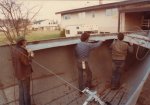
Installing side decks origami style. All the deck beams and stringers were welded on, on the ground, before installing. 1984

IMG_20190123_0002.jpg
 
Last edited:
Status
Not open for further replies.
Top