Starting a diesel

Generally, an indirect injection diesel will need to be preheated, a direct injection won't. Yes there will be exceptions, but an indirect injection diesel has a greater surface area that will initially absorb the heat generated by compression, a direct injection's combustion chamber is partly on top of the piston and doesn't have a pre combustion chamber's surface area. Most cars up to the late 90s had the indirect design due to it being quieter with less diesel knock and they had glow plugs fitted that protruded into the precombustion chamber. An exception being the Austin Rover diesel, hence the noise it made. Commercial vehicles didn't need to be as refined or quiet so it was acceptable for those to be fitted with direct injection diesels with the diesel being injected directly on top of the piston.
Then came common rail with electronic high pressure injectors in the late 90s. They are all direct injection but could be made more refined and quiet by the use of electronics with the injector firing numerous times per stroke. Most don't need glow plugs for starting (Mercedes for example is an exception) but use the glow plugs to reduce emissions during cold running and at different times throughout a journey. They may only need glow plugs for starting if the temperature was well below zero.
Your older pre 2000 transit was direct injection, your Peugeot xud was indirect. The volvo 200x range is direct, whereas Betas for example are indirect.
If an engine could do without any preheat it wasn't fitted such as the old Transit.
The indirect injection was quieter, more refined but at the expense of fuel efficiency. Hope this generalisation helps.
Absolutely spot on, with the help also of wikipedia which endorses everything you quote I have now an understanding. you certainly know the subject.
 
I beleieve WD40 used to use propane or similar, thats why it was good as a starting aid. As others have noticed, it no longer works. The starting fluids using ether, hence the smell, ether will go bang on fairly low compression. The reason it damages diesels is that the ether bangs as soon as it gets hot on the firing stroke, usually before the ignition point in the cycle. So it causes pre ignition. Damaging to pistons and ring lands. Using it in a petrol engine isnt so bad, the lower compression means that it doesnt usually ignite on the compression stroke on its own. It has to have the spark. This then allows the engine to fire at the correct point, ie no pre ignition.

But in practice it causes NO PROBLEMS WHATSOEVER if used purely as a starting aid if the glow plugs or other starting system is defective.

50 years 'on the tools' working on all small engines, from mopeds to light trucks. From 100 year plus old timers to contemporary stuff with computer controlled injection.

If it is squirted constantly into a diesel engine intake while cranking, what you suggest IS a possibility.

Diesel pistons are very strong. They do break, but not often on a well maintained vehicle in good order.

I have never heard or seen one that has broken through the use of starting fluid.

Like engines 'Getting used to Easystart' I firmly believe it to be an old wives tale.
 
If you need to crank for more than a few seconds you have a problem which should be sorted out.

Edit: In the case of my new engine, which started needing lots of cranking, the problem was an intermittent open circuit in the fuse of the glowplug circuit. Took me five minutes to find, but not until after I had run up a yard bill of almost a grand trying to find the problem. Intermittent faults are a bugger.
My engine takes so long to start that I always think it's not going to.

Glow plugs have been mentioned in past threads, so I took mine out and tested them with fly-leads - they all certainly glow red hot.

Perhaps I should allow a longer pre-heat - heat the glow plugs for 30 seconds or 60 seconds instead of just a few? Can I do any damage by doing this?
 
A lot of old engines struggle and need all the help they can get. However if it's a fairly modern/unknackered engine it should start pretty lively.

The plugs burn out eventually. I had some reason to check this last year so I know Beta recommend a max of 10 seconds pre-heat.

I had an old engine that struggled a bit and later the starter motor packed in. *I had it rebuilt and my God, that was the end of starting problems. Like having a new engine.

*Edit
To make it clear it was the starter that was rebuilt, not the engine (y)

.
 
Last edited:
As another says - the themostart is on the engine side of air filter directly screwed into the intake pipe. .... and should not be too much distance from the actual engine .....
There's no fine art to this ... the act of engine drawing in air will pull the heat ...

Pipe ? I use clear plastic diesel pipe so I can see the fuel .... the connection to the plug does get hot if powered too long - but a suitable heat resistant clear fuel pipe will survive.

Any small reservoir ... even a large syringe without plunger is enough ... the amount of fuel needed for a start is miniscule .... literally less than a tear drop !!
I actually use the pipe itself as my reservoir ... its about 6" long and has a larger pipe pushed over end as a friction fit to allow a slightly larger hole for me to fill the first pipe ... when the plug valve used to work properly - it was good for a number of starts ... but the plug valve developed a trickle leak and now if needed - I top up the pipe before use.

I have a small plastic 100ml bottle ready to create a new reservoir ... it has a nipple outlet ... all it needs is a hole made to fill it and a simple pop stopper .... if you've ever refilled printer cartridges - you usually get pop stoppers in the kit ... the bottle in fact is from same kit !


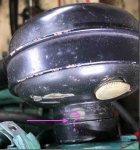
That's brilliant, thanks for all that detail. There doesn't seem to be much room between the filter and the engine though, and access is tricky - is this (see pic) where the thermostart needs to go? I was sort of hoping that it might be ok to stick it upstream of the filter instead for convenience...
 
I don’t think addiction to Easystart is necessarily apocryphal. It could be, however, that using a starting agent masks a problem which steadily gets worse, resulting in increased reliance on extra ‘ooomph’ to get the engine going.

It is because the engine is knackered that it needs starting fluid at every start. As you say, masking a problem.

My old Fiat Scudo with the sheared off glow plugs needed a one second squirt through the little hole I drilled in the air filter housing. Once going, even in cold winters it would start without a squirt for the rest of the day, even if left for eight hours.

I could have fixed the Scudo by removing the head and engineering or having the sheared off glow plugs spark eroded out.

A 6mm drill and a fiver for a can of jollop was a far more economical and pragmatic solution.
 
But in practice it causes NO PROBLEMS WHATSOEVER if used purely as a starting aid if the glow plugs or other starting system is defective.

50 years 'on the tools' working on all small engines, from mopeds to light trucks. From 100 year plus old timers to contemporary stuff with computer controlled injection.

If it is squirted constantly into a diesel engine intake while cranking, what you suggest IS a possibility.

Diesel pistons are very strong. They do break, but not often on a well maintained vehicle in good order.

I have never heard or seen one that has broken through the use of starting fluid.

Like engines 'Getting used to Easystart' I firmly believe it to be an old wives tale.
Same experience work wise as you. Plus I used to spanner for Gary Bryan before his smash at Oulton. The addiction old wives tale is because of what I describe, it is wear that causes the need for ether and then damage caused by the ether that over time makes them worse.
 
Whoops, pic didn't appear - try again:

View attachment 93085
Those air filters are not the most secure on those engines usually being held with a jubilee clip. Could you imagine what might happen if the pop of the diesel igniting caused the air filter to come off? You now would have a very angry air filter dangling by a fuel pipe spewing a flame, going round in cirles. If you do try this make the mounting of the air filter more secure.
Incidently I did fit glow plugs to one of those air filters which made a huge difference to the starting for a few years until the owner eventually got new valves and seats. Two glow plugs, a glow plug relay, and a push button switch.
 
My engine takes so long to start that I always think it's not going to.

Glow plugs have been mentioned in past threads, so I took mine out and tested them with fly-leads - they all certainly glow red hot.

Perhaps I should allow a longer pre-heat - heat the glow plugs for 30 seconds or 60 seconds instead of just a few? Can I do any damage by doing this?
Are you sure that your glow plugs are actually glowing in situ, and doing so at full belt? Mine were working fine, but the intermittent supply fault meant that most of the time they weren't getting fed. Even in the sub-zero depths of winter my Citroën diesel never times the glowplugs at more than ten seconds, and my Nanni starts like a dream now with five seconds' heating.
 
I could have fixed the Scudo by removing the head and engineering or having the sheared off glow plugs spark eroded out.

A 6mm drill and a fiver for a can of jollop was a far more economical and pragmatic solution.
I think the key principle is that you don't need to mend every fault, but you do need to know precisely what a fault is in order to decide whether or not to fix it.

I apologise for banging on about the DS again, but I long ago learned with that car that while some hydraulic leaks matter and some don't matter, you have to investigate each one to find out which type it is. I learned this the hard way when I discovered - on the M6 at 10.30pm on a rainy night - that what I had dismissed as "probably a drip from a low pressure return pipe" turned out to be "actually a pinhole developing in the main high pressure delivery pipe".

And so with a marine diesel. It doesn't matter if it takes a while to start, as long as you know why it takes a while to start and the reason isn't likely to get worse or cause other problems. The main reason I ditched my 1GM10, although it never missed a beat, is that it would occasionally eat a sump full of oil in three hours, and I didn't know why.
 
Are you sure that your glow plugs are actually glowing in situ, and doing so at full belt? Mine were working fine, but the intermittent supply fault meant that most of the time they weren't getting fed. Even in the sub-zero depths of winter my Citroën diesel never times the glowplugs at more than ten seconds, and my Nanni starts like a dream now with five seconds' heating.

Have to agree ... keeping that glow plug powered for too long can destroy the 'valve' that feeds it ... so no matter the element is glowing red hot - if no fuel is getting to it - you are wasting your time.

I know it doesn't help when a plug is under a bonnet and you're in the drivers seat etc. - but my Perkins - I hear a definite POP when the fuel ignites and a wisp of white smoke curls out of filter.

I would be inclined to remove the glow plug ... keep it all connected and a jump lead to ground it to engine block ... try it then - see if fuel is getting through ...
 
Whoops, pic didn't appear - try again:

View attachment 93085

If you have room .. why not add a short extension collar - drill collar - fit the Thermostart ... mount filter to the extended collar ? The Thermostart only needs a small hole to screw into.

You could if careful fit in the space you have ... making sure of course - you remove filter first .. stuff rag in to stop drillings falling in ... once drilled use a magnet to collect any bits etc.
Screw in and done.
 
Those air filters are not the most secure on those engines usually being held with a jubilee clip. Could you imagine what might happen if the pop of the diesel igniting caused the air filter to come off? You now would have a very angry air filter dangling by a fuel pipe spewing a flame, going round in cirles. If you do try this make the mounting of the air filter more secure.
Incidently I did fit glow plugs to one of those air filters which made a huge difference to the starting for a few years until the owner eventually got new valves and seats. Two glow plugs, a glow plug relay, and a push button switch.

Blimey - its not a big explosive pop .... if it blows the filter of - then you have some Thermostart there !!!!

Put it another way - if same setup has had Ether sprayed at it - THAT can cause a much bigger POP than a diesel drip fed glow plug !!
 
Are you sure that your glow plugs are actually glowing in situ, and doing so at full belt? Mine were working fine, but the intermittent supply fault meant that most of the time they weren't getting fed. Even in the sub-zero depths of winter my Citroën diesel never times the glowplugs at more than ten seconds, and my Nanni starts like a dream now with five seconds' heating.
I measure the volts drop (permanently) across the plugs' supply. It's only millivolts but the meter shows fsd for four plugs a'workin and proportionately less if any fail.
 
Last edited:
I measure the volts drop (permanently) across the plugs' supply. It's only millivolts but the meter shows fsd for four plugs a'workin and proportionately less if any fail.

Volts maybe ... but its the FUEL FEED is the killer here .. and amps of course !

When the fuel 'drips' onto the filament - its reading should cause a flicker ... caused by the temp change of the filament ...
 
Volts maybe ... but its the FUEL FEED is the killer here .. and amps of course !

When the fuel 'drips' onto the filament - its reading should cause a flicker ... caused by the temp change of the filament ...
I have misled (as usual!). I measure the volts drop across the feed wire to the plugs not the volts at the plugs. The feed wire, although substantial, still has a resistance and the volts drop I measure is as a result of that resistance and the current drain from the plugs.

Is that better?!
 
I have misled (as usual!). I measure the volts drop across the feed wire to the plugs not the volts at the plugs. The feed wire, although substantial, still has a resistance and the volts drop I measure is as a result of that resistance and the current drain from the plugs.

Is that better?!

But helps not ...

If the plug is heating up from the voltage applied .... but not assisting the start - then its a FUEL FEED problem. You could play all day with voltage - but if no fuel is getting through - you're just wasting battery power for nothing.
 
Are you sure that your glow plugs are actually glowing in situ, and doing so at full belt? Mine were working fine, but the intermittent supply fault meant that most of the time they weren't getting fed. Even in the sub-zero depths of winter my Citroën diesel never times the glowplugs at more than ten seconds, and my Nanni starts like a dream now with five seconds' heating.
Well, that does indeed remain in question. It's just a matter of trying one thing at a time - now I know the glowplugs themselves have not failed, and so I must move onto something else, and wondered if I'd not been leaving them on long enough.

When I took them out and tested them they took, I'd say, about 5 seconds to get glowing red hot. Is that "full blast"?

Have to agree ... keeping that glow plug powered for too long can destroy the 'valve' that feeds it ..
Could you possibly expand on this, please?

Which valve do you refer to, and what is its function? Do you mean the injector?

… so no matter the element is glowing red hot - if no fuel is getting to it - you are wasting your time.

… I would be inclined to remove the glow plug ... keep it all connected and a jump lead to ground it to engine block ... try it then - see if fuel is getting through ...
I'm sure the engine starts immediately once it's warm, so doesn't that rule out a fuel problem?
 
Top