Stabilizers for Blue Angel, engineering question

BartW

Well-Known Member
Joined
9 Oct 2007
Messages
5,236
Location
Belgium
www.amptec.be
After having some e-mail communication and a quote from CMC, www.cmcmarine.com , manufacturer of electrically driven stab systems, I ‘ve got my head spinning, and am seriously considering this upgrade for the boat.
The budget is still steep, and perhaps not in relation to the value of the boat, but I gave myself some good excuses to go for it;

Apart from the engineering challenge,
- In SOF you can have sometimes a unexpected and unpredicted mistral,
Prediction only F3-F4, but when coming from over the sea , fetch can produce some very nasty swell, especially when coming 90° beam side.
- The nice and popular places over there (f.e. Porquerolle , St Tropez Pamplone, …
Have a swell all day in high season from the many passing boats at planning speed

Still many doubts about the spending, but when going for a system, I’m almost convinced that the CMC system is the one I need; because
the ease of installation, and because the system appears to be well engineered.
CMC claims to have installed over 200 systems , the smallest is the one now standard in a San Lorenzo 72, which is the one that is quoted for BA.

Questions:

1) For the installation, I need a naval architect to do some calculations on the strength of the hull, and to design the reinforcement around the stabs.
Any idea who can help me with that ?
CMC can point me to some, or I could try via the former Canados workers, but perhaps someone on here has a good suggestion.

2) Appart from many length, beam and weight value’s,
a very important figure from the boat, that CMC is asking for is the GMT value (transverse metacentric height).
They need this value to calculate the "effectiveness" of the system.
After googling, I understand what the value means, and could try to calculate / estimate,
but I think I better leave that to a Naval experienced engineers., so then we’re back at Q1

Any input / advice is welcome
 
Just got a PM from a friend questioning the Stabilizer upgrade,
other people might have the same concern therefor I post my answer here

- I believe that the Canados hull is strong enough to have such a system, we know that the boat is much heavyer then similar more modern boats,
therefore the search for a good naval architect
Many more or less similar boats, also some very old examples have stabs.

- the weight of the total system is approx 400kg all included, there will nevertheless be influence on the sailing char. I hope it will be a improvement :)
yes and fuel consumption has alway's been a concern, but due to more stable navigation, on average this will compensate with the extra drag.
Moreover if I can't afford the fuel bill anymore I'll sail her at D-speed, and I know that the stabs would be working then also, the perfect compromise for not having to buy a D-boat for my old day's.

- the CMC system, is the most simple system to install, very few heavy components compared to a hydraylic system, no hydraulic hoses, just some cables between the drives and the controllers.

- Financially it does absolutely NOT make sense to add such an expensive upgarde, but this is the same with every aspect in owning a boat isn't it ;-)

- I'll probably stick with Blue Angel, for a long time, as we did many personal adaptations that you won't find even in much newer boats.
and I don't dare to think about getting her sold.
A new boat of this size won't be for me, at least not in this live :).
Now we are used to this size, I don't fancy anything smaller nor bigger.

- good assistance and advice from experienced people is crucial for this project. ao This thread here is (a small) part of that hopefully.

Many thanks E for questioning this substantial project, sometimes I need to be pointed to reality :)
 
Bart, assuming that you have made the decision to go for the upgrade, it not being a economical question, but you having decided that BA is worth investing in, because you want her just perfect for you for several years. Once through that, then the rest is a purely technical challenge. As an Engineer (sorry, not Naval), as long as you mount the stabiliser fulcrum on a base of sufficient strength, which any competent engineer should be able to calculate, and you can seal the shaft through the hull, this should not be too difficult. The supplier should be able to tell you where, in terms of fore and aft, the optimum geometry should be, you then need to find the right position given the compromises you will have with a boat not designed to package this system. The rest is all about money. :)
 
Bart, I would have thought the first thing to do would be to contact Canados directly and ask if they can recommend a naval architect who knows their boats. Maybe even the original architect who designed your boat is still around. I'm no expert but, to calculate the metacentric height, surely the architect has to have access to dimensioned drawings and component weights for your boat in which case I guess it's necessary to appoint an architect who has access to the original Canados drawings. I guess it's possible to calculate the metacentric height without dimensioned drawings but then I presume the architect then has to take accurate measurements of your boat which might be costly and time consuming
 
interesting thread, Bart, care to give a ballpark figure of such an operation?
(in % of the current value of BA would be acceptable if you don't want to give # as yet)

cheers

V.
 
Good stuff BartW. Are you thinking to do this job now, or next winter? I will happily take you out to sea in M2 if you want to feel the effectiveness of the stabs, but that would be June/July this year

There must be some naval architecture calcs and references for this. Match1 was the first fin stabbed boat Fairline ever built, and they asked Olesinski's office to do the calcs. Olesinski came up with a new specification for hull lay up in a square approx1.5m x 1.5m around the stabs. Remember this pic of the hull thickness? About 80mm
P1010428.jpg


Actually they re-worked the calcs after Match1 and made the later stabbed hulls (they have done another 6 or so stabbed sq 78 since Match1) a bit thinner. M2's hull something like 60mm thick around the stabs. I can post pics. So with retrofit you can expect the naval architect to specify something like an extra 20 layers of GRP to create maybe 70mm hull thickness

I think DL is a Naval Architect. Ask him maybe? Otherwise, David Greening in Chichester UK is a good guy (he did a project for me years ago - proper engineering/naval architecture job)
 
Last edited:
Just out of interest, BartW, I guess you've thought about a gyro stab? I would have thought a gyro stab is a much easier retrofit although I assume a gyro stab is more expensive
 
Many thanks E for questioning this substantial project, sometimes I need to be pointed to reality :)
Oooh, who is this E who is trying to bring rationality in a forum like this? Name and shame!
Doesn't he/she know that here in the asylum, sanity checks are banned? There are T-groups for that... :rolleyes:

Re. your Q1, with apologies if this will sound simplistic to the more technically minded, I think that the importance of naval architects in the design of these things is a bit overrated.
I mean, I've seen 3 boats where a fins stab equipment was retrofitted, and both the fins placement and the internal strengthening were only based on the yard experience, plus some good old common sense.
And in all of them, the result was quite good, though of course you would never know if and how much it could have been better with a more accurate study.
The point is, fin stabs are so much effective in stabilizing a hull roll, that it takes a HUGE design mistake, to achieve a poor result.
Besides, in retrofitting, to some extent the fins placement (and the consequent hull strengthening) is driven by the internal possibilities, rather than by the ideal position along the hull.

In your boots, the first thing I would look for is a yard with some GRP building experience (rather than just repair/maintenance), and possibly one which has already accomplished a similar project.
By carefully evaluating with them where to place the fins and how to reinforce the interior, you can't go awfully wrong.
After all, the basic rule is very simple: transversally, the fins should be placed as far as possible from the centerline, and longitudinally, as near as possible to the CoG.
Which on a boat as BA, roughly means at 1/3 of the waterline, from astern.
But if for instance such "ideal" placement falls around the bulkhead between the e/room and the master cabin (as typically happens on 70 footers), I wouldn't hesitate to move it half a meter in either direction, based on what makes life easier for installation, maintenance, etc.
Maybe, I would rather move them a bit forward if you wish to privilege the effectiveness at displacement speed, and the other way round for higher speeds, but that's already in the "hair splitting" realm...
 
Last edited:
Now that Bart has said he wants to keep BA in the future the whole project makes more sense. But I cannot begin to imagine the disruption this project will cause to the boat. First of all, how will it affect the interior? Space has to be found to accommodate the system in an interior that was designed without allowing for this space. Then the strengthening of the hull, another 20 layers of GRP over an area of 1.5 x 1.5mtrs, that means more interior having to be removed to get that done. Never mind the cost of the system, I suspect the installation preparations and the removal/redesigning of the interior will be even more expensive. This is just a gut feeling, I have no experience in the installation of these systems. It will make an interesting thread though. :)
 
Oooh, who is this E who is trying to bring rationality in a forum like this? Name and shame!
Doesn't he/she know that here in the asylum, sanity checks are banned? There are T-groups for that... :rolleyes:

Re. your Q1, with apologies if this will sound simplistic to the more technically minded, I think that the importance of naval architects in the design of these things is a bit overrated.
I mean, I've seen 3 boats where a fins stab equipment was retrofitted, and both the fins placement and the internal strengthening were only based on the yard experience, plus some good old common sense.
And in all of them, the result was quite good, though of course you would never know if and how much it could have been better with a more accurate study.
The point is, fin stabs are so much effective in stabilizing a hull roll, that it takes a HUGE design mistake, to achieve a poor result.
Besides, in retrofitting, to some extent the fins placement (and the consequent hull strengthening) is driven by the internal possibilities, rather than by the ideal position along the hull.

In your boots, the first thing I would look for is a yard with some GRP building experience (rather than just repair/maintenance), and possibly one which has already accomplished a similar project.
By carefully evaluating with them where to place the fins and how to reinforce the interior, you can't go awfully wrong.
After all, the basic rule is very simple: transversally, the fins should be placed as far as possible from the centerline, and longitudinally, as near as possible to the CoG.
Which on a boat as BA, roughly means at 1/3 of the waterline, from astern.
But if for instance such "ideal" placement falls around the bulkhead between the e/room and the master cabin (as typically happens on 70 footers), I wouldn't hesitate to move it half a meter in either direction, based on what makes life easier for installation, maintenance, etc.
Maybe, I would rather move them a bit forward if you wish to privilege the effectiveness at displacement speed, and the other way round for higher speeds, but that's already in the "hair splitting" realm...
+1 to every word of that
My stabs feel like they are in the perfect position. Yet actually they are not under bulkheads and are under a walk in wardrobe which is a room no-one cares about. Now that isn't a coincidence. As Mapis says, work out the theoretical answer then build according to practical considerations.

Nice project :-)

Also consider 2 x seakeeper 8000 gyros
 
Bart, I would have thought the first thing to do would be to contact Canados directly and ask if they can recommend a naval architect who knows their boats. Maybe even the original architect who designed your boat is still around.

indeed, Canados is on top of my list for contacting, through my former Canados workers connection.

Mike do you realise you started all this ?
Actually I was at the CMC booth at Metz, but the guy's were very bussy and my mind was on a hydraulic system, so I was not seduced by the electric solution, didn't consider it to be useable for me.
I spoke with 2 hydraulic stab and one gyro stab manufacturers, and got some contact names,
but didn't continue with the project, too many other things on hand.

after reading your post in Jfm's M2 thread, and investigating all info on the CMC website,
they got me interested,

........... So, yes, I'm still tempted by a mainstream planing boat with stabs and on that subject, what do you think about these new electric stabs http://www.cmcmarine.com/stabilis-electra/? They seem to do everything hydraulic stabs do but in a more compact and more easily fitted package

and right now I'm counting my euro's :)
 
Last edited:
Also consider 2 x seakeeper 8000 gyros

I did,
I spoke with the guy's at Metz,

would take a lot of space in the e/r,
would require a very big rebuild (moving the gennys')
and even then, E/R space will be compromised, which I would hate.
I like the available space for tools, maintenance stuff, scuba compressors, temporary storage, etc...

Not cheap either.
therefor I skipped the gyros idea.
 
Last edited:
interesting thread, Bart, care to give a ballpark figure of such an operation?
(in % of the current value of BA would be acceptable if you don't want to give # as yet)

I could do that when you tell me what you think is the current value of Blue Angel :)
I'm very interested myself :)
 
I did, spoke with the guy's at Metz,

would take a lot of space in the e/r,
would require a very big rebuild (moving the gennys')
and even then, E/R space will be compromised, which I would hate.
I like the available space for tools, maintenance stuff, scuba compressors, temporary storage, etc...

Not cheap either.
therefor I skipped the gyros idea.
All agreed BartW. The 2x seakeeper take up too much space on the Sq78 as well. I was on one recently at the factory, that was launched 2 months ago. Worse still, the space they consume is in the utility/engine room, which is my personal space! Overall, fins are a beter answer imho

Big project, and good luck with it. The effect on the boat will be truly transformational
 
Re. your Q1, with apologies if this will sound simplistic to the more technically minded, I think that the importance of naval architects in the design of these things is a bit overrated.
I mean, I've seen 3 boats where a fins stab equipment was retrofitted, and both the fins placement and the internal strengthening were only based on the yard experience, plus some good old common sense.
And in all of them, the result was quite good, though of course you would never know if and how much it could have been better with a more accurate study.
The point is, fin stabs are so much effective in stabilizing a hull roll, that it takes a HUGE design mistake, to achieve a poor result.
Besides, in retrofitting, to some extent the fins placement (and the consequent hull strengthening) is driven by the internal possibilities, rather than by the ideal position along the hull.

In your boots, the first thing I would look for is a yard with some GRP building experience (rather than just repair/maintenance), and possibly one which has already accomplished a similar project.
By carefully evaluating with them where to place the fins and how to reinforce the interior, you can't go awfully wrong.
After all, the basic rule is very simple: transversally, the fins should be placed as far as possible from the centerline, and longitudinally, as near as possible to the CoG.
Which on a boat as BA, roughly means at 1/3 of the waterline, from astern.
But if for instance such "ideal" placement falls around the bulkhead between the e/room and the master cabin (as typically happens on 70 footers), I wouldn't hesitate to move it half a meter in either direction, based on what makes life easier for installation, maintenance, etc.
Maybe, I would rather move them a bit forward if you wish to privilege the effectiveness at displacement speed, and the other way round for higher speeds, but that's already in the "hair splitting" realm...

good advice MapisM, will discuss this route with CMC,
within 2 weeks will go to the yard I had in mind for anual maintenance,
they actually build boats, (but mainly wood iirc) and listen how they would approach the project.
I can also asc CMC if they know a yard who has experience.

also about positioning, I'm restricted with my options due to available space, but compared to a SQ78 that seemed ok,
will discuss this also with CMC with pics (pics have been posted before but will post these here again later)
 
Bart, have you " lifted floorboards" cabin soles and done a provisional recci @ arround 1/3 rd from the stern ?
I dought you will find wide open blank spaces - waiting to to be " glassed up " - reinforced .
Lots of things / gear will have to be moved and things relocated - perhaps to a detriment ? ?
100 k € will buy a lot of fuel to take you off to far places to dive when SoF is exhausted / boring.
Like Corsica - Sardinia ?
Poss less effected by the mistral , which if I understand your motive correctly is the main driver here?
 
Last edited:
here is a picture (previously posted by Jfm in the rebuild thread)
that shows where the fins would be in comparison to a SQ78, = similar length


the two black vertical lines on BA show where the fuel tanks are (full width of the boat)
in the e/r behind these tanks is no room, (beam water tanks)
but in the spot where they are drawn, is space with a bit flexibility
 
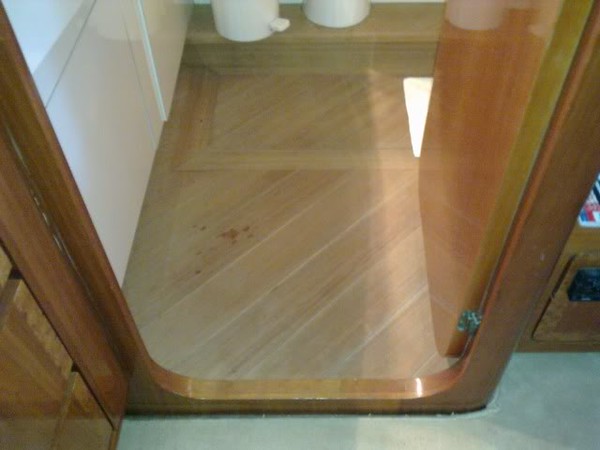
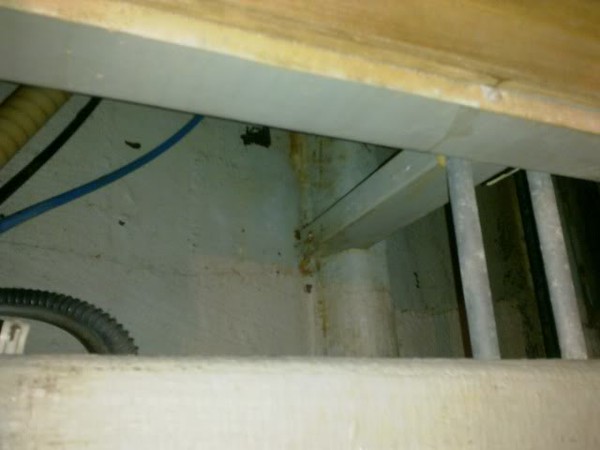
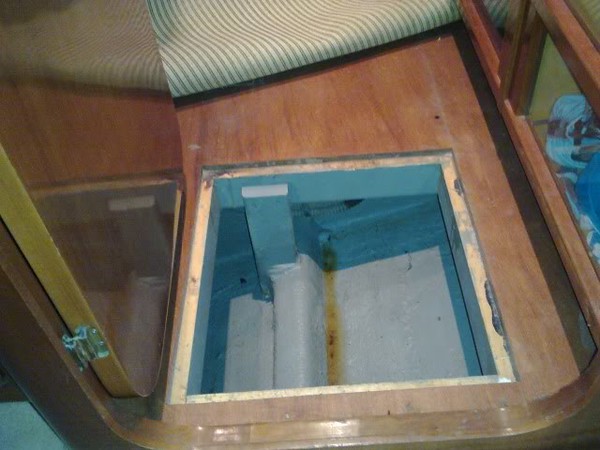
here are the positions inside:

on SB side, in the owners cabin heads,
perhaps we have to take out the toilet, bidet and the floor, (we have had to dismantle already)
but if you could see what we are doing at this moment in the crew cabin,
then this here is easy.

i-8rdQXHs-L.jpg


i-HP5dzGp-L.jpg


i-mL9b6tK-L.jpg


and in the dressing room on P side,
also there its possible to go more towards the stern, by removing some of the floor.
all acces-able

i-98q2xGW-L.jpg


if the position here is right,(weight distribution wise) In believe its doable

the hight for the electric drives (approx 35cm) seemes OK,
first thing to check when at the boat
 
Last edited:
Top