Splicing dyneema to the clew-end of genoa sheets

I'm with Roberto - the clew ring is enough danger by itself on a large Genoa. Using a soft shackle and/or eliminating a bowline is still going to leave it as a danger of which to be cautious. Removing the bow line should make tacking easier, no hang ups, the reduction in danger - not part of the equation for us (35m^2 headsails). Our 45m^2 screacher has tape instead of a clew ring - but it is still treated with respect.

Jonathan
I agree that the danger of the sheet when the sail is flapping is still present, however it is *reduced* by getting rid of the bowline. The only way to eliminate all the risk is to stay in bed (unless you live on board!)
 
I agree that the danger of the sheet when the sail is flapping is still present, however it is *reduced* by getting rid of the bowline. The only way to eliminate all the risk is to stay in bed (unless you live on board!)

That seems a bit like saying, would you rather be trampled by 20 horses or kicked in the head by one.

Being kicked, may, be technically less harmful than being trampled by 20 horses, but you still wouldn't volunteer to be in that position!
 
Re: danger - I've experienced the heavy bowlines hitting things, (including my face) when the sheet is loose. Using eye splices and soft shackles eliminated this issue.

Re: strength - 6mm dyneema has a breaking strain of 40,000N. The combined sail-area of the whole boat is roughly 600sqft. If this were all genoa, in 40kts of wind, it would exert a force of 20,000N on the sheet.
Breaking strain was not my concern with the 6mm dyneem. You could fit wire jib sheets if worried purely about strength - but clearly wire plus lots of tension around the foredeck would give lots of other risks. 6mm dyneema is not much wider than wire, and much more risk of getting wrapped round something - or worse somebody’s limb. And I would not be surprised to find thin 6mm sawing a groove in the pole fittings over 3,000 miles.

But actually, getting back to the original objective, which seems to be for using when goose winged on a long ocean passage. In this case typically the best solution is:
- whisker pole independently held in position with three ropes - uphaul plus forward and rear downhaul ; and
- dedicated third sheet rigged through pole back to either widest point of beam or the spinnaker blocks near stern.

Generally the jib/ genoa tracks are not in the optimum location for a poled out sail, too far inboard and forward. Hence the third sheet approach gives
(a) better angle and hence less strain on pole - and often avoids the sheet pressing on lifelines; and
(b) most flexibility/safety, as can furl sail fully or even swap to reaching mode on either tack (eg at night) without having to move the pole, which can stay in place till daylight (or whenever used next).

Hence using a spinnaker sheet, or any long enough sheet (attached as for spinnaker sheet, either with bowline or snapmshackle) for poling out would avoid needing to mess with the current arrangement for jib sheets which seems to be working fine for non poled out use.
Third sheet is what we use in this circumstance.
 
That seems a bit like saying, would you rather be trampled by 20 horses or kicked in the head by one.

Being kicked, may, be technically less harmful than being trampled by 20 horses, but you still wouldn't volunteer to be in that position!

The reduced mass concentrated at the clew means the flogging sheet poses less of a danger at the cockpit-end when you're working with it.
 
Breaking strain was not my concern with the 6mm dyneem. You could fit wire jib sheets if worried purely about strength - but clearly wire plus lots of tension around the foredeck would give lots of other risks. 6mm dyneema is not much wider than wire, and much more risk of getting wrapped round something - or worse somebody’s limb. And I would not be surprised to find thin 6mm sawing a groove in the pole fittings over 3,000 miles.

But actually, getting back to the original objective, which seems to be for using when goose winged on a long ocean passage. In this case typically the best solution is:
- whisker pole independently held in position with three ropes - uphaul plus forward and rear downhaul ; and
- dedicated third sheet rigged through pole back to either widest point of beam or the spinnaker blocks near stern.

Generally the jib/ genoa tracks are not in the optimum location for a poled out sail, too far inboard and forward. Hence the third sheet approach gives
(a) better angle and hence less strain on pole - and often avoids the sheet pressing on lifelines; and
(b) most flexibility/safety, as can furl sail fully or even swap to reaching mode on either tack (eg at night) without having to move the pole, which can stay in place till daylight (or whenever used next).

Hence using a spinnaker sheet, or any long enough sheet (attached as for spinnaker sheet, either with bowline or snapmshackle) for poling out would avoid needing to mess with the current arrangement for jib sheets which seems to be working fine for non poled out use.
Third sheet is what we use in this circumstance.

To mitigate the problems you raise, the dyneema sheet end is only 2.5m long and I can cut it shorter if necessary. However, I am tempted by your 3rd sheet solution...
 
...But actually, getting back to the original objective, which seems to be for using when goose winged on a long ocean passage. In this case typically the best solution is:
- whisker pole independently held in position with three ropes - uphaul plus forward and rear downhaul ; and
- dedicated third sheet rigged through pole back to either widest point of beam or the spinnaker blocks near stern...

What I said earlier, but - pedant mode on - I think it's a guy not a sheet when led through the pole. But whichever, I agree with the post!
 
So far, so good. The Dyneema sheet is far easier to manage in tacking. The only downside is that the very hard Liros dyneema is a (…!) to splice.
I find with Liros dyneema it helps to give it a bash with a hammer as you pull the cover back down. When it has locked up it loosens it up again and you can keep moving,

When you get to the difficult bit of burying, soak it in 50/50 water and Fairy Liquid. It made a huge difference on some 6mm that I couldn't get to move any other way.

I have had problems with bowlines on genoa sheets! Specifically we had a set of sheets, not now used, which just untied their bowlines literally in a few minutes, and since then we have religiously added three cable ties to each bowline.

I had a hunch and subsequently experimented and seemed to prove that if the tails are about 4-6" it's the perfect length to vibrate loose in tacks. I now leave about a foot, and the end of the tail hardly moves.

Someone will say that that much loose will flail and foul on something, but it hasn't yet.
 
Or you could borrow from what is seen on the outriggers of some Imoca: the sheets of some of their sails are fed through a low friction ring, whose position can be adjusted by lines fitted along the outrigger or from outrigger to hull. There are some that have an opening, a bit like an opening snatch block except a lot lighter and less massive, saves from having to feed the whole sheet inside them.

For some reason the image does not upload, here is the link with an example
http://www.antal.it/data/files/prodotti_img/Soft_Links/HK16_G_635852704205787435.jpg
 
I've just realised that I have my Genoa sheet home for washing
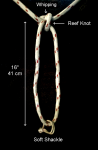
so here's a pic of my single rope sheet arrangement.
The whipped Reef knot stops snagging on the shrouds and makes a loop for the clew attachment, the length of the loop gives me a good full turn around the genoa when furled.
I previously used an alpine butterfly knot, but it tightened up too much and made it difficult to undo.

Genoa Sheet.png
 
Update: I spliced 3m of 6mm dyneema to the end of each of my genoa sheets in Santa Marta, Colombia. We're now in Samoa, having just come through a severe gale/storm on the way from Bora Bora. The dyneema ends have made using the pole for wing on wing very easy as the dyneema easily fits in the pole jaw and there's been no issue with chafe or splice strength.
 
Update: I spliced 3m of 6mm dyneema to the end of each of my genoa sheets in Santa Marta, Colombia. We're now in Samoa, having just come through a severe gale/storm on the way from Bora Bora. The dyneema ends have made using the pole for wing on wing very easy as the dyneema easily fits in the pole jaw and there's been no issue with chafe or splice strength.

Thanks for the update.

Jonathan
 
I can’t see changing the bowlines on the end of my sheets as that’s much better and safer than the silliest thing inherited which was a single snapshackle with both sheets attached - made it super quick changing sails but I kept it when we changed to roller reefing and it once came undone when there was just a scrap of sail out because the weather was so rough. So from then it’s always been two separate sheets with a bowline.

However I was struck by the mention of the change you would get from the jaws of the pole if used for days and weeks as we are planning. I like the idea of a separate guy which I would attach alongside the normal sheet (which I would leave slack) so that it gets the wear near one end. And also maybe the low friction ring instead of the block I had also been thinking of.
 
Currently, the genoa sheets are 16mm polyester braid-on-braid. They have eye splices in the end and are attached to the clew with soft-shackles (on this size of sheet and sail, using bowlines is frankly dangerous whenever the clew flaps during sail changes).

I have discovered that the eye-splice is too wide to fit through the jaws of the whisker-pole. On our looming ocean crossing, we will be spending weeks wing-on-wing so I need to solve this problem. My plan is to remove the eye-splices and then splice a metre of dyneema into the end of the sheet. My force calculations show that 6mm dyneema should be sufficient, and I have this on board. This will easily pass through the jaws of the pole and the transition from dyneema to polyester should not be nearly as bulky as the previous eye-splice. This will allow the pole to slide on the sheet all the way up to the clew without obstruction.

Is there a reason I haven't thought of why this solution would be a bad idea?

More like 9 mm to match the 16 mm polyester. You are suggesting a much lower safety factor than the original design. Additionally, 6mm will be difficult to splice to 16mm without a big drop in strength (too great a size difference for the standard method).

Re: strength - 6mm dyneema has a breaking strain of 40,000N. The combined sail-area of the whole boat is roughly 600sqft. If this were all genoa, in 40kts of wind, it would exert a force of 20,000N on the sheet.
 
Update: I spliced 3m of 6mm dyneema to the end of each of my genoa sheets in Santa Marta, Colombia. We're now in Samoa, having just come through a severe gale/storm on the way from Bora Bora. The dyneema ends have made using the pole for wing on wing very easy as the dyneema easily fits in the pole jaw and there's been no issue with chafe or splice strength.
So you didn’t go for the separate sheet through the pole, threaded through spinnaker leads or similar, as often recommended as best practice.
 
I do know how to tie a bowline. So does my son, who is a career deck officer as well as an RYA instructor having been a Sea Cadets instructor and of course holds an EDH certificate. We checked each other’s knots.

This was the first time that this happened to me in fifty years of owning cruising boats. So it is perhaps conceivable that one day it may happen to you, or to someone else. Which is why I mentioned it.
That is an odd one because the bowline is often described as a knot impossible to undo under tension.

To the OP. The idea of having three joins ( sheet to dynema, dynema to shackle, shackle to clew) rather than just one is not good - three times as many points of failure.

the 6mm dynema will have half the breaking load of the 16mm braid on braid so either one is over the top ( most likely) or the other is not enough

I dont know what the ideal solution is. I have a similar issue in that my genoa sheets are bowlined to the clew direct but this is giving me issues when tacking because they pass the mast exactly where there is hardware that they tangle on. Cant do anything about the hardware so I need to find a less "knobbly" way of attaching the sheets.
 
Last edited:
That is an odd one because the bowline is often described as a knot impossible to undo under tension.

To the OP. The idea of having three joins ( sheet to dynema, dynema to shackle, shackle to clew) rather than just one is not good - three times as many points of failure.

the 6mm dynema will have half the breaking load of the 16mm braid on braid so either one is over the top ( most likely) or the other is not enough

I dont know what the ideal solution is. I have a similar issue in that my genoa sheets are bowlined to the clew direct but this is giving me issues when tacking because they pass the mast exactly where there is hardware that they tangle on. Cant do anything about the hardware so I need to find a less "knobbly" way of attaching the sheets.

It is a very hard laid braid on braid rope. When you tack, the clew will usually flog a little, no mater how careful you are. It is that that can undo a bowline.

An ancient solution to the issue of sheets hanging up on the mast is to take a taut line from the foredeck (eg from the windlass, or from a mooring cleat) to a point on the mast above any cleats. I’ve done this for half a century.
 
Given the conditions we've just been through, I'm confident that there's no issue with the strength of the dyneema. Splicing was a doddle, I used locking splices with buried tails.
More like 9 mm to match the 16 mm polyester. You are suggesting a much lower safety factor than the original design. Additionally, 6mm will be difficult to splice to 16mm without a big drop in strength (too great a size difference for the standard method).

Having full sail up in 40kts of wind would be a mistake. Even having full genoa up would be a mistake, and it would still provide a x2 safety factor for the dyneema.

Re: strength - 6mm dyneema has a breaking strain of 40,000N. The combined sail-area of the whole boat is roughly 600sqft. If this were all genoa, in 40kts of wind, it would exert a force of 20,000N on the sheet.
 
To the OP. The idea of having three joins ( sheet to dynema, dynema to shackle, shackle to clew) rather than just one is not good - three times as many points of failure.

the 6mm dynema will have half the breaking load of the 16mm braid on braid so either one is over the top ( most likely) or the other is not enough

I dont know what the ideal solution is. I have a similar issue in that my genoa sheets are bowlined to the clew direct but this is giving me issues when tacking because they pass the mast exactly where there is hardware that they tangle on. Cant do anything about the hardware so I need to find a less "knobbly" way of attaching the sheets.

The joins are as follows:
1. Soft shackle through the clew of the sail
2. Locking eye splice in dyneema end
3. Locking splices holding dyneema to polyester braid on braid

I am confident that my soft shackle knots are strong enough - they did not fail when used in a standing jury rig holding the lower shrouds to the mast, even when the bottle screws were correctly tensioned.

As I made the locking splices for the eyes and the sheet to dyneema joins myself, I know that the only ways they could fail are through chafe, or if the braid of the rope failed, which seems to me to be almost impossible.

So I don't think there's an issue with multiple joins - they're not causing weak points - if splices can't hold things properly, all eye-spliced mooring lines and anchor rode, snubbers and halyards with spliced-in shackles would be useless.
 
The joins are as follows:
1. Soft shackle through the clew of the sail
2. Locking eye splice in dyneema end
3. Locking splices holding dyneema to polyester braid on braid

I am confident that my soft shackle knots are strong enough - they did not fail when used in a standing jury rig holding the lower shrouds to the mast, even when the bottle screws were correctly tensioned.

As I made the locking splices for the eyes and the sheet to dyneema joins myself, I know that the only ways they could fail are through chafe, or if the braid of the rope failed, which seems to me to be almost impossible.

So I don't think there's an issue with multiple joins - they're not causing weak points - if splices can't hold things properly, all eye-spliced mooring lines and anchor rode, snubbers and halyards with spliced-in shackles would be useless.

It just seems overly complex when you could have used hollow dyneema braid, inserted each sheet into the hollow braid, leaving a gap of only hollow dyneema in the middle, sewn with dyneema fishing line and then cow hitch the hollow part in the middle to the clew. Low profile, nothing to get caught, the dyneema is both slippery and abrasion resistant (in this application).

There are a couple of articles in Practical Sailor - this is the follow up article

Sewn Splices Two-Year Followup - Practical Sailor

Jonathan
 
It just seems overly complex when you could have used hollow dyneema braid, inserted each sheet into the hollow braid, leaving a gap of only hollow dyneema in the middle, sewn with dyneema fishing line and then cow hitch the hollow part in the middle to the clew. Low profile, nothing to get caught, the dyneema is both slippery and abrasion resistant (in this application).

There are a couple of articles in Practical Sailor - this is the follow up article

Sewn Splices Two-Year Followup - Practical Sailor

Jonathan

For clew attachment, I prefer soft shackles through locking eyes in the dyneema. I've toyed with the cow-hitch idea but I don't like the way you have to pull the whole sheet through to attach/detach. The only nobbly part in this system is the small button knot of the soft shackle right up snug against the clew.

I wanted a narrower gauge line for the first couple of metres of the sheets so that it would slide through the pole jaws more readily - hence the end splice.
 
Top