"Spillover" fridge / freezer design

Lomax

Well-Known Member
Joined
22 Sep 2016
Messages
375
Visit site
With the abysmal weather preventing any outside work, I've turned my attention to the design of the fridge/freezer. I've long had the idea of using some kind of plastic bins as the compartments, not only to save time, but because they would provide a smooth, easy-clean and durable interior. After some searching I think I've found a good option in Wham's "recycling bins" (minus lids):

Wham recycling bins.jpg

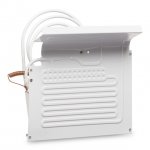
I have a Waeco/Dometic CU-85 compressor with the "L" shaped VD-01 evaporator plate:

Waeco CU-85 and VD-01.png
Dometic VD-01.jpg

The idea is to use the smaller 25L bin as a "freezer" compartment, with the evaporator mounted on the wall separating it from the "fridge" compartment. The two compartments are connected along the top and bottom by six 50mm diameter pipes, which can be selectively plugged to control the airflow. The top three holes (allowing "warm" air to move from the "fridge" to the "freezer") are behind the top of the evaporator plate, but as this is mounted on 16mm stand-offs there's still room for the air to move. The bottom three holes are below the evaporator and unrestricted. This combined unit would then be routered into the "lid" of a plywood box sized to allow 10-15cm of insulation all around. The insulation would be a two-part PU foam, introduced through a series of holes in the box's "lid" and allowed to completely fill the box, after which the actual worktop itself is mounted on top (with hinged lids for the fridge/freezer compartments - not shown below). Some illustrations:

fridge-freezer-01.png
fridge-freezer-02.png
fridge-freezer-03.png
fridge-freezer-04.png

What do you guys think, is this a viable design? Do you see any obvious problems?
 
Last edited:
I don't think you have enough insulation, certainly not if going to a hot climate like the med. 75 min to 100mm would good.
I designed a fridge/freezer for my Ocean lord, standard fridge was a joke even if the UK. I had a liner made by tektanks in a cuboid form (narrow and deep) with an insulated divider separating into 2 areas freeze and fridge. The plates resided in the freezer section and a small thermostatic fan sensed in the fridge was inserted in the divider. You must not let the air flow though the bottom as it will get too cold.

Lids are 60mm thick in polypropylene encapsulating the insulation.

The divider needs insulation otherwise it get very cold and freezes the fridge.

Because it is a cuboid it was easy to add 4 layers of 25mm foil insulation around the whole fridge. Of course the space in which it sits will determine the size of the liner but DON'T scrimp on the insulation.

I think this will be more expensive than your route but in the med it uses only about 12 amps overnight 10 to 7am. That means my 2 x 85 solar panels can run it
indefinitely.

If you want a proper freezer then you need to get a powerful unit. Penguin will tell you what you need. If you want to use the whole space as a fridge you can slow the motor speed down as well, dropping the running amps from 8 to 3.

Just some thoughts
 
I have built two fridge freezers over the years. I used the an eliptical evaporator plate mounted in the fridge compartment. You mount the plate so it becomes the freezer section. Add a bottom in perspex for easy cleaning and plug the bottom of the plate with closed cell foam that is removable for cleaning. A similar closed cell foam lid with a pespex backing plate seals the cold air in the freezer. There is nothing else to do. Set the stat so it keeps stuff at the correct temperature in the fridge (approx 4degC) and you will have deep frozen stuff in the freezer. My eliptical evaporator plate gives me 8litre freezer capacity with the remaining fridge circa 85 litres. My tub was made in 316 s/s with minimum 100mm kingspan insulation all round. Very ecenomic to operate
 
I don't think you have enough insulation, certainly not if going to a hot climate like the med. 75 min to 100mm would good.

The design includes 100-150mm insulation in all directions except "up". Haven't thought much about the lids yet, but assume some kind of insulating plug stuck to the underside of each lid, which goes part way down into the cooled compartments when closed.

You must not let the air flow though the bottom as it will get too cold.

Well, the connecting tubes are not quite at the bottom in the design, and they can of course be raised further. I'm not keen on a fan; I want a design that steals an adjustable amount of cold from the "freezer" side to create a passable "refrigerator" side by convection alone.

The divider needs insulation otherwise it get very cold and freezes the fridge.

It is insulated in my design.

If you want a proper freezer then you need to get a powerful unit.

I don't expect anything like a "proper freezer", just a small space for ice-cubes, icecream and vodka...

I used the an eliptical evaporator plate mounted in the fridge compartment.

Replacing the evaporator is not a good option as they cost £120-150.
 
I think you are going well. (You can come and work on my yacht anytime) I have a similar type fridge/freezer but my freezer is the larger compartment. I have a Waeco with a "U" shaped condenser. My insulation is 5 in. (13 cm.)

To regulate the airflow between compartments I have one 75 mm hole and a butterfly vent. There is a gap at the top of the insulated divider to allow air flow.
View attachment 70723
I also have "plug" type lids but I wonder if they are really essential since they are at the top? I'd like much larger openings so I can easily clean the contents of the fridge/freezer.

Realistically if you had a front opening freezer you'd only lose the cold air in the freezer when you had the door opened. That is not a lot as all the goods would remain frozen and the freezer would quickly get back to normal as the freezer unit cooled the air. (Of course you'd be careful how often you opened the freezer door each day, the door would have to be a neat fit and be well sealed)

How do you stop the frozen goods from smashing up against the condenser in rough weather?

Clive Cooper
 
Last edited:
Replacing the evaporator is not a good option as they cost £120-150

Trying to Install an evaporator plate on your own is not a brilliant idea (Waeco says it is a two man operation) I tried on my own and fractured one of the tubes - cost $260)
 
Last edited:
I think you are going well. (You can come and work on my yacht anytime) I have a similar type fridge/freezer but my freezer is the larger compartment. I have a Waeco with a "U" shaped condenser. My insulation is 5 in. (13 cm.)

Thank you :)

To regulate the airflow between compartments I have one 75 mm hole and a butterfly vent. There is a gap at the top of the insulated divider to allow air flow.

And this is working ok for you? Or are you having trouble getting the right temperature in the fridge and/or freezer?

Realistically if you had a front opening freezer you'd only lose the cold air in the freezer when you had the door opened.

This is true, but there is another important reason why front opening fridge or freezer won't work: space! With a front opening unit you need to have the free floorspace for the swing of the door, which means (at least in my case) that the person opening it has to get out of the way, making actually getting stuff out of it awkward.

How do you stop the frozen goods from smashing up against the condenser in rough weather?

Not a problem I had considered. But my boat is not suitable for rough weather; only 10' wide and flat as a pancake. Should she be exposed to wind & waves powerful enough to cause damage in the freezer I would have other more urgent concerns!

Trying to Install an evaporator plate on your own is not a brilliant idea (Waeco says it is a two man operation) I tried on my own and fractured one of the tubes - cost $260)

Yes, these need to be handled very carefully!
 
In terms of the "overflow" function, since I do not know how this set-up will perform, the idea is to err on the side of providing more flow than is likely to be needed, and to then selectively plug the conduits until it's reduced to an adequate level. This may of course need to be adjusted when the contents change. So I'd be interested to hear whether you think the overflow capacity of 3x50mm pipes on the cold side (bottom), and 3x50mm pipes on the warm side (top) will be sufficient? Also interesting is the relative positioning of these conduits; should the cold flow be positioned part way up on the dividing wall to preserve more cold air in the freezer?

Edit: Here I have raised the position of the "cold" conduits by 4cm, and moved the evaporator plate to the external wall of the freezer compartment - the intention being that this arrangement will increase the temperature difference between the two compartments somewhat.

fridge-freezer-05.png
 
Last edited:
Lomax

I'm running out of time tonight. I'm trying to find the article which inspired me to the design I am using but I think it must be in a folder in the yacht.

It will be raining here tomorrow so I should have more time to find it. I know the author of the article knew what he was talking about and he had a slide which allowed him adjustment of air flow.

Catch you tomorrow

Clive
 
And this is working ok for you? Or are you having trouble getting the right temperature in the fridge and/or freezer?

I've made up everything for my fridge/freezer and the air conditioning/fridge mechanic has had a look at it and suggested a change: the way I was going I wouldn't be able to clean it properly (now fixed) but otherwise he was happy with it.

He used to live in Darwin (a port in Northern Australia - very hot) and used to work on boat refrigeration. He said one big mistake builders make was continuing the foam insulation out to the hull as sea water temperature at Darwin can be 30°C (83°F) and the heat goes straight through the hull, through the foam insulation and into the fridge. He said there must be air circulation around the fridge/freezer.

I haven't finished mine yet so I can't answer your question. I have aluminum fuel tanks and I read if I mount them directly onto wood (or fibreglass) I will get condensation and, in time, the tanks will corrode. I will have to remove the fridge to get at the tank then Sikaflex plastic/nylon/acrylic strips to the tanks and then install the fridge permanently.

I tried to find the magazine article that explained how to go about building a "Spillover" fridge / freezer" but can't. Not to worry as the author obviously based his article on the Adler Barbour Installation and Operating Manual

http://liveantares.com/wp-content/uploads/2016/12/adlerbarbour.pdf

If you have a look at Page 7 you'll see they suggest
"You may need to install a manual damper over the hole to better
control individual compartment temperatures. This can be a
simple disc with a single pivot screw"


My intuition tells me this is sound advice.

Hope all goes well

Clive Cooper
P.S. There's some interesting links here
https://www.google.com.au/search?bi....6.0.0....0.R7RwdgP_hmo#imgrc=YOlF1F4L7fKXxM:
 
Last edited:
Looks like a brilliantly simple and effective design. Ingenious. I hope it works for you.

Thank you - I'm on a pretty tight budget both money and time-wise, so always looking for cheap and simple solutions! :)

He said one big mistake builders make was continuing the foam insulation out to the hull as sea water temperature at Darwin can be 30°C (83°F) and the heat goes straight through the hull, through the foam insulation and into the fridge. He said there must be air circulation around the fridge/freezer.

This sounds like very good advice indeed, especially in my case as the back of the fridge meets the hull above the waterline and the steel does get quite warm when the sun shines on it. I had originally planned to line the box with a bag of "space blanket" type material and leave the back open, so that when filled with foam this would be pressed tightly against the hull. The space blanket would serve as a radiated heat barrier and make for easy removal of the whole unit as it would prevent the foam from sticking to the hull (and the inside of the box). I will now re-evaluate this and give the box a rigid back with an air gap instead!

I tried to find the magazine article that explained how to go about building a "Spillover" fridge / freezer" but can't. Not to worry as the author obviously based his article on the Adler Barbour Installation and Operating Manual

Thank you, I will take a look at this!
 
I've made up everything for my fridge/freezer and the air conditioning/fridge mechanic has had a look at it and suggested a change: the way I was going I wouldn't be able to clean it properly (now fixed) but otherwise he was happy with it.

He used to live in Darwin (a port in Northern Australia - very hot) and used to work on boat refrigeration. He said one big misqtake builders make was continuing the foam insulation out to the hull as sea water temperature at Darwin can be 30°C (83°F) and the heat goes straight through the hull, through the foam insulation and into the fridge. He said there must be air circulation around the fridge
QUOTE]
We sail in the Caribbean. Whilst in Bonaire/Curacao we have water temperatures of 30degC. Our 100/150mm of fridge insulation touches the hull. We have no problem with the fridge. Its very fugal on power. I think if you have a hull that is anything other than white then having a fridge anywhere near the hull could be a problem. We have a dark blue stripe below the toerail that gets very hot. The galley cupboards are noticeably warm when the sun has been on this part of the hull.
 
QUOTE]
We sail in the Caribbean. Whilst in Bonaire/Curacao we have water temperatures of 30degC. Our 100/150mm of fridge insulation touches the hull. We have no problem with the fridge. Its very fugal on power. I think if you have a hull that is anything other than white then having a fridge anywhere near the hull could be a problem. We have a dark blue stripe below the toerail that gets very hot. The galley cupboards are noticeably warm when the sun has been on this part of the hull.[/QUOTE]

Hi Geem

You say the fridge insulation touches the hull and you have no problems? I wonder what your hull is made of: a sandwich hull, solid glass, steel.....?

Thankfully my hull is Airex foam, painted white and with six dorade vents
so with a bit of luck I will share your experience in not having problems.

Clive Cooper
 
Last edited:
You say the fridge insulation touches the hull and you have no problems? I wonder what your hull is made of: a sandwich hull, solid glass, steel.....? QUOTE
My hull is solid glass. Done four Caribbean winters with air temperatures in the low 30s and sea temperatures up to 30degC. Insulation touches the hull along the back edge. I used 25 and 50mm kingspan to build up the thickness between the s/s fridge tub and the hull. Never had a problem. Multiple layers of aluminium foil on the kingspan aid heat reflection.

Thankfully my hull is Airex foam, painted white and with six dorade vents
so with a bit of luck I will share your experience in not having problems.

Clive Cooper[/QUOTE]
 
Thankfully my hull is Airex foam, painted white and with six dorade vents
so with a bit of luck I will share your experience in not having problems.

Clive Cooper[/QUOTE]
I forgot to mention that in my experience in the Caribbean, dorade vents are a waste of time. They simply do not move enough air. We have three large ones and they do nothing to cool the boat. You need big hatches or lots of portlights or both. Wind scoops are useful when the wind is light. A sun cover to cover the sprayhood is also very useful especially if your sprayhood is dark coloured. We have a large cover that suspends under the boom and ties to the guard wires. A game changer when you are anchored in blazing sunshine!
 
[/QUOTE]
I forgot to mention that in my experience in the Caribbean, dorade vents are a waste of time. They simply do not move enough air. We have three large ones and they do nothing to cool the boat. You need big hatches or lots of portlights or both. Wind scoops are useful when the wind is light. A sun cover to cover the sprayhood is also very useful especially if your sprayhood is dark coloured. We have a large cover that suspends under the boom and ties to the guard wires. A game changer when you are anchored in blazing sunshine![/QUOTE]

I live in a windy precinct so I find the dorade boxes excellent and never ever get condensation but that could be due to a cored hull and deck too.

I have four hatches and all windows (X12) open. I liken a boat to a car parked in the sun.
“When temperatures outside range from 80 degrees to 100 degrees, the temperature inside a car parked in direct sunlight can quickly climb to between 130 to 172.” (Center for Disease Prevention) Of course as soon as you open a window of the car the temperature quickly drops even in a slight breeze.

Clive
 
Last edited:
Top