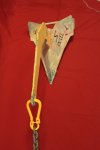
Spade anchors

I can well understand why the galvanising on anchor chain wears away. We see how a boat swings about at anchor, and we've probably all seen the pretty pattern left on the sand or mud by the movement of the chain.
What I'm not so sure about is why it is acceptable that the galvanising on an anchor deteriorates at a similar rate. We're all led to believe by the aficionados of modern fashionable anchors, that they set within their own length, and having set, don't budge. If that's the case, and therefore the lack of abrasion, why does the galvanising wear so much and so fast?
Because on Spade anchors the galvanising is badly done. It's clear from this post that my anchors is not the only one to have terrible galvanising
 
I can well understand why the galvanising on anchor chain wears away. We see how a boat swings about at anchor, and we've probably all seen the pretty pattern left on the sand or mud by the movement of the chain.
What I'm not so sure about is why it is acceptable that the galvanising on an anchor deteriorates at a similar rate. We're all led to believe by the aficionados of modern fashionable anchors, that they set within their own length, and having set, don't budge. If that's the case, and therefore the lack of abrasion, why does the galvanising wear so much and so fast?

Most of the anchor chain is 'simply' rubbing on the surface. The anchor is driven into an abrasive medium with some considerable force. If you want to sand rust off steel, say, then gently rubbing it with abrasive will, eventually, remove the rust - attacking the rust with considerable vigour will remove the rust more quickly. The chain on the surface is also being abraded by a movable abrasive, the sand is not held stationary (think of cleaning grease of your hands with fine sand) the anchor is buried in some less movable abrasive (think of cleaning you hands with abrasive paper).

Th idea that an anchor is actually stationary I cannot believe is correct - as the wind varies in direction the anchor will ,move - in a firm abrasive medium. As the wind builds the anchor will move forward, or backward?, I don't think this movment is necessarily easy to measure simply by looking from the surface.

The more shiny zinc you have on the surface of your galvanising, for a given galvanising thickness, the shorter the life. Galvanising is an alloying process - the alloys are harder than zinc. The longer you leave the object in the bath the more zinc you convert to alloy - but the more zinc you use the more money it costs the galvaniser (he needs to heat the bath for longer and he uses more zinc to convert to alloy). With HDG there is a limit to the amount of alloy you can make - try to make the galvanising too thick and it will flake off more easily when cold.

Vyv on his website has a neat test for chain to identify how well adhered is the alloy to the underlying steel. The alloy should not flake when the steel is bent.

The common galvanising specification is 70 or 80 microns (including the zinc). This specification, and galvanising itself, is focussed at protecting stationary objects, steel beams etc. Anchors and chain are simply piggy backing on a process ideal for stationary objects. We have an elevated platform for our car (we are perched on a very steep hill and the platform gives us somewhere flat). We are maybe 200m from the sea. The platform is marginally over 20 years old, galvanised and completely rust free - no abrasion, clean atmosphere. Leave raw steel exposed - you see rust in a week

The problem is you can galvanise steel with a coating of 20 microns or 100 microns - they look exactly the same. Guess which one will last longer in an abrasive environment.

In case anyone thinks TDG, aka Armrogalv is any different - the coating is all alloy but a thin coating will abrade quickly and expose the raw steel. The different processes have the same issues, unclean steel with not galvanise well, a thin coating will abrade more quickly than a thick coating.

TDG is more precise in terms of galvanising thickness - measure the surface area to be galvanised, know how much zinc dust converts to alloy and how thick an alloy layer is vs zinc used. Heat and when all the dust has been converted you know fairly precisely what thickness you have achieved. Its seems HDG is a bit more of an art (or less of a science) as the steel chemistry varies, the zinc bath chemistry varies, the temperatures of the bath are not necessarily well controlled, the time in the bath varies - but who cares....? Gal thickness for engineering products is less critical......

In the early days of Armrogalv here in Oz, PWB a local chain maker was persuaded to have tonnage quantities of chain coated. PWB have all their gal chain HDG coated by a 'sub-contractor' - International Galvanising. The chain was duly sold and within a short space of time complaints came rolling in. I was given about 6 random lengths of chain and measured the coating thickness at 20 microns. I documented this in a local article suggesting that there was inadequate quality control - PWB threatened me and the publisher with an expensive lawsuit. I pointed out my abrasion tests - PWB backed off (but have not spoken to me since). If there was a specification it was not achieved and PWB certainly had not conducted their own tests nor measured the gal thickness of the product they sold. It did make me think they might not measure the gal thickness using HDG - either. Since then PWB was bought by Kito - but we still don't talk to each other. It did raise, to me, some awkward questions - which (of course) have never been answered.

It is refreshing to hear that Viking Anchors are looking at galvanising other than Hot Dipped Galvanising. My experience suggests that if TDG is controlled it is better than HDG. However the finished product is a dull dark grey finish, unlike the shiny zinc of HDG. I will guarantee they will receive complaints of galvanising quality (in the same way people think anchors should be heavy and weight is more important than design) - old ideas die slowly - if at all!

Take care, stay safe

Jonathan
 
Last edited:
Most of the anchor chain is 'simply' rubbing on the surface. The anchor is driven into an abrasive medium with some considerable force. If you want to sand rust off steel, say, then gently rubbing it with abrasive will, eventually, remove the rust - attacking the rust with considerable vigour will remove the rust more quickly. The chain on the surface is also being abraded by a movable abrasive, the sand is not held stationary (think of cleaning grease of your hands with fine sand) the anchor is buried in some less movable abrasive (think of cleaning you hands with abrasive paper).

Th idea that an anchor is actually stationary I cannot believe is correct - as the wind varies in direction the anchor will ,move - in a firm abrasive medium. As the wind builds the anchor will move forward, or backward?, I don't think this movment is necessarily easy to measure simply by looking from the surface.

The more shiny zinc you have on the surface of your galvanising, for a given galvanising thickness, the shorter the life. Galvanising is an alloying process - the alloys are harder than zinc. The longer you leave the object in the bath the more zinc you convert to alloy - but the more zinc you use the more money it costs the galvaniser (he needs to heat the bath for longer and he uses more zinc to convert to alloy). With HDG there is a limit to the amount of alloy you can make - try to make the galvanising too thick and it will flake off more easily when cold.

Vyv on his website has a neat test for chain to identify how well adhered is the alloy to the underlying steel. The alloy should not flake when the steel is bent.

The common galvanising specification is 70 or 80 microns (including the zinc). This specification, and galvanising itself, is focussed at protecting stationary objects, steel beams etc. Anchors and chain are simply piggy backing on a process ideal for stationary objects. We have an elevated platform for our car (we are perched on a very steep hill and the platform gives us somewhere flat). We are maybe 200m from the sea. The platform is marginally over 20 years old, galvanised and completely rust free - no abrasion, clean atmosphere. Leave raw steel exposed - you see rust in a week

The problem is you can galvanise steel with a coating of 20 microns or 100 microns - they look exactly the same. Guess which one will last longer in an abrasive environment.

In case anyone thinks TDG, aka Armrogalv is any different - the coating is all alloy but a thin coating will abrade quickly and expose the raw steel. The different processes have the same issues, unclean steel with not galvanise well, a thin coating will abrade more quickly than a thick coating.

TDG is more precise in terms of galvanising thickness - measure the surface area to be galvanised, know how much zinc dust converts to alloy and how thick an alloy layer is vs zinc used. Heat and when all the dust has been converted you know fairly precisely what thickness you have achieved. Its seems HDG is a bit more of an art (or less of a science) as the steel chemistry varies, the zinc bath chemistry varies, the temperatures of the bath are not necessarily well controlled, the time in the bath varies - but who cares....? Gal thickness for engineering products is less critical......

In the early days of Armrogalv here in Oz, PWB a local chain maker was persuaded to have tonnage quantities of chain coated. PWB have all their gal chain HDG coated by a 'sub-contractor' - International Galvanising. The chain was duly sold and within a short space of time complaints came rolling in. I was given about 6 random lengths of chain and measured the coating thickness at 20 microns. I documented this in a local article suggesting that there was inadequate quality control - PWB threatened me and the publisher with an expensive lawsuit. I pointed out my abrasion tests - PWB backed off (but have not spoken to me since). If there was a specification it was not achieved and PWB certainly had not conducted their own tests nor measured the gal thickness of the product they sold. It did make me think they might not measure the gal thickness using HDG - either. Since then PWB was bought by Kito - but we still don't talk to each other. It did raise, to me, some awkward questions - which (of course) have never been answered.

It is refreshing to hear that Viking Anchors are looking at galvanising other than Hot Dipped Galvanising. My experience suggests that if TDG is controlled it is better than HDG. However the finished product is a dull dark grey finish, unlike the shiny zinc of HDG. I will guarantee they will receive complaints of galvanising quality (in the same way people think anchors should be heavy and weight is more important than design) - old ideas die slowly - if at all!

Take care, stay safe

Jonathan
So you don't have an answer. ?
 
Because on Spade anchors the galvanising is badly done. It's clear from this post that my anchors is not the only one to have terrible galvanising
Exactly. As with just about everything, there are good and bad ways of producing. Galvanizing is no different. The manufacturer wants to limit the amount of zinc he uses as it is nowadays quite expensive. After emerging from the bath the items are shaken or centrifuged to remove as much as possible. According to most standards the final thickness should be 80 microns plus but who knows whether this applies to anchors?

The sleeved joint is a particular problem, galvanised sheet stacks are highly susceptible to corrosion, forming white hydroxide deposits. The zinc is consumed very rapidly.
 
On the Morgan's Cloud - Attainable Adventure site the same topic came up last year. In the comments a few people mentioned some success with Zinga - a gloop that is painted on. Not a complete solution but helpful to slow things down. I bought some as it has, apparently, a very long shelf life but haven't tried it yet.
 
The galvanising is very poor and rusting is exacerbated by multiple sharp edges. The wear rate on the tip and edges must be very high. These areas are sometimes shiny when I retrieve the anchor and were obviously the first to start rusting. I regalvanised mine several years ago and it seems to be lasting well and I dont think the lead has much influence. The process of regalvanising has tended to round off some of the sharper edges which helps. Its a pity it was made two piece. Does anyone actually take theirs apart.
 
One reason to make anchors in pieces they are easier to store and cheaper to ship. Assembled anchors take up a lot of space and are difficult to pack. If you leave a Spade assembled you are then encouraging corrosion at the joint as the joint cannot be washed out and will stay salty damp for longer.

The one I had regalvanised had been welded, badly, together. If you were regalvaniasing I'd seriously look at welding into one piece - but weld to close all the gaps, top and bottom.

I have wondered how many people dismantle their Spade anchor - especially larger ones.

KAM

The lead seems to be about 10% of total weight and is focussed in the toe - if you had your Spade anchor regalvanised without the lead being removed - it will no longer be ballasted. It will not work as well as it should.


All anchors lose their galvanising at the toe and along the 'forward' leading edges - constant use of the anchor will remove any signs of rust. I took to painting my anchors with whatever 'brightish' and contrasting paint I had left over from 'whatever'. This is our steel No 4 Excel (now retired in favour of the identically sized aluminium version) and you can see how there is wear at the toe and on the flaps at the heel. (sorry the picture is a bit out of focus - it was taken for other reasons)
IMG_4707.jpeg

Jonathan
 
For a good friend (Vyv) and Jonathan,
I bought a new 20kg Spade which became v rusty around the joint, cleaned it up, heavily Zn sprayed it (5-7 coats?) then sold it to a friend and bought a second hand 25kg Spade. Also v rusty around the joint, prev owner had got fed up w Spade and the one I got from him had been a free replacement for his previous Spade which had gone rusty.

I sent Spade an email but never got a reply. My suspicion is that the galvaniser they use is operating with a small Ni % in the Zen bath which has the effect of stopping the growth of the Fe-Zn intermetallic layer. Customers would not know the difference. Still bright & shiny galv finish but it is a reduced Zn thickness. While Ni is an expensive additive 0.15% is worth spending if they can save on their Zn use.

We end up being victims of this.

The second hand 25 kg Spade that I bought still suffers from rust at the joint even though I heavily coated the Pb & joint with Zn spray and replaced the stainless Bolt with a galvanised bolt and added a generous coating of Duralac on the bolt for good measure. I rinse it w fresh water at the end of the season and re-spray (3x) . Note that the joint area is not subject to the same heavy wear and abrasion as the point of the anchor which is always inevitably a little rusty at the end of the season.
Andrew
"Genial Bee"
 
The sharp edges don't help. I had my Spade and Bruce regalvanised at the same time. The Bruce (genuine) has more rounded edges and is in much better condition than the Spade which is suffering again after several seasons use.
 
As another sailing metallurgist I would welcome Vyv Cox's comment.i have done millions of dollars worth of business as a zinc supplier to the galvanising industry so know some of their habits and customs. Correct, that zinc is a lot more expensive than it used to be so how do you make a product look nicely galvanised but use less zinc? The answer is to dope the zinc with a v small % of nickel. This results in a premature blocking of growth of the Zn-Fe intermetallic layer.
My suspicion is that this is what Spade's chosen galvaniser is doing. The final product looks nice & shiny like any normal galvanised product, except you would not know that the Zn layer is a lot less.

A pity bec I like the performance of the Spade. Mine is a 25 Kg on a 43ft/13 m boat but it rusts terribly such that I have to rub down the rust every two years and give it several coats of Zn spray, including inside the joint and having changed the stainless bolt to a galvanised bolt.

The only thing Spade seems to do to address the problem is to offer a new anchor, sometimes at 50% , sometimes free. Prblm is the replacement will also go rusty until they fix their galvanising.
 
This is an old thread, but the information is still valid.

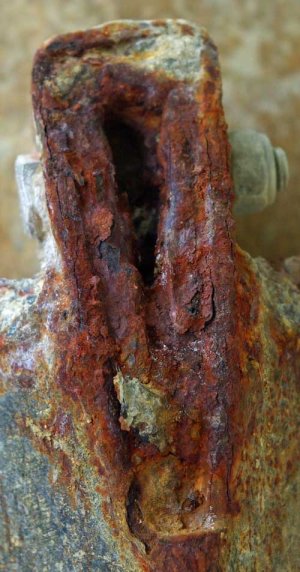
The steel Spade is an excellent anchor, but many full time cruisers report the durability of the galvanising is subpar. If you have one, be careful to inspect (and clean) the underside where the stock inserts into the fluke. This area can suffer significant corrosion when the rest of the anchor looks fine. This can only be seen turning over the anchor, so it is sometimes missed.

IMG_1165~photo.jpeg
 
About 10 years ago Spade seemed to be emerging as a real winner and they could be bought at very good prices in the Channel Isles. Like robmcg in post 18, I looked around marinas and saw that they were almost universally rusty and noticed criticisms on some US chat sites.

I decided not to invest, it may be, mainly, a cosmetic problem but the galvanizing is there to prevent it and nobody wants to be fussing with a tin of zinc paint after spending top dollar.

.
 
About 10 years ago Spade seemed to be emerging as a real winner and they could be bought at very good prices in the Channel Isles. Like robmcg in post 18, I looked around marinas and saw that they were almost universally rusty and noticed criticisms on some US chat sites.

I decided not to invest, it may be, mainly, a cosmetic problem but the galvanizing is there to prevent it and nobody wants to be fussing with a tin of zinc paint after spending top dollar.

.
If you are considering a Spade, look also at the Rocna Vulcan.
 
As another sailing metallurgist I would welcome Vyv Cox's comment.i have done millions of dollars worth of business as a zinc supplier to the galvanising industry so know some of their habits and customs. Correct, that zinc is a lot more expensive than it used to be so how do you make a product look nicely galvanised but use less zinc? The answer is to dope the zinc with a v small % of nickel. This results in a premature blocking of growth of the Zn-Fe intermetallic layer.
My suspicion is that this is what Spade's chosen galvaniser is doing. The final product looks nice & shiny like any normal galvanised product, except you would not know that the Zn layer is a lot less.

A pity bec I like the performance of the Spade. Mine is a 25 Kg on a 43ft/13 m boat but it rusts terribly such that I have to rub down the rust every two years and give it several coats of Zn spray, including inside the joint and having changed the stainless bolt to a galvanised bolt.

The only thing Spade seems to do to address the problem is to offer a new anchor, sometimes at 50% , sometimes free. Prblm is the replacement will also go rusty until they fix their galvanising.
I have a 30kg Spade. It went rusty within 12 months. We do hundreds of nights at anchor every year so the ground tackle gets a hard time.
I fitted my new Spade in 2021. In the last 12 months whilst back in the UK I had the Spade regalvanised. Yorkshire Spin Galvanising. It will be interesting to see how long it lasts with better galvanising than the original
 
I have a 30kg Spade. It went rusty within 12 months. We do hundreds of nights at anchor every year so the ground tackle gets a hard time.
I fitted my new Spade in 2021. In the last 12 months whilst back in the UK I had the Spade regalvanised. Yorkshire Spin Galvanising. It will be interesting to see how long it lasts with better galvanising than the original
A properly galvanised Spade sounds like a very good choice of anchor.

The only night our 25kg Rocna let us down, we were anchored next to a larger boat whose 20kg Spade held fast. Identical conditions, same scope. That was enough to convince me as to which design is better.
 
Galvanizing is a sacrificial coating on steel. While still there, it will oxidize in preference to the steel hosting the coating (the anchor). When the zinc is all gone, or nearly, the steel will start corroding. In and out of seawater is quite corrosive, without any other problems like electrolytic corrosion.
Abrasion only hastens the erosion of the coating, it will slowly disappear even without abrasion, just like on land, but faster due to the chloride in seawater.
While specs are often quoted as 80 microns thickness, most galvanizers struggle to get the coating that thin, and 100-120 microns is more typical on an anchor. Chain less thick. Thickness is only partially in the control of the galvanizers, there are about 4-5 factors that affect thickness. The steel chemistry is the primary influence and the galvanizer has no say in that.
 
A further problem is that the spade has many sharp edges. I had mine re galvanised a few years ago. It certainly looked a lot better than the original but it is now wearing and rusting along the sharp edges. I suspect the sharp edges are probably part of the reason it works so well.
 
Some of you might have noticed that I am a big fan of Spade anchors. I have been using them since 2004. They are an excellent holding anchor and they set very quickly in their own length. Here is the rub.
The galvanising is terrible. In 2020 we found ourselves back in the UK having been in and around the Caribbean since 2014 on this boat. Whilst I was home I decided to do something about my very rusty Spade anchor. After numerous calls and emails Spade very kindly offered to provide me with a new Spade at half price on the proviso that I cut the old one up and sent them a photo. I did this and a couple of weeks later took ownership of a shiny new Spade.
During our conversations with the UK suppliers we talked at length about the reason why my old Spade was a ball of rust. I spoke to my friend who is a metalagist and we agreed that the exposed lead and zinc coating of the anchor in seawater was likely contributory. We sent Spade evidence to this effect. We also said that I intended to pour epoxy into the top of the ballast chamber on the new anchor to encapsulate the lead and thereby isolate the lead from the galvanising. When mine turned up it had already been done. In fact all Spades now seem to have this epoxy addition.
In July 2021 we relaunched our boat and sailed from Lancaster to the isles of Scilly, then Falmouth, Bayona in Spain, Cascais, the Algarve, the Canaries then the Caribbean. Apart from a six week stay in a marina where we did a stint back in the UK for family reasons and an attempt at Portuguese residency, we have either been sailing or at anchor.
The new Spade anchor is rusty. It's not just at the pointy end but all over in locations that you wouldn't expect. More emails with the UK importers and they offered to give me another one at the cost of shipping to the UK and VAT. All in about £200. That then leaves me with problem if getting it to the boat in the Caribbean.
I tried to explain that they have an issue with their galvanising but they don't want to know. They suggest I have an electrolyse problem. By comparison, my anchor chain lasts about three to four years before it starts to show rust. That is being constantly rubbed across the seabed by the movement of the boat but still lasts at least three times as long as the galvanising on the Spade.
I have declined a new Spade anchor. It would cost me about £400 to ship it to Curacao. I could get a friend to bring one out for me but in 12 months I would be in the same situation with a rusty Spade. Until Spade can accept they have a problem and address the galvanising issue, I for one won't be buying another one even heavily discounted.
It might be time to try a Viking ..
I have been using Spades since they first came out in the 90's.

I've used probably every anchor devised by mankind and Spade is the best in terms of setting, and holding.

But my experience lines up exactly with yours -- the galvanizing is awful. It's not really a problem if you're living on board and anchoring continuously -- because the seabed scrubs the rust off. But otherwise -- it's awful.

My solution was to switch to the Turkish stainless copy of the Spade -- the Ultra.

My experience over a number of years now -- the Ultra is not quite as effective as the Spade. Why -- I don't know -- maybe some subtle difference in geometry? But it's effective enough for me, still better than any other anchor I've ever used besides the Spade.

And it is a beautiful, gleaming object, which gladdens the eye. And mud comes off of it 10x easier than with the much rougher galvanized surface.

On balance I'm very happy, and recommend.
 
I haven't seen a very rusty one but many you see have a rusty point. That happened on my 20kg one.
 
Top