
LadyInBed
Well-Known Member
This is mine. Note that the orientation of triangle at the base is the same as the orientation at the top.
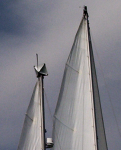


There's a strange lack of vertical planes in all those reflectors. I don't see anything that supports your argument at all TBH.Thank you LinB ....
Just to remind others and to show :
View attachment 89028
If people would stop and actually consider angles of reflection and how points up - some claim to be Rain catch - will affect reflected signal. The correct Rain Catcher as I show - you get either single plane reflection or dual plane reflection whichever orientation is at time signal hits .... its why its been a discussion item ever since they appeared .....
Have a look at Trinity House site : Navigation buoys
Take a look at the Reflectors bolted inside the lattice frame .. (not really needed given the metal structure usually ..... ) they are there ... Oh Look .... isn't that strange !
Here's a reflector on a Buoy - agreed it is not an Octo ... but more points ... similar though once mounted ...
EBM 10/12 - Beacon buoy by Mediterráneo Señales Marítimas, S.L.L. | NauticExpo
>>>>>>>>>>>>>>>>>>>>>>>>>>>>>>>>>>>>>>>>>>>>>>>>>>>>>>>>>>>>>>>>>>>>
As always - you are free to decide how and if you mount ... it does not really bother me ... I answered a query from another using a reflector that was sold with correct orientation installation ... not modified or changed by me ...
Yeh takes yer biscuit and eats or not ...

QINETIQ/D&TS/SEA/CR0704527/2.0Page 316Recommendations
'Based on the results of this report it is recommended that yachtsmen always fit a radar reflector that offers the largest RCS practicable for theirvessel.
The RCS of the radar reflector should have a minimum consistent RCS of 2m2.
The Sea-Me is the recommended product if power is available
If power is not available then the passive Large Tri-Lens reflector is recommended
The 4” tube reflector is not considered suitable due to its poor performance. It is also recommended that the 2” tube reflector is not suitable since theperformance of this target will be even lower.
It is recommended that poorly performing radar reflectors are not fitted as it is possible that the user could be lulled into a false sense of security believing that their chances of detection has been enhanced. '

@lw3895's point was that of the reflectors on every single buoy in the links you've provided (including the extensive range in Trinity House's video) not one has a vertical surface. None.Think you missed the point of angular reflection ...
You can draw it if so inclined ...
Lets say RF signal hits one plane and it reflects off at angle not returning to source .. but it hits second plane which because of the design now sends it back in direction of source .... try it ... get your school boy protractor out ..
View attachment 89035
Simple .... but put your flat panel version up and draw it .... tilt it - see what happens ...
Anyway - I've said my piece .. shown examples ....
And how does your simplistic ray tracing work in a regime where the reflecting surfaces are not much bigger than a wavelength?Think you missed the point of angular reflection ...
You can draw it if so inclined ...
Lets say RF signal hits one plane and it reflects off at angle not returning to source .. but it hits second plane which because of the design now sends it back in direction of source .... try it ... get your school boy protractor out ..
View attachment 89035
Simple .... but put your flat panel version up and draw it .... tilt it - see what happens ...
Anyway - I've said my piece .. shown examples ....
Oh dear. Once more. The pictures in the links you provided. None have any vertical surfaces. Your reflector in your opening post of your treatise on how to rig a reflector has vertical surfaces. Yours in not oriented in the same way as theirs. Yours will not hold any water when it rains.Vertical surface ?
Look again .... the orientation I am illustrating with the buoys and the mast rigged - is the V ..... go back and compare again ... whatever way you rig - you will have a vertical on our reflector ... but my illustrated rig creates similar V 's
Why would Trinity House etc. waste time mounting that way ? Its to create angular reflection what ever happens in the seaway.
As to protractor - so he should - but has it been used to confirm my comment about reflective angles ?

Oh dear. Once more. The pictures in the links you provided. None have any vertical surfaces. Your reflector in your opening post of your treatise on how to rig a reflector has vertical surfaces. Yours in not oriented in the same way as theirs. Yours will not hold any water when it rains.
Did you read the link to Qintiq's report? Do you understand that bouncing a beam from a three plane corner will always return it on the reciprocal, while a two plane will only return it on the reciprocal
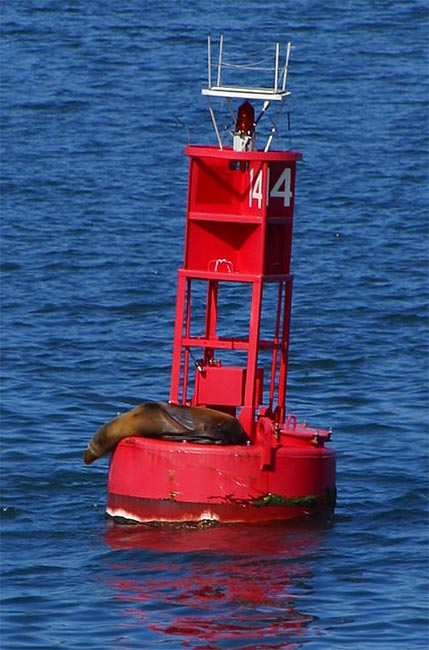
This one has got a seal of approval

The seal possibly doubles up as a foghorn?@lw3895's point was that of the reflectors on every single buoy in the links you've provided (including the extensive range in Trinity House's video) not one has a vertical surface. None.
So more of a question as to why you provided links that don't back up the point you're making.
I also think that he knows his way round grown up protractors.
I found some American ones that do support you.

In most circumstances the octohedral reflector does pretty well. The difference in orientations is mostly about eliminating or minimising the nulls in the return. The advantage of the catch rain position over the double catch rain is that with the reflector upright there are always at least 2 corner reflectors returning a signal at any orientation whereas in your suggested orientation there are likely to be bigger nulls when one of the corners is pointing (almost) directly towards the signal.Thank you LinB ....
As always - you are free to decide how and if you mount ... it does not really bother me ... I answered a query from another using a reflector that was sold with correct orientation installation ... not modified or changed by me ...
Yeh takes yer biscuit and eats or not ...

Well done girls .....
Hang it from three equal length lines tied together at one end and attached to the new holes in the picture. You can do the same on the opposite (bottom) side and run it up to a spreader.How you string it up to remain so is the tricky part.
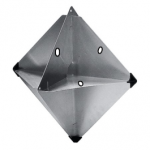
Hang it from three equal length lines tied together at one end and attached to the new holes in the picture. You can do the same on the opposite (bottom) side and run it up to a spreader.
View attachment 89094


