
Some weather tutorials..

Plus a question - why does the pressure often peak about half ten in the morning?
(no clouds round here :) )

DR9giMD.png
 

Looks like it, thanks! Amazing how a tiny little chip for a couple of quid can pick up such fine detail. :cool:

, the phenomenon is known as "atmospheric tides", and although at first glance they seem similar to oceanic tides (2 highs and two lows per day), they are actually quite different.

The moon only has a minor effect on the atmosphere - about 0.9 hPa at the equator, decreasing towards higher latitudes. The atmospheric tide we observe is mostly the result of the diurnal heating and cooling of the atmosphere, and the gravitational effect of the sun. In this case, the sun is more important gravitationally than the moon because its effects are "in sinc" with the diurnal heating cycle.

The atmospheric tide generally has its maximum amplitude at the equator - varying by about 4 to 5 hPa over a day - and decreases with latitude. It has about half the amplitude at 30 degrees latitude. As it depends critically on solar insolation, the variation is greatest on cloud-free days in summer, and is reduced in cloudy conditions.

Its effects have to be taken into account and corrected for when calculating surface pressure falls/rises (unless you are looking at 24 hour changes of course), and in QNH forecasts for aviation.

This is one phenomena that is not backwards in the northern hemisphere!
http://forum.weatherzone.com.au/ubbthreads.php/topics/623576/Barometric_tides
 
So anyone dig useful info from the 500mB charts? I'll look at least once a day but only really as a quick glance for what's likely to happen in the next week or so, if the 5640m height line for 500mB is pointing at scotland consistently then it's very likely to be sunny all the way down at 37N. With the lows tracking 300 - 500Nm north of that line. But that could be obvious scrolling through the MSLP as wll, the 500mB are just an instant few seconds overview of what's likely. Must be more to be learned further up the atmosphere, unread as yet link - https://vos.noaa.gov/MWL/dec_08/milibar_chart.shtml
Lots models here . http://mag.ncep.noaa.gov/model-guidance-model-area.php

So how do others get useful info from the 500mB which can't be found on gribs/surface synoptics?
 
Last edited:
Nobody ever even look at the 500Mb charts then? Where's Frank gone when you need him :)

Best guess at being more useful than synoptics/GFS so far is looking here>
http://mag.ncep.noaa.gov/model-guidance-model-area.php
Then selecting europe, GEFS-SPAG and 500 510 552 ht.
Today seems to start to fall apart round about 3rd Jan but seems to be pointing to Scotland or above until 18:00 on the 5th. So I predict (guess ;) ) that the depressions will track mainly above Scotland for the next week. With further south being quite nice for a week, winter nice anyway.
Anyone else want to do a weeks forecast? Always very hard to quantify how well you've done with actual data, maybe tracking lows with 500Mb charts is a better way to approach longer range.


Which is what the GFS & ECMWF MSLP models say anyway, but without any comparing of different model runs. Another nice site > http://wxcharts.eu/?panel=default&m...plottype=10&lat=37.144&lon=-7.723&skewtstep=0
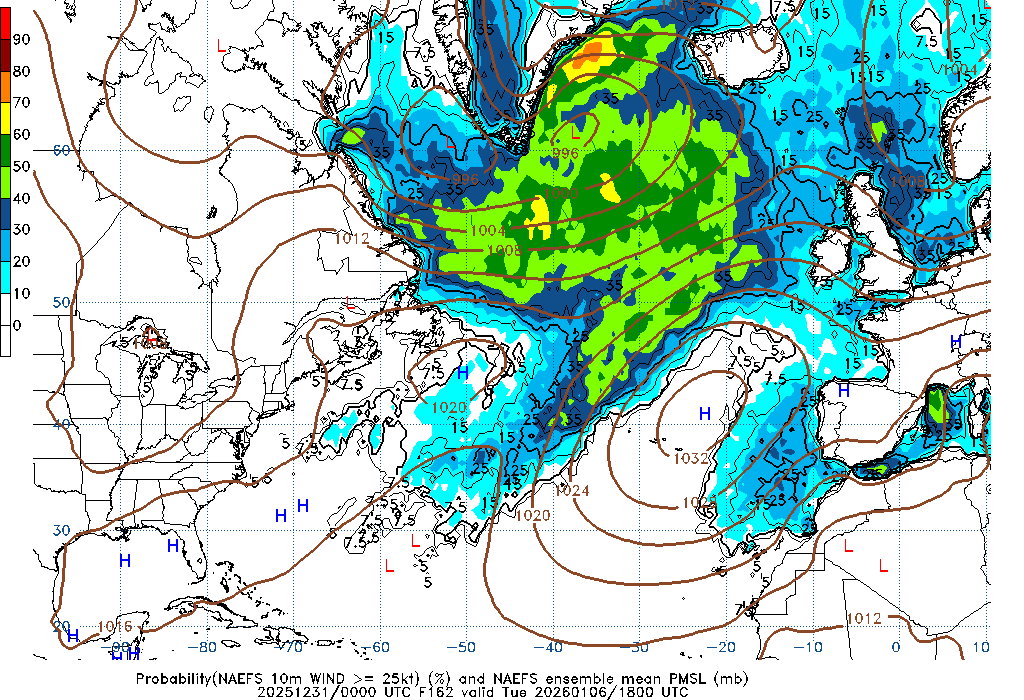
Probabilistic wind speed looks similar -
https://ocean.weather.gov/prob_guidance.php?model=naefs&basin=atl&cycle=00&plot=25&loop=1

naefs_00_atl_f162_25.gif
 
Last edited:
Nobody ever even look at the 500Mb charts then? Where's Frank gone when you need him :)

Best guess at being more useful than synoptics/GFS so far is looking here>
http://mag.ncep.noaa.gov/model-guidance-model-area.php
Then selecting europe, GEFS-SPAG and 500 510 552 ht.
Today seems to start to fall apart round about 3rd Jan but seems to be pointing to Scotland or above until 18:00 on the 5th. So I predict (guess ;) ) that the depressions will track mainly above Scotland for the next week. With further south being quite nice for a week, winter nice anyway.

Well that seems to have come to be, and looking reliable at least up until the 9/1/19 - so GEFS could well be worth a bookmark in your weather folder, or maybe it was just luck ;)


NftFrOD.png
 
Top