Solar panels,

Seastoke

Well-Known Member
Joined
20 Sep 2011
Messages
13,374
Visit site
Amate is on a mooring on the Dart ,so he has 2 ,110 ah batteries linked together,now a supplier says he can two solar panels one each for each battery, through each individual controller ,how can this work when they are linked
 
? There must be more to the story. I have a single 200W panel for 3 x 140Ah house batteries but a separate 30W to keep the starter batteries topped up. Maybe there was some confusion in the dialogue with the vendor?
 
When you say they are linked, do you mean the negative terminals are linked for a common return, or positive terminals are also linked, putting the batteries in parallel? Normally 2 batteries would go via a '1-2-both-off' switch I would expect.
I am assuming they are common return linked which is why it was suggested for 2 separate panels, though if the batteries are then connected in parallel (switch is in 'both' position) then both panels would be charging both batteries.
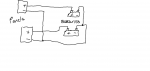
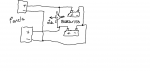
Please see my 2 very dodgy drawings to understand my theory a bit better!
 

Attachments

  • sp-batt.png
    sp-batt.png
    18 KB · Views: 0
  • sp-bat1.png
    sp-bat1.png
    21 KB · Views: 0
When you say they are linked, do you mean the negative terminals are linked for a common return, or positive terminals are also linked, putting the batteries in parallel? Normally 2 batteries would go via a '1-2-both-off' switch I would expect.
I am assuming they are common return linked which is why it was suggested for 2 separate panels, though if the batteries are then connected in parallel (switch is in 'both' position) then both panels would be charging both batteries.
Please see my 2 very dodgy drawings to understand my theory a bit better!

They are in parallel no switch
 
Yes. If he doesn't have a single large space or aesthetics for 1 panel you can create a solar panel bank. My setup will accommodate a bank of 4 which is actually the recommendation for my 3 house batteries in parallel. Aesthetically I can only carry one large panel as opposed to 4 smaller ones. Why this recommendation the book of words did not specify.
 
Say one is fully charged one is half wont the full battery tell the charge controller s that they are both full and switch off
 
Say one is fully charged one is half wont the full battery tell the charge controller s that they are both full and switch off

If they are wired in parallel then current would flow from the charged battery into the part charged battery until there is equilibrium.
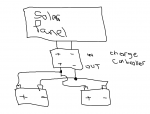
In this configuration they are both permanently wired, no switch in between them, so the current from the charge controller would divide between the 2 batteries.parallel batteries.png
 
Last edited:
If they are wired in parallel then current would flow from the charged battery into the part charged battery until there is equilibrium.
In this configuration they are both permanently wired, no switch in between them, so the current from the charge controller would divide between the 2 batteries.View attachment 76745

But won’t one charger say putting 13.5 volts .in ,will the other assume that they are fully charged
 
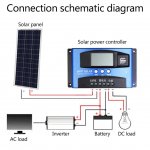
I would imagine you use only 1 charge controller. Wire the panels in parallel (assuming they are 12v panels) and into the charge controller. The one output will feed both batteries. The battery charge will equalise due to being in parallel and the current will split between them.
 
I would imagine you use only 1 charge controller. Wire the panels in parallel (assuming they are 12v panels) and into the charge controller. The one output will feed both batteries. The battery charge will equalise due to being in parallel and the current will split between them.

correct. My controller will only take 20 Amp max. Hence I could not as above put on 4 x 200W panels but would have to scale down accordingly so the entire array of 4 did not exceed the controller's capacity.
 
correct. My controller will only take 20 Amp max. Hence I could not as above put on 4 x 200W panels but would have to scale down accordingly so the entire array of 4 did not exceed the controller's capacity.
s-l1600.jpgs-l1600 (1).jpg
£15 off ebay!
I have the 20Amp version...
 
My MPPT controller set me back 10 times that price! Thats what you get for buying German and not Chinese :disgust:
 
I bought a Victron MPPT controlled for my 600w solar bank.
Victron aren't the cheapest but they do have a huge range to choose from.

Back to the OPs question.
If the batteries are connected together - either series or parallel, I should think that a sindle array of solar panels connected with a single solar controller would be best.
If using a Victron MPPT, remember that the voltage on the solar panels needs to be 5v above the battery voltage before the controller switches on. This might mean connecting solar panels in series. There are pros and cons though. Panels connected in series means lower current so smaller wires or less loss in the cables. But shades solar panels could block the electric flow for panels in sunlight. Good quality solar panels often incorporate diodes (bypass diodes and blocking diodes) to resolve this issue. Panels connected in parallel don't have this problem but IMO, you would still need some protection on the panels if one should go short circuit. Series or parallel is a complex subject but generally, people go for solar panels in series - I did.

Back to the main question.
I believe you can simply add banks of controllers in parallel across the batteries - always fit fuses or MCBs though.
 
remember that the voltage on the solar panels needs to be 5v above the battery voltage before the controller switches on. This might mean connecting solar panels in series. .

exactly,
probably that is the reason why OP's vendor mentioned 2 solar pannels, (in combination with MPPT)
because when having a higher series voltage, on average, you are much more time above boat voltage (12V?)
so you will get more solar power from the panels

Victron MPPT (designed in Holland, not Germany) is high quality equipment, and the only good choice for solar panels on boats,
not at all compareable with cheap chinese stuff
 
exactly,
probably that is the reason why OP's vendor mentioned 2 solar pannels, (in combination with MPPT)
because when having a higher series voltage, on average, you are much more time above boat voltage (12V?)
so you will get more solar power from the panels

Victron MPPT (designed in Holland, not Germany) is high quality equipment, and the only good choice for solar panels on boats,
not at all compareable with cheap chinese stuff

Up until last summer I was living in Malta and working for the largest Marine Electronics company on the Island. We saw a lot of Victron equipment failing due to the fact that they had absolutely no protection against moisture and the PCBs were getting wet (water ingress or condensation) and blowing up the unit! Maybe later models are better protected but I am far happier with my £10 Chinese solar controller than I would be with one of the Vicrtons. At least if I blow it up it will not cost a small fortune to replace!
Back to the original post - if you put the panels in series, thereby increasing the voltage, would the controller not require a large heatsink as I assume it is a linear regulator on the output, or is it akin to a SMPSU where the input is chopped, goes across a transformer and gives a stable (12v or so) output at a higher current?
 
Top