Solar panels. In series or parallel?

Denek

Well-Known Member
Joined
12 Jan 2013
Messages
321
Location
Thurleigh bedfordshire
Visit site
Thinking of adding another panel to my boat. I have one already. ( don’t have specs to hand) if I want to add another or indeed several Q 1 do they all need to be identical and Q2 should they be wired in series or in parallel ? I think it should be the latter but thought I would ask.

i already have a regulator which was purchased with the original panel. Again I don't have the specs to hand but would I need to upgrade this do you think.

thanks
 
Without the specs of your current regulator and the panel you already have, I'm afraid that it's almost impossible to give a meaningful answer.

In general, if none of the panels are in shade, then series connection is best, provided your regulator can handle the voltage.

Richard
 
Mine are in series and work fine ... I've got all the wiring to try parallel but haven't got round to it yet.

I have noticed one interesting thing about having them in series - you can tell immediately by the voltage if a panel is fooked .... I have 3 panels and he max voltage logged each day is around 64 volts ... when a panel fails it is obvious as the max voltage drops by 1/3.

In parallel it's the current that drops, but that can drop due to clouds, shadows etc. so it's not as obvious that a panel has died.
 
Thanks for this information.
so they do not all need to be the same specification from the sound of it. Pardon my ignorance but if wired in series as I understand it the voltage increases and if in parallel it’s the Amps so Say 4 panels in parallel each 5 amp you get 12 v 20 amp but in series you would get 5 amps but 48 v what is the advantage of each? Assuming your batteries are 12 v where does the extra go. Like I say pardon my ignorance.
 
Thanks for this information.
so they do not all need to be the same specification from the sound of it. Pardon my ignorance but if wired in series as I understand it the voltage increases and if in parallel it’s the Amps so Say 4 panels in parallel each 5 amp you get 12 v 20 amp but in series you would get 5 amps but 48 v what is the advantage of each? Assuming your batteries are 12 v where does the extra go. Like I say pardon my ignorance.

Denek

You might like to have a look at te link below as it explains all about solar panels in simple terms.

Most larger solar panel systems are swinging over to 24V these days. Because mine is a ketch I plan to mount two panels in series over the transom as my system is 24V.

I believe these days there are panels where shadows are not so much of a problem but at this stage they are more expensive. (Maybe I'll mount a couple of those under the mizzen as well)
RAINBOW POWER COMPANY
12 Volt, 24 Volt or 48 Volt | Limitations & Solutions
 
Last edited:
i think what the OP is asking ( as as what i would also like to know ) is what are the practical differences ,, what can one do and not do and vice versa ,, practical examples ..
 
Thanks for this information.
so they do not all need to be the same specification from the sound of it. Pardon my ignorance but if wired in series as I understand it the voltage increases and if in parallel it’s the Amps so Say 4 panels in parallel each 5 amp you get 12 v 20 amp but in series you would get 5 amps but 48 v what is the advantage of each? Assuming your batteries are 12 v where does the extra go. Like I say pardon my ignorance.
In simple terms, the losses through any cable are related to the amperage that the cable has to carry. Cables carrying high voltages can be very thin, like the HT cables in your car which carry tens of thousands of volts whereas cables carrying high currents, like the cable to your electric oven, which only carries 30 amps, need to be very thick.

Provided that your regulator can carry the high voltage and use it efficiently, which is where MPPT controllers have advantages, with normal cables you will get more of the power produced at the panels actually through to the batteries because of the lower transmission losses.

Richard
 
But if one panel is partly shaded, or they are mismatched in power in some other way, then parallel may be more efficient.

It may be better to optimise efficiency early and late in the day rather than when you likely have more power than you know what to do with at noon.
 
One thing not pointed is that panels in parallel need to be the same voltage but can be of different wattages.

Panels in series must be the same current specification but can be different voltages.

To explain this you can put a 24vdc panel in series with a 12 vdc panel to get 36 vdc but the current flow needs to be the same for maximum output.

This is the same effect as one panel in a series arrangement being permanently in the shade.
 
But if one panel is partly shaded, or they are mismatched in power in some other way, then parallel may be more efficient.

It may be better to optimise efficiency early and late in the day rather than when you likely have more power than you know what to do with at noon.

I am trying to understand the physics f solar cells

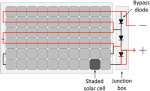
Apparently the latest solar cells have diodes between cells so that current can't flow from unshaded cells to shaded cells.
Would what you are saying still apply?
 
One more small point is that at low light levels panels in series will produce a charging current where parallel panels won't.
To charge, the input voltage needs to be higher than the battery voltage. Two in series @ 7v gives 14v so will charge but in parallel gives 7v which won't.
 
I am trying to understand the physics f solar cells

Apparently the latest solar cells have diodes between cells so that current can't flow from unshaded cells to shaded cells.
Would what you are saying still apply?

This excellent prsentation appears to be relevant to my query.

I'm going to have a look at it tomorrow morning (It's getting late here)

Bypass Diodes | PVEducation
 
One more small point is that at low light levels panels in series will produce a charging current where parallel panels won't.
To charge, the input voltage needs to be higher than the battery voltage. Two in series @ 7v gives 14v so will charge but in parallel gives 7v which won't.
Doubt it - have you tried it? With a 36 cell panel it takes little light light to get the voltage 5v above the battery voltage to turn on a victron regulator, it will charge but milliamps.
 
Apparently it would be too costly to have one diode per cell so they have one per string of cells

This does however mean that one shaded cell can reduce the power of a conventional module by one third (60/72 cells, three BPDs). In the absence of BPDs, the power loss could be even greater.


1596198766430.png

From a shade resilience point of view, it would be better to incorporate more BPDs because smaller strings will be bypassed in the case of partial shading

Photovoltaics in the shade: one bypass diode per solar cell revisited
 
A recent issue of PBO carried a comprehensive article on this subject. One of the points extolled the virtues of having a small number (say 4) of small panels arranged in such a way that there were two sets of panels in series, connected together in parallel , with diodes protecting the series sets.
 
In simple terms, the losses through any cable are related to the amperage that the cable has to carry. Cables carrying high voltages can be very thin, like the HT cables in your car which carry tens of thousands of volts whereas cables carrying high currents, like the cable to your electric oven, which only carries 30 amps, need to be very thick.

Provided that your regulator can carry the high voltage and use it efficiently, which is where MPPT controllers have advantages, with normal cables you will get more of the power produced at the panels actually through to the batteries because of the lower transmission losses.

Richard
yes,, and ,, what are the practical advantages in either system ???
 
Top