Solar panel for battery maintenance charge

Norman_E

Well-Known Member
Joined
15 Mar 2005
Messages
25,017
Location
East Sussex.
Visit site
How many watts solar panel output do you need to maintain a healthy charge level. If anyone has the correct figure per 100 amp hours battery capacity it would help me decide whether to go down the solar panel route to maintain battery levels when the boat is left. I do have pretty well guaranteed sunshine but also high temperatures, and a total battery bank of about 480 amp hours.
 
10W would give 0.5A (not the 0.8 expected as voltage is high). 0.5A X 4 hours daily = 2Ah that is 60Ah monthly. I think that it is charging power. Just for maintenance I would suggest half of it or less. All IMHO.
 
Glyka might be pretty right on the solar power you need to just maintain the battery. Against natural discharge. Certainly with 480 AH of battery, provided you charged all batteries 10 or 20 watts without a regulator would give you some usefull charge.
The actual panel you buy depends on what physical size you can cope with and how much money you feel like lashing out.

On a small boat a large panel is a real pain to mount in a way that looks OK and doesn't get damaged.

I have settled after many years (and panels) on attaching bunge and mounting the panel on top of the boom cover so it is always put away before sailing. I use flying leads to plug and socket just inside the cabin. Previous panels were mounted on the front hatch cover and typically got a boot in the middle to smash the panel.

My solar power is 5 watts to a 14AH NiCad battery as the only power source. OK for radios and occasional short night sails. Oz summer. But you should get the biggest you can fit and afford. (price is prety much proportional to capacity) good luck olewill
 
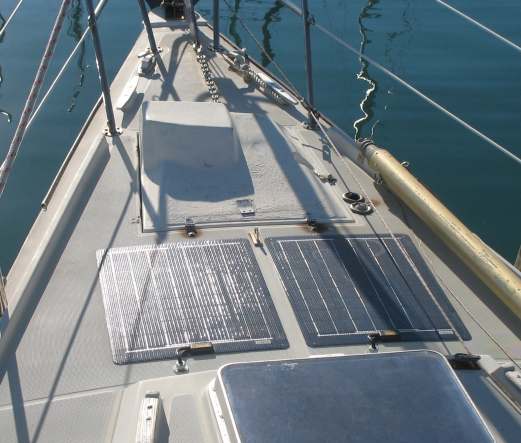
Solara1.jpg

These are my solara SM120 that give 1.7A peak current each.

In spite of frequent partial shadowing, 3A is what I usually get from both. Average daily charge is about 20-25 Ah (summer).
 
[ QUOTE ]
Isn't there somewhere else you could put them , the partial shadows seem pretty big to me

[/ QUOTE ]
SWMBO vetoed /forums/images/graemlins/smile.gif

OTOH I really liked this position, no shadow when the sun tent is in place, no overstructure and the output is satisfactory without compromising appearance and racing performance!!!

Note that the most significant shadow comes from the forestay-roller and it's there when the sun is really high (11:30 - 12:30) and the ambient light is quite strong.
 
ambient certainly helps where you are , but over here the rigging cutting over the panel would be enough to sometimes cut the charge rate by fifty percent most of the time
 
An interesting thing that I 've noticed and that I have to check again is this:

Now (winter) that the sun is low even here, an hour or so before the sun sets, with a clear sky I get 0.2A and with a clouded sky (a thin layer covering all of it) I get 0.8 - 1A !!!

I think that this may be possible as with a clear sky the rays come at such an angle that they are very weak whereas light diffusion that occurs at the thin cloud layer causes a good percent of the light to come vertically!

Anyway, I noticed it just yesterday but I will try to doubleckeck it although it won't be easy as after 40 continuous days (unusual this time of the year) of sunshine in Athens, winter is probably coming and clouds are present all the time since Monday.
 
might be worth trying the panels in an area that has absolutely no rigging shadows , although I know it's not easy to find such an area , but seriously , any shadows will cut down performance by megga loads , even one line , might be worth begging permission from she who holds the ' looks ' card to allow a few experiments for the sake of performance
 
It's too late now, they're installed (glued) cables are in place, and all.

But really, when with a theoretical maximum of 3.4A I get 3.0A most of the time, I'm very satisfied. In fact I would recommend this place to anyone that would like to have some help in charging without going into big trouble. Don't forget that here in Greece, during the summer anything aft the mast is covered by some kind of tent.
 
fair enough , glue tends to make it a bit of a sticky situation , makes me wonder why they haven't come up with sails that have the photo electric cells built in though , the suns only at its peak for a few hours a day so most of the time it's at an angle
 
I leave my boat on moorings for about 2 weeks at a time, I do not have heavy drain appliances( fridge,heater,etc) just the usual cabin lights(5) and VHF,Raymarine suite of ST60's. The engine is used only to get on and off the trot moorings-10 mins max at each end of a day is typical. Also I have a low drain alarm system which is on-guard constantly when I am absent and which sends me text messages occasionally to reassure me that all is well- drain about 0.50ma.Even if the alarm is accidentally tripped the additional drain from the 3 minute siren hasn't presented an electrical shortfall

I have two 100Ah sealed batteries which are topped up by a 30W semi-flexible solar panel feeding through a charge regulator, which when the engine battery is full switches over to the domestic battery.

This arrangement has worked well in it's first season with both batteries showing a charge of 13V + when I return aboard.

Hope this helps
 
Agree with Wizard's value.

I have tried a 10w flexible panel horizontal on a window sill (house), north facing window, winter. i.e. not the optimum position.

This will overgharge a 7AH battery in a few days.
Also, fully charge a 65h battery
Maintain the charge on a 110ah battery (which has passed its best.)
All these with no drain on the battery.

Not yet tried on boat, but suggest that one may well maintain a good condition 65Ah battery, with the solar panel placed inside the cabin, below a transparent hatch.
 
Norman, I see your boat is in Turkey. When my boat was in Greece I found a 10wt panel was plenty to maintain charge on a 110AH battery over the winter. In fact I used to disconnect it in the spring and only reconnect at the start of the summer hols. In the summer I have several more larger panels necessary for the fridge autopilot radio windlass etc.
Now the boat's in north Italy and the parrallel battery pair is up to 210AH the 10wt panel is about right for maintenance.
 
Thanks to everybody for all the input. It looks like I should really buy more than one panel, but I think I will try to get about 40 watts with a regulator as that size seems to be enough to maintain sufficient charge whilst I am away, without being too big. If voltage drops to about 12 volts I will not be concerned, the only real objective is to keep the batteries above say 11.5 volts, after leaving the boat with them fully charged.
 
not sure if your 13+ volts when you return on board is a good indication of battery state because the solar panel is still connected and will be giving 13+ volts. I think you need to disconnect the solar panel and switch on a couple of lights for 5 or so mins then measure the voltage with everthing turned off. I am sure some folks will disagree.
 
Not sure how much difference the heat makes - I used an old 15 watt panel (seemed to max out at about 100 mA) to maintain fully charged batteries during last winter lay up and they cranked the diesel first try in the spring.
 
Norman with 480AH of battery and 40 watt panel I wouldn't fit a regulator. There is no way you could damage the batteries with 40 watts provided all were charged.
The simplest way to charge all the batteries if they are isolated from one another is to fit additional diodes one to each battery.
These are cheap from RS Maplin etc. get into the junction box of the panel and you will find a diode in the +ve wire. it has the anode connected to the panel the cathode (with a band marked at that end) goes to your +ve lead to the battery. Attach another similar diode in the same way anode to the panel cathode to another wire to the next battery bank and another diode for another isolated battery bank.
I hope your panel is simillar to all the ones I have seen. if you can't get into a junction box then just add diodes one for each battery bank connected anode to the solar panel +ve wire.
good luck but I found panels on the fore deck got damaged easily.
olewill
 
Top