Snubber length and size vs size of yacht (length/weight) and mixed rode experiences

think the general opinion is that is must not be too thick or else it defeats its purpose.
Not really: rope construction, material, age, etc play a big role in elasticity characteristics.
Newish rope is a lot more elastic at low % of breaking strain than at high % (elongation curve is S-shaped) so the bigger you use the more % elasticity you have; then new rope eventually becomes old, a different thing, plus there is 3_strand vs octoplait, polyamide vs polyester, etc etc all contributing factors. Take a few different types and see what happens in real world use, no need of a hurricane, elasticity difference is often 1.5-2x so rather visible. :)
 
Not really: rope construction, material, age, etc play a big role in elasticity characteristics.
Newish rope is a lot more elastic at low % of breaking strain than at high % (elongation curve is S-shaped) so the bigger you use the more % elasticity you have; then new rope eventually becomes old, a different thing, plus there is 3_strand vs octoplait, polyamide vs polyester, etc etc all contributing factors. Take a few different types and see what happens in real world use, no need of a hurricane, elasticity difference is often 1.5-2x so rather visible. :)

We use dynamic climbing rope as a snubber simply because it is specifically 'designed' for repeated snatch loads. It is nylon, so enjoys the elasticity of nylon but it has a braided outer cover that offers some protection for the core (so its the same nylon as 3 ply - but different). Dynamic climbing rope is not made to a strength specification (that is not relevant for climbing rope) - though the bigger the rope the stronger it is (obviously). The other attraction is that it could be sourced free so it had 2 characteristics that could not be ignored.

Snubbers are consumables, as Roberto points out. We have always carried spares (which can be used as dock or shore lines if necessary)

Jonathan
 
We have 80m of 10mm chain and only 1 bow roller. I use a bridle (so the snubber doesn't have to share the same roller) of 14mm anchor plait and a 3/8 ... 10mm chain hook.
Each leg of the bridle has a loop spliced into it and I simple put those over the forward mooring cleats and then through a fairleads. The anchor plait is protected by "layflat hose" as it goes through the fairleads.
The bridle is about 8m long (each leg) and at the chain hook end the anchor plait is secured around a SS thimble, and held by stitching through the anchorplait and then whipped.
The boat is 14m and fully loaded is about 16 tons. We've anchored like this in remote sheltered Scottish West Coast Lochs with the wind gusting at over 40 knots and the boat shearing around, partly due to the wind gusting off the land, and partly due to the very narrow lifting keel, which doesn't have much lateral resistance.
This arrangement has lasted well for around 6 years with about 100 days at anchor per year.
You can really see the nylon anchor plait stretch when I set the anchor, by going slow astern.
Nylon will stretch to around plus 60% of it original length before it breaks, which makes it ideal for use as a snubber.
 
What I have and what I would choose if starting from scratch are two different things.

42 foot boat that wanders 60 degrees either side of the anchor sometimes with max force when it changes direction. We have anchored most nights when cruising over the last 10 years but less so in our curent cruising ground. Often in 40 plus gusts and once saw a 60 plus but only a couple of times had waves (rather than swell) coming into the anchorage.

What we have is 60m of 10mm galvanised chain shackled to 60m of 12mm nylon 3-strand (although I haven’t used the warp since adding it 4 years ago). Our snubber is also 12mm nylon 8m long with a thick rubber dogbone that increases in length about 70cm . It is attached to a chain hook (which I always prefer to something captive) with about 2-3 metres from bow cleat but if very windy forecast I’d let out the full 8m.
 
What I have and what I would choose if starting from scratch are two different things.

42 foot boat that wanders 60 degrees either side of the anchor sometimes with max force when it changes direction. We have anchored most nights when cruising over the last 10 years but less so in our curent cruising ground. Often in 40 plus gusts and once saw a 60 plus but only a couple of times had waves (rather than swell) coming into the anchorage.

What we have is 60m of 10mm galvanised chain shackled to 60m of 12mm nylon 3-strand (although I haven’t used the warp since adding it 4 years ago). Our snubber is also 12mm nylon 8m long with a thick rubber dogbone that increases in length about 70cm . It is attached to a chain hook (which I always prefer to something captive) with about 2-3 metres from bow cleat but if very windy forecast I’d let out the full 8m.
Rupert,

What you describe sounds like classic (and sometimes destructive) veering. Have you thought of rigging a bridle, there are ideas in some of the posts - but from the amidship cleats and through the bow fairleads (with suitable abrasion covers).

The bridle might help to tame the veering and keeping the bridle short beyond the fairleads will maximise the separation of each arm - if its a long narrowg 'V' it will act more 'like' a single snubber.

Jonathan
 
We have 80m of 10mm chain and only 1 bow roller. I use a bridle (so the snubber doesn't have to share the same roller) of 14mm anchor plait and a 3/8 ... 10mm chain hook.
Each leg of the bridle has a loop spliced into it and I simple put those over the forward mooring cleats and then through a fairleads. The anchor plait is protected by "layflat hose" as it goes through the fairleads.
The bridle is about 8m long (each leg) and at the chain hook end the anchor plait is secured around a SS thimble, and held by stitching through the anchorplait and then whipped.
The boat is 14m and fully loaded is about 16 tons. We've anchored like this in remote sheltered Scottish West Coast Lochs with the wind gusting at over 40 knots and the boat shearing around, partly due to the wind gusting off the land, and partly due to the very narrow lifting keel, which doesn't have much lateral resistance.
This arrangement has lasted well for around 6 years with about 100 days at anchor per year.
You can really see the nylon anchor plait stretch when I set the anchor, by going slow astern.
Nylon will stretch to around plus 60% of it original length before it breaks, which makes it ideal for use as a snubber.
Your fixed length bridle does have a potential flaw. We normally choose to anchor in around 5 metres. An 8 metre snubber might well allow the hook to touch the seabed, which is the only circumstance in which a chain hook can release itself.
 
Rupert,

What you describe sounds like classic (and sometimes destructive) veering. Have you thought of rigging a bridle, there are ideas in some of the posts - but from the amidship cleats and through the bow fairleads (with suitable abrasion covers).

The bridle might help to tame the veering and keeping the bridle short beyond the fairleads will maximise the separation of each arm - if its a long narrowg 'V' it will act more 'like' a single snubber.

Jonathan

I agree it is an issue - never caused any dragging even in strong gusts. I have experimented with long bridles to no noticeable effect. The most success has been an asymmetrical bridle from chain to one mid ships cleat as this reduces the veer on on side . I’ve also had some success with rigging a bed sheet as a big dodger on one side of the cockpit and fron that experiment I’m thinking of a riding sail. No luck at all with a bucket on a short lead from bow or stern but this season will try my metre wide drogue.
 
If my boat sheered 60° to each side, I would definitely be looking into the possibilities of a riding sail. I have one, but as a ketch, with significant windage aft, I find that she doesn't sheer about that much. My riding sail is double, has slides for the mizzen mast, and the two clews are each sheeted out to the bulwark rail at the quarters. I also have a light tubular spreader (boathook) between the two clews. I am surprised that more boats, particularly of the lighter and shallow variety, don't use riding sails.
 
Veering! The best way that I have found to cut down 'sometimes destructive veering' is by using the Hammerlock Moor. My main anchor is a 30kg Spade so for the Hammelock I use the back up stowed away 25kg Spade. So if you are in 8m of water (add 1 m water to bow roller and 1 extra meter) your Hammerlock anchor is now on a 10m rode. Your main anchor is on whatever you have set it at...mayber 8-1 if you can. The deployment of Hammerlock anchor is done at the zenith of a veer. Just put it over and it will now drag along the bottom cutting your veer, in many cases quite dramatically. It also has the advantage of being a back-up anchor if you can work out a system to extend the rode. I have heard stories of boats dragging down on peoples anchor in places like Greece and so having a second anchor ready close to the boat sounds like it may be an advantage.

Chain Stoppers and Snubbers are like beer and crisps.

All this talk of snubbers has been very informative. But there are times when a snubber fails or is incorrectly set or it is pointless setting one up because there is no wind or tide. And setting your anchor with a snubber attached is an art I have yet to master! So imho a chain stopper and a snubber are both equally important.

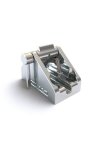
My chain stopper (picture enclosed) is a chunky 8mm 5/16 Lewmar model. Great piece of kit. But would I recommend it? Well that is another story. But everything is good now and it is the ultimate back up windlass protector with 4 x 7 inch screws holding it down. It is always on when setting the anchor and used when weighing anchor when I have to go below to knock down a cone of chain in the anchor locker.

Some of the best chain stoppers are simple home made ones. I have a back up chain stopper to protect the chain stopper just in case. It is a loop of dynema with an old kong chain hook (the rubbish ones with the pins - the pin is now drilled out) attached. It is simply looped over the Sampson post forward of the windlass and manually attached to the chain making sure there is some correct slack. And actually this would have saved me a lot of trouble instead of fitting the Lewmar! But it is not as quick and simple and ultimately not as safe (for the fingers).

I met one chap who had welded an upside down T shape chain stopper to his bow cleats using very chunky chain and welded his hook onto a link. He was very pleased with his set up, he called it 'bomb proof.' He never used a snubber. Watching his boat at anchor it always amazed me how his chain always hung straight down when everyone else was lifting up and being 'snubbed.'
 

Attachments

  • Lewmar Chain Stopper.jpg
    Lewmar Chain Stopper.jpg
    13.9 KB · Views: 6
Last edited:
Your fixed length bridle does have a potential flaw. We normally choose to anchor in around 5 metres. An 8 metre snubber might well allow the hook to touch the seabed, which is the only circumstance in which a chain hook can release itself.
The bow is about 2m above the waterline, and the mooring cleats about 1m back from the fairleads and we often anchor in 5m at low water (draft 3.3m keel down), so technically you are correct, the chain hook could be become detached. However, in the 7 years or so I've been using this system it hasn't happened. I wanted to keep the snubber as long as possible to help absorb the "shock" loading when the direction of shear changes. Like RupertW, the Southerly can swing quire wildly at times and it really loads the anchor up when the 16 ton boat changes direction. Having said that we haven't dragged to anchor, except once when it slowly ploughed a furrow in very soft mud.
The anchor is a 20kg spade, which to my mind is a little under sized, but it is the biggest I can get into the anchor locker. I find the spade really effective, if it been blowing all night the 1000wat windlass won't pull it out even when the chain is vertical, and I have to drive over the anchor to release it. It surfaces with a good lump of mud or clay on the anchor and you can tell it has been very well dug in by the mud mark on the sank.
The boat was supplied with a 16kg delta, which was totally inadequate.
The protection at the fairlead is essential, you can see the anchor plait stretching between the cleat and the fairlead in testing conditions.
 
Veering! The best way that I have found to cut down 'sometimes destructive veering' is by using the Hammerlock Moor. My main anchor is a 30kg Spade so for the Hammelock I use the back up stowed away 25kg Spade. So if you are in 8m of water (add 1 m water to bow roller and 1 extra meter) your Hammerlock anchor is now on a 10m rode. Your main anchor is on whatever you have set it at...mayber 8-1 if you can. The deployment of Hammerlock anchor is done at the zenith of a veer. Just put it over and it will now drag along the bottom cutting your veer, in many cases quite dramatically. It also has the advantage of being a back-up anchor if you can work out a system to extend the rode. I have heard stories of boats dragging down on peoples anchor in places like Greece and so having a second anchor ready close to the boat sounds like it may be an advantage.

Chain Stoppers and Snubbers are like beer and crisps.

All this talk of snubbers has been very informative. But there are times when a snubber fails or is incorrectly set or it is pointless setting one up because there is no wind or tide. And setting your anchor with a snubber attached is an art I have yet to master! So imho a chain stopper and a snubber are both equally important.

My chain snubber (picture enclosed) is a chunky 8mm 5/16 Lewmar model. Great piece of kit. But would I recommend it? Well that is another story. But everything is good now and it is the ultimate back up windlass protector with 4 x 7 inch screws holding it down. It is always on when setting the anchor and used when weighing anchor when I have to go below to knock down a cone of chain in the anchor locker.

Some of the best chain stoppers are simple home made ones. I have a back up chain stopper to protect the chain stopper just in case. It is a loop of dynema with an old kong chain hook (the rubbish ones with the pins - the pin is now drilled out) attached. It is simply looped over the Sampson post forward of the windlass and manually attached to the chain making sure there is some correct slack. And actually this would have saved me a lot of trouble instead of fitting the Lewmar! But it is not as quick and simple and ultimately not as safe (for the fingers).

I met one chap who had welded an upside down T shape chain stopper to his bow cleats using very chunky chain and welded his hook onto a link. He was very pleased with his set up, he called it 'bomb proof.' He never used a snubber. Watching his boat at anchor it always amazed me how his chain always hung straight down when everyone else was lifting up and being 'snubbed.'

So you use a 25kg Spade anchor as a weight to drag over the seabed. ? That seems rather an expensive way to achieve not very much. For interest, what tidal range is there where you sail? If, for example, you were sailing where I am just now, where the tidal range is 6m, say 20feet, if your "hammerlock" is dragging on the bottom at HW, the boat is going to have to shear a long way before your Spade is going to do anything useful at LW.

Edit. I see you are in the Med, where there is little or no tide.
 
Well I suppose in tidal waters you would just set the hammerlock anchor when needed with the scope required and adjust as necessary. The point is, as you point out, you drag the anchor (the heavier and pointier the better) over the seabed on basically a bit longer than a 1-1 scope. I have yet to try this method in 50kn when it would be most needed but it works very well in 30-40kn. I suppose it's just mucking around at the end of the day seeing what works and having a go. There may well be times when having two anchors deployed will let you sleep better. Some people swear by tandem anchoring and others like the V. Those two methods do not fill me with confidence for a myriad of reasons. The hammerlock cuts down the veer and is also ready to be deployed as a second anchor if needed. For the rode I use 5m 10mm chain and 100m 16mm octoplait (and a separate 30m set-up adequate for practising in shallow waters). I would prefer most every time to be on a single anchor on a single rode. But that does not mean I have not experimented and would be ready to deploy a second anchor in hopefully a non crowded anchorage if needed. The Navy use hammerlock mooring technique and I suppose the merchant navy and oil rigs do as well.

I have had 2 Rocnas, a 20Kg and a 25Kg and have found them both to be flawed (the hoop is the flaw). The 25kg Rocna was a great setter at almost any scope! The Spade seems to like to set with about 4-1 scope.
 
I have had 2 Rocnas, a 20Kg and a 25Kg and have found them both to be flawed (the hoop is the flaw). The 25kg Rocna was a great setter at almost any scope! The Spade seems to like to set with about 4-1 scope.
What is the flaw with the hoop on the Rocna? It's only 2 years ago that I purchased a 16Kg one and so far no problem.
 
The problem I had with them seems to be unique, I have never known anyone to suffer the same problem. Other people have reported problems with the Rocnas ability to reset in some seabed conditions... the hoop gets tangled with weed and stuff and this affects the ability to reset. I have had to de-weed my old hoop loads of times. But neither of my Rocnas ever dragged or did not set. They were great in every way except for on two occasions. When weighing the anchors (the 20kg one year and the 25kg the other year) I found chain had wrapped around the hoop so this needed dealing with via hook and trip line. I have two theories on this matter. The first is... both times I was anchored in tidal waters - one time for 3 weeks - and so the boat swinging 360 degrees could have wrapped chain around the hoop. The second possibility is i dumped the chain on the anchor when first deployed and the chain was caught up in the hoop. One time was in a tidal river and I am quite sure the chain was not fouled because I ended up quite a bit further back from my desired position. Or maybe it was...but it held fast. The other time was in fairly benign conditions when weighing anchor at slack water with no wind so maybe the conditions were perfect to wrap chain around the hoop...there was no tide or wind to straighten it. And maybe I did dump the chain and fouled it - even though the anchor held me firm for 7-8 weeks at this spot. So for whatever reason having chain wrapped around the hoop could have caused a drama if the wind had been blowing because it needed dealing with and obviously could not be stowed. So with the Spade I believe it is impossible to foul? I mentioned to someone once after they had anchored a long way from where they intended that if they had a Spade they could just dump x 2 then float back a bit and let out another x2 and then set and be able to anchor exactly where intended. Obviously I got reprimanded for recommending that dumping chain on anchor was acceptable! Obviously the hardest time to anchor is at slack tide with no wind because firstly it is hard to judge where everyone else is anchored and secondly it is easier to foul the anchor if not careful. My now preferred method when there is no wind or anything is to set the anchor going forward in tick over. Going astern we go in circles.
So maybe the Spade is just idiot proof and the Rocna is for experts only!
 

Alain Fraysse's articles about advantages of mixed rope appeared in the mid90s on a (since disappeared) French magazine Loisirs Nautiques, he later put the content on the web site.
I found the articles rather convincing and since started using long snubbers (5-10-15+m), a number of years have elapsed and having not had any major problem in anchoring, though I cannot demonstrate the snubbers helped, I will surely keep on using them.
As for the different types of rope that can be used, the usual consensus goes "nylon-polyamide more elastic than polyester", "3-strand more elastic than octoplait", etc etc. I have not made statistically significant testing, but I have snubbers made in 8strand polyester which are more elastic than 3strand nylon (apparently contrary to any logic), bigger diameter rope more elastic than smaller diameter, rope made with supertiny filaments (not sure of the term, the tiniest material element found on a rope) which frayed with whatever came in contact, 3strand rope that under a varying load kept on twisting around itself thus having the attached chain wrap/unwrap around the rope and eventually damaged it, etc.
I think experimenting with the type of available equipment can help in finding what is suitable or less suitable.
 
Mixed rodes seems popular with small boats and boats with no windlass. I would love to have a mixed rode because then I wouldn't need a snubber and I would be lighter! I think the French chap who invented the Spade anchor swore by chain and rope. And I think the Rocna website also says chain and rope is probably the best way to go in a blow. But splicing and matching a rode to chain and expecting it to go through the windlass is not possible if you are interested in maximum strength. I think my windlass will take 14mm rope but the 8mm chain needs at least 16mm rope. Even if it were possible you would then have to fasten the rope (to a cleat or Sampson post to protect the windlass) and make a fair lead with no chafe so I imagine lots of stainless steel fittings would be in order and trying to fasten and unfasten this rode under load seems like it would be a hard task and could easily be dangerous for the hands.
'The Right Rode' by Steve Dashew https://www.petersmith.net.nz/boat-anchors/docs/dashew-right-rode.pdf
 
The mixed rode obviously has some major advantages (and disadvantages) - its anchoring gear -you need to accept some compromises.

One though to mull over.

Chain is crudely sized toward the weight and length of the yacht, commonly length. The assumption is worst case scenario and that is using an all chain rode (no snubbers) and snatch loads. If you have a mixed rode, and are using the rope and enough of the rope then snatch loads will be much less, in fact should disappear - so using a, slightly, smaller size of rope than you might like will be satisfactory. Secondly chain is historically very reliable - stories of chain stretch, which would need tensions 2 x WLL, are like hens teeth - so the spreadsheets of chain vs yacht are conservative - so again you you could use a slightly smaller piece of rope.

If you are using G40 chain as a direct t replacement of G30 - your G40 chain will be well over strength. If you are using G43 chain the WLL is 'artificially' high - you are better to compare UTS not WLL.

The big issue with a mixed rode - is what ratio of rope to chain.

If you have ambitions to visit the tropics then coral will eat your rope overnight - and you really have no choice.

If you have lots of chain (in a mixed rode), say 40m then when you anchor in shallow water you will still need a snubber anyway.

If the ambition is to save weight - then use a high tensile chain (as Dashew would recommend anyway).

If you want a mixed HT chain and rope - you do have a real issue as the windlass sized for chain will be far too small for the rope - but you could use the capstan to retrieve the rope (faff about when you come to the join) and then retrieve the rest using the gypsy. Sizing rope to match HT chain is only one of the issues - finding shackles to join chain to anchor can pose problems as well. The shackle that fits the chain might lock up in the slot off the anchor - its not easy. If you are trying to match - take the chain, a few links, and anchor with you, sit down comfortably and try different shackles. Note that though shackles look the same (for the same sized clevis pin) they can have subtle differences. If you are down at the small size 6mm or 1/4" you will not find a shackle matches for strength and you will need to use a Omega link or hammerlock to fit in the chain (these will then need to be galvanised) - wonder people don't buy 6mm or 1/4" G70 chain! We had our 6mm chain and components all galvanised in one batch.

As mentioned already having HT chain and a long snubber is quite feasible (and you still have all chain).

Again if you use a mixed rode - the rope will be retrieved first and will sit in the bottom of the locker, wet and muddy. The chain will sit on top of the fusty rope. The seawater in the rope will evaporate and condense on the chain locker sides - and drip over your chain. A good environment to ensure the chain has a short life. Again you can faff about and separate the rope, hanging in a separate locker - so as to prolong chain life.

The rode and anchoring is simply full of compromises. Everyone to their own.

Jonathan
 
Top