Small Sailing Boat with Inboard Diesel. Advice Needed

Jim@sea

Well-Known Member
Joined
12 Feb 2010
Messages
4,575
Location
Glasson Dock
Visit site
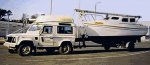
I am after a small sailing boat (20 - 24ft) which I can tow and it needs to be a bilge keel.
I can get a drying out mooring in Morecambe Bay near where I live.
I am aware that any boat I get which may have an Outboard either on the transom or in a well is liable to be nicked.
So a small boat with an inboard Diesel would be the answer.
The last sailing boat I had 15 years ago was a Drascombe Lugger but could do with something a bit bigger.
Any suggestions please.
 
If you want to tow it, then you need to do the sums for the mass of everything and look at what your car can tow, or what car you are prepared to change to.
Unless you aspire to using various bases, then the costs of running a big towing car will likely pay for haul out and storage?
 
Beware of small diesels in small boats. They are heavier than outboards which is not good either for sailing or towing. A good reliable one is expensive, both cost of engine and cost of installation, and an unreliable one is a nightmare and the total cost of repairs and spare parts can add up to more than the cost of a new outboard. Then there are lobster pot lines and assorted marine rubbish just waiting for your propeller...… and dragging a propeller through the water will do sailing performance no good at all.
Incidentally, for shoal draft, trailer friendliness and ability to take ground, there are solutions other than bilge/twin keels. Bilge keels for a 20 - 24 ' boat are likely to mean a draft of about 2' which is a lot for launching/retrieval and there's a reason why many small boats have centreboards or lee boards.
But it's your choice.
 
Look at the small Hunter's, Hunter Horizon 21,23, Duette. SOme have a great system that has an Outboard in the quarter locker. With a small boat a small Outboard can be used that can be more easily removed, and if there is enough wind you can sail! Boat's without Diesel engines are genrally simpler and easier to look after as I'm sure you know from your Drascombe days.
Lifting keel could also be good solution, e.g. Hunter Medina Parker 21, 23, Red Fox 20 with the advantage that they float in less water.
Have fun
 
Some people have put small diesels like 1GMs into quite small boats, but they tend to be one-off and not a budget option.
Some people tow bigger boats, e.g. Impala 28's which commonly have 1GMs in, but you need to watch the weight carefully and drive a Land Rover or similar.

It is possible to search Yachtworld.co.uk, put in length, budget and select 'diesel'.
I tried this it threw up some nonsense but also more choice than I'd have guessed.
 
Nowt wrong in principle with diesels in small boats, but they need to be good ones (most are). Having had both outboards and inboard diesels I prefer the latter, but I'm a cruiser and cover long distances. If you just want to potter round the bay you're better off with an outboard.

An outboard has the advantage of lower weight for towing, especially if you can put the outboard in the towing vehicle, rather than leave it on the towed boat. If you can't, the outboard's weight is right at the back of the boat, just where you don't want it.

Diesel gives much better range, economy and waterside fuel availability. They are generally more reliable, last many decades, are easy to service, and can generate all the electricity you want.
But
a knackered and unreliable old diesel is a liability, especially in a small boat, where the cost of replacing it with something you can be sure will be reliable will be disproportionate. I suggest you get an engineer to check over; fire up; and give you an informal, verbal assessment of any diesel engine in a boat you are thinking of buying. (Formal written engine surveys are so hedged with qualifications they have little advantage, it seemed to me.)

That's what I did with the last boat I bought, the diesel engine of which is 40 years old (a Bukh), hadn't been run for 18 months but started within a second, and in the subsequent two years has proved very capable and reliable. I took a chance on a previous boat that had a recent replacement Beta, and that, too, proved very satisfactory.

Some older diesel engines are generally considered worth avoiding - Petter, BMW, Renault, for example (though some get good service from them). I believe parts are problematic for some older Volvos and Yanmars. A modern Volvo, Yanmar, Beta or Nanni should be no problem at all. Bukh DV series engines are simple and solid (though very heavy), and have been in continuous production for 40 years, and parts still all readily available. They're used in lifeboats, so low hours used ones from that source are fairly readily available as cheap(ish) replacements should an old one fail.
 
If your only worry about an outboard is getting it nicked, then perhaps secure stowage would be an option? A local guy had another idea. He painted it in very non-standard colours, which would make it unattractive as difficult to sell on.
Put it out of sight in the cabin? and chained with hefty stuff to a strongpoint?
 
Put it out of sight in the cabin? and chained with hefty stuff to a strongpoint?
If I was strong enough to lift it into the cabin I would be strong enough to lift it into a dingy to take home.
I did see an advert for a boat with an 8hp Outboard but I imagine that could be quite heavy being 4 stroke.
Twenty years ago I had a boat with a 9.9 Evinrude (2 Stroke) which was very heavy, But as it was a detuned 15hp that would explain it.
I would also mention that when I started boating they were fitting Stuart Turner Inboards in small boats.
 
You have a mooring available, so use it. I've seen many a debate over the advantages of trailer sailers and the consensus of most owners is that rigging and launching before and derigging and revering afterwards is such a faff, they quickly find a mooring. The real advantage of a trailable boat is the ability to drag it off to the Scottish coast or further afield for a holiday.

As for engines, an outboard is going to be cheaper to buy and a good one will always be better than a bad inboard, but they generally don't work so well in waves, are more expensive to run and are stealable, no matter what you do. If the bad guys want it badly enough, they'll cut your transom up to get it off, which would write off most small boats.

A decent inboard diesel will be cheaper to run and more reliable and, given decent fuel, will drive you home quite happily long after you're wishing you'd stayed home watching East Enders (I hate soaps!). I wouldn't buy a boat with an inboard petrol engine (are there any left?) unless it was cheap enough to re-engine with a diesel.

Good luck!
 
A few Anderson 22's ( lift keel ) have inboards of various types but these engines mean a lot of weight in the wrong place - aft, drag, corrosion, expensive to maintain and sacrificing very useful stowage space under the cockpit.

Unless you have a HUGE boat - 100'+ I think towing a 20'ish boat will end in tears.
 
Last edited:
I am after a small sailing boat (20 - 24ft) which I can tow and it needs to be a bilge keel.
I can get a drying out mooring in Morecambe Bay near where I live.
I am aware that any boat I get which may have an Outboard either on the transom or in a well is liable to be nicked.
So a small boat with an inboard Diesel would be the answer.
The last sailing boat I had 15 years ago was a Drascombe Lugger but could do with something a bit bigger.
Any suggestions please.


There are some Fox Terriers that are both bilge keel and inboard diesel fitted.
 
The only problem I have encountered with my Invader 22 and it's Tohatsu 9.8 is the tendency for it to get dangerously close to being swamped by following waves. I've considered extending the leg length to make it sit out of the water by another 6" but I can't be sure the cost of the extension would be worth it. It was built with an inboard single cylinder diesel but a previous owner had it removed, it does make for a boat with lots of extra storage, if you're into longer cruising.
 
Why do you want to tow it? Look very very carefully at how to get it on and off the trailer. Most boats over 18ft or so this can be a major and time consuming operation. A lot of preparation for launching and retrieval and rigging/de-tighing the boat is involved. Then as above the tow vehicle. You are restricted to a thirsty 4x4 generally, as few modern cars will tow more than around 80% of their weight legally. Plod do check, too. It's a nice easy way of increasing their detection figures. Here on the S Coast they run regular check points for private vehicles towing caravans and boats.

Keeping a trailer sailer at home means it stays there unless you have several days to make the effort worthwhile. You won't go out for the day because half of it is spent loading and unloading!
 
I have owned two Sadler 25s in my time. One had a 5HP outboard - the other an 11HP inboard diesel.

The one with the outboard was a sailing boat! The outboard, on a bracket on the port side of the transom, was unreliable in any amount of wind/sea. In a sea, even with a longshaft, the prop would come out the water then plunge back in. With any amount of wind on the port side, the prop would come out of the water - so I learned to motor on "starboard tack"!
Occasionally, on a relatively calm/level sea, 5HP wasn't sufficient to make any headway into a stiff breeze.
The storage under the cockpit floor was immense! When racing, we put the dinghy & outboard in there, and still had room for a large coolbox!
We only had one battery and no fueltank - but probably carried as much fuel in cans as we would with an inboard diesel.
The outboard had a charging coil, but since we didn't use the outboard much keeping the battery charged (for the VHF only in those days) was an issue. Log & echo sounder were battery operated. It was in the days before solar panels.

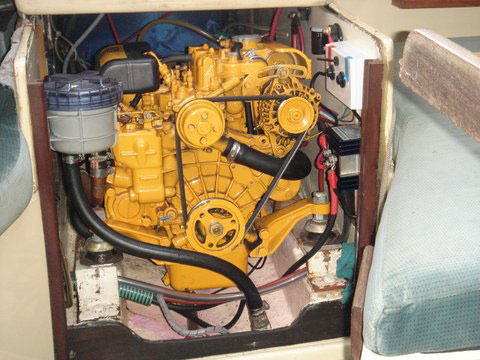
The inboard diesel was much much more dependable as a means of propelling the boat! Also charging the batteries. The downside was "the locker under the cockpit" was full of engine!!!!!!
VetusStrainer.jpg


I towed my first one a handful of times, hiring a Land Rover to do it.
 
Top