small outboards with alternators

Most small outboards from 5 hp , maybe 4hp, are avaialble with at least a lighting coil.
I'd think the option to have a lighting coil has been around 40 years or so on most brands.
Once the lighting coil is fitted it's a simple step to add a rectifier for battery charging.

Probably not a viable proposition to fit a lighting coil and rectifier to an old engine but in some cases an ordinary bridge rectifier can be added cheaply enough if the lighting coil is already fitted. Some need a special rectifier.

Electric start models ( but then we are talking more than 8 hp) generally have battery charging as standard except very old ones.

Sail versions often have battery charging as standard
 
So how do I know whether mine, or one I'm considering, has a lighting coil? What is a lighting coil?

Sorry to be thick.

It's a coil mounted under the flywheel that uses the flywheel magnets to generate a small amount of power for powering navigation lights.

you would have to ask or consult the original spec .

There would probably be a connector on the cowl .
Maybe with battery charging fitted a flying lead to connect to the battery .. or at least the terminals under the cowl for it.

Tell us the full details, make, model, year, model number and serial number and it might be possible to look up some info. or find an owners manual online if really lucky
 
Charging/lighting coil

Most small o/b engines have a coil under the flywheel with magnets in the flywheel. This coil provides a pulse of electricity for ignition. It is not difficult therefor to add another coil for lighting. The lighting coil if fitted as Vic says comes out as socket for a plug to go to the lights.
Unfortunately the coil is usually designed to drive 12v lamps with AC. The makers may well supply a rectifier box to convert this AC to DC to charge a battery. Unfortunately a battery needs something around 14volts to push any charge into it. (depends on charge state of the battery) This normally means that with 1.4 volts dropped in the diodes there is not enough voltage to push real current into the battery.
My Johnson 6HP will typically put .3 amp into the battery at reasonable cruise revs.
You could possibly make a bridge rectifier out of 6 Schotky diodes. They have a much lower natural volt drop but you still could not expect real charge current. In the end most people find that a solar panel does the job much better than o/b charging. good luck olewill
 
I had a Honda 7.5hp outboard as main power on our boat two back (Newbridge Venturer). Noticing that this engine shared it's powerhead with the then popular Volvo-Penta sailboat drive, I acquired the superior(to the standard pressed steel one) cast flywheel from a scrapped motor of that badging and the coil array which had a much uprated charging output by vertue of having double the number of coils. It provided enough power to run a fridge and keep the batteries charged as well as providing as much lighting both internal and external as we needed. We did though have a wind genny to keep the batteries topped up on our swinging mooring in Poole Harbour when we were away.

Chas
 
If you can source the parts - which used to be available off the shelf - it's quite easy to fit a charging coil on something like a Yamaha 4 or Mariner 5 2-stroke, we did; it will require a 'puller' to remove the flywheel.

As VicS says, an engine which already has one should have some sort of electrical connector to plug into the boat & charge the battery.

These sort of charging coils were pretty feeble at around 3 amps, but well worth having particularly if motoring in calms using an autopilot.

Modern 'sailpower' type engines tailored for use on yachts often have uprated charging to around 6 amps.

For this sort of use i suggest you look for a remote fuel tank equipped engine too, that tends to go hand in hand with charging.

I can heartily recommend the Mariner 5hp 2-stroke if you find a well maintained one, also the very similar Yamaha 4hp 2 stroke ( but check the gearshift on the Yam', has a known problem seizing in its' mounting, but easily fixed ).
 
Some later Seagulls (those with an in-built starter cord and non-exposed flywheel) are either fitted or can be retro-fitted with a alternator giving a 12v charging voltage at 2 or 4 Amps output (cable selectable).

However, I would suggest you think twice about fitting any permanent magnet alternator to a small outboard (unless you know it is definitely going to be used) - and especially one providing several Amps output - as in this world you never get anything for free, and some of the motor's HP will be absorbed by simply driving the magnets around. Not much of an issue with a bigger engine, but when you're trying to squeeze the last drop of grunt from a tiddler ...
 
OK, thanks people. I have a Mariner 4HP 2 stroke (with reverse gearbox, late 1980's model, but low hours), which I get on with. I had been considering replacing it if I could find a similar sized engine which would also charge a battery effectively. I hadn't considering modifying the Mariner until now.

Mariner 4ML 6EO L 338389
 
Last edited:
You have not said what the serial number is, but I think a 1980s model will be of Japanese origin (rebadged Yamaha ??)

If that is so
the 60 watt lighting coil, if not already fitted is part number 91697M and its current price in the USA is approx $70.

The rectifier assembly is part number 84329M and is approx $132

the voltage regulator , should you feel the need for it, is part number 84125M and its current US price is $387

But check the above parts numbers

If you are lucky enough to already have the coil fitted, or even if you have to buy and fit one, for very little money you can use a suitably rated bridge rectifier from Maplin.


EDIT Ok your number confirms it to be Japanese and a 1989 model

Check the parts at http://www.boats.net/parts/search/Merc2/Mariner/4A/parts.html
 
Last edited:
You have not said what the serial number is, but I think a 1980s model will be of Japanese origin (rebadged Yamaha ??)

If that is so
the 60 watt lighting coil, if not already fitted is part number 91697M and its current price in the USA is approx $70.

The rectifier assembly is part number 84329M and is approx $132

the voltage regulator , should you feel the need for it, is part number 84125M and its current US price is $387

But check the above parts numbers

If you are lucky enough to already have the coil fitted, or even if you have to buy and fit one, for very little money you can use a suitably rated bridge rectifier from Maplin.


EDIT Ok your number confirms it to be Japanese and a 1989 model

Check the parts at http://www.boats.net/parts/search/Merc2/Mariner/4A/parts.html

Vic, much appreciated. The Voltage regulator is the expensive bit, when you say " If I feel the need for it" what are the implications of doing with / without?
 
Vic, much appreciated. The Voltage regulator is the expensive bit, when you say " If I feel the need for it" what are the implications of doing with / without?

Many with small low output charging coils don't have a voltage regulator. My Evinrude does not. Higher output charging systems generally do and its becoming fashionable to fit them on the smaller ones as well now.

The only time you are likely to need a regulator will be if you run for long periods at high revs and only have small capacity battery .. even then if its a battery that can be topped up no problem.

Quite frankly the output from a outboard that is only used as a sailing boat auxiliary is next to useless. Mine is connected but until I also fitted a solar panel I still had to take the battery home for charging occasionally.

If the coil is fitted spend a few quid on a Maplin bridge rectifier by all means otherwise spend the money on a solar panel.
 
Quite frankly the output from a outboard that is only used as a sailing boat auxiliary is next to useless. Mine is connected but until I also fitted a solar panel I still had to take the battery home for charging occasionally.

We trailer sail, so most times I can charge at home. I've just fitted a Tillerpilot and want to do more single-handing, so I want some way of keeping enough life in the battery to run the Tillerpilot if I'm going to be away for more than a few days, and in most trips of a few days, I would tend to run the engine for a few hours anyway, so hopefully this would be a reasonable solution.

Is this going to output at sufficient voltage to charge a battery?
If it's 60W (say 50 achieved), then am I right that it would take about 22 hrs to charge a completely flat 90 AHr battery? Or in other words, 2 hrs running would charge about 10% of the capacity?
 
We trailer sail, so most times I can charge at home. I've just fitted a Tillerpilot and want to do more single-handing, so I want some way of keeping enough life in the battery to run the Tillerpilot if I'm going to be away for more than a few days, and in most trips of a few days, I would tend to run the engine for a few hours anyway, so hopefully this would be a reasonable solution.

Is this going to output at sufficient voltage to charge a battery?
If it's 60W (say 50 achieved), then am I right that it would take about 22 hrs to charge a completely flat 90 AHr battery? Or in other words, 2 hrs running would charge about 10% of the capacity?
The tillerpilot draws 0.5 - 1.5 amps so for a days sailing you'll need about 8aHr. Due to charging losses you'll have to double that amount of input to your battery. To keep the battery topped up you'll need to run the o/b quite a few hours. I think a better bet would be a small solar panel which doesn't make a noise or use fuel.
 
We trailer sail, so most times I can charge at home. I've just fitted a Tillerpilot and want to do more single-handing, so I want some way of keeping enough life in the battery to run the Tillerpilot if I'm going to be away for more than a few days, and in most trips of a few days, I would tend to run the engine for a few hours anyway, so hopefully this would be a reasonable solution.

Is this going to output at sufficient voltage to charge a battery?
If it's 60W (say 50 achieved), then am I right that it would take about 22 hrs to charge a completely flat 90 AHr battery? Or in other words, 2 hrs running would charge about 10% of the capacity?

It should output a high enough voltage but the open circuit volts are dependent on the engine speed.The volts are not controlled as they are with a "proper" alternator. You may well find that the o/c volts will be quite high at high revs but at low revs you may find the volts are not high enough for any effective charging.
 
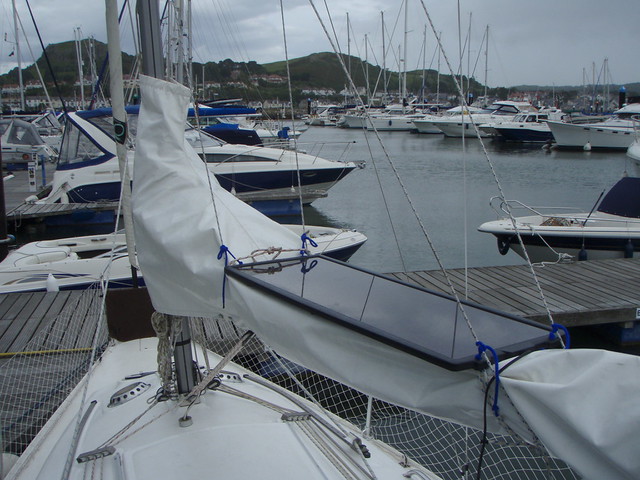
We purchased this solar panel last season to keep the battery charged up we got it from Maplins.

5743605417_2ef99ceda8_z.jpg
 
Top
