Singlehanded overboard - getting back onboard options

99.9% of the time you are dead right but in any survival situation you have 2 options:-
Lay there & say "I am dead"
or start thinking " S..t this is not going to happen this way, what can i do now?)

Of course, but even with a positive mental attitude you are almost certainly dead. So put all your effort into not going over, but don't give up in the five or ten minutes of meaningful effort you have if you do.

In one of the William stories by Richmal Crompton, a horrified policemen finds WIlliam digging around an unexploded bomb outside the Hall gates (spoiler: it turns out to be the stone ball from one of the gateposts). William tells him not to worry, as he has a brought a couple of saucepan lids which he can hold up for protection "if it starts exploding".
 
If I go overboard and die I hope I won't die wondering, "what if ..":

When I Ieave the cockpit to to get in/set lines and fenders I stop the boat. If I have to leave the cockpit when under way I either stop the boat if under power or de-power if I can under sail. Although I have a system where I can lower the bathing ladder that really is more in hope than expectation; my main reasons for depowering the boat are that I'm less likely to be thrown out by hitting a wave and that if I do go overboard it won't drift too far and may help rescue/recovery teams find me quicker.

My jack stay goes down one side of the coach roof, round the mast and back down the other side. I clip on the furthest away and I can't go over the side I'm on. If I get thrown to the other side I'm hoping something gets in my way rather than go overboard. If its rough I wear 2 tethers so I can always be clipped on somewhere if I have to unclip my main one for some reason. I still haven't figured out a good system for going forward of the mast other than staying sat down and shuffling forward.

My tether has one of those quick releases that lets me release myself if I'm hanging overboard and can't get back in. https://www.force4.co.uk/wichard-qr-snap-shackle-with-swivel-eye-m.html

I have a DSC hand held and PLB tethered to my LJ.

I have the sea-tag MoB system but stopped using it single handed because of two many false alarms. Its OK for when I have crew.

As I say, I don't want to die wondering and these threads are always informative.
 
A spare halyard set at the length of to get you to the bow would hopefully swing you to a similar hight at the stern..... If you were clipped onto a jack stay would keep you from swinging outwards as well.

But, don't fall overboard.
 
Depends how you rig the jackstays, nothing stopping you clipping in to the jackstay on the opposite side of the boat or shortening the tether. Much as I hate triple headed tethers they give you a lot more flexibility.

So if the boat is going to windward in a blow, you go round the sprayhood on the lee side hook on & clamber back over the cabin top to get to the windward side ???
Alternatively have a tether so short that you cannot stand up ?? I had a crew who bought a short tether. That soon got replaced for one of my standard ones.

let's face it 90% of boats put the jackstays in the most practical place, the side deck. May seem bad if someone goes over, but if bad positioning actually causes a fall, then which is worse? There is really no satisfactory solution if one has to go on deck, other than be aware & take care
 
let's face it 90% of boats put the jackstays in the most practical place, the side deck. May seem bad if someone goes over, but if bad positioning actually causes a fall, then which is worse? There is really no satisfactory solution if one has to go on deck, other than be aware & take care
True, but you can work out ways of giving yourself maximum protection, e.g. a three headed tether and moving about using the old climbing rule, three points of contact for the rock or in our case the boat.
 
A spare halyard set at the length of to get you to the bow would hopefully swing you to a similar hight at the stern..... If you were clipped onto a jack stay would keep you from swinging outwards as well.

But, don't fall overboard.

& if the boat went into a gybe whilst you were getting from the cockpit & were hooked to the halyard you might be dragged over the side as it caught the halyard
Have to admit that- thinking laterally- being hooked from above does sound better than being hooked from foot level. However, the boom is the problem with that one me thinks
 
Last edited:
What I'm missing is documentation.

"My plan is that I will...." But they have not actually tried it in, say, 20 knots. Did you jump in and grab the rope while the boat was going 7 knots? Did you try climbing the rope ladder or sling while sailing at 70 knots?

My MOB drill works because I have done it with just the two of us.

Climbers have a saying about what we call "physiological gear" (anchors that are no darn good). "you might as well tie in to your nuts if you are going to use that." The point is, gear that is crap can give you a false sense of security which is far more dangerous than looking at the situation realistically.

If you fall in tether with a short (1-meter) tether you have a fair chance of scrambling back aboard. There are many examples and no examples of drowning that I am aware of (with a 1-meter tether). In cold water, if you are wearing a dry suit you have a fair chance of surviving until help comes if you are close inshore.

Other than that, it is safer to consider the edge to be a 500-foot cliff. You may believe you can survive if you jump off that cliff, but it's not very likely, is it? In this case, a survival attitude might encourage you to take chances that are not, in fact, chances at all.
 
& if the boat went into a gybe whilst you were getting from the cockpit & were hooked to the halyard you might be dragged over the side as it caught the halyard
Have to admit that- thinking laterally- being hooked from above does sound better than being hooked from foot level. However, the boom is the problem with that one me thinks

Agreed, not ideal like most things but better then watching your boat sail off.

Inboard jackstays on teather, outboard ones on the other hook, if you really want to be sure, wear a harness under your life jacket and use two different teathers on two different jackstays with two different harnessssssss...

Personally I find moving around with a teather a right pain in the backside but I understand the consequences.
 
Have any of you actually tried the halyard method? If you have not, why post about a method that is potentially dangerous? This is not a new idea and it is not accepted because it does not work. At all.

I have tried it. I was asked to try it as part of an article. It is, IMO, very dangerous most of the time.
* If the length is too short it lifts you off your feet.
* You can't crouch or sit when a wave comes.
*If the length is too great, it wraps around the spreaders. The worse the weather, the more the knots. This is not only aggravating, it could inhibit your ability to change sails.
* The slack can even get around your neck. No kidding, had it happen.
* If you are not also tethered, you will be hanging many feet to leeward with no way of getting back to the boat. On a small boat, with your 200 pounds hanging from the masthead, she will lay way over. Fun.

The ONLY way this can work is if crew actively tails the halyard, keeping the slack out. That takes it off this thread. Frankly, the same time spent on careful use of tethers is safer.
 
Last edited:
Because it's a method published in a magazine that runs/sponsors these forums and a option to consider.

I'm sure people can make their own mind up by trialling and listening to others experience which you've kindly given.
 
Because it's a method published in a magazine that runs/sponsors these forums and a option to consider.

I'm sure people can make their own mind up by trialing and listening to others experience which you've kindly given.
You are correct.

Curiously, if you read the article closely, they never implied they had tried the halyard method in any real weather. The boat is in chop with no pitching. They also added the detail of using a pruisk to adjust line length. Well, moving the prusik requires letting go with both hands, something that makes no sense in a seaway while you are standing tall.

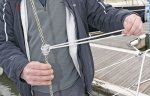
"YM reader Tony Hughes suggested clipping to a vertical line, like a spinnaker halyard or pole uphaul, instead of jackstays. A fall arrester or a Prusik knot clipped onto your harness is used to slide up and down the vertical line to ensure you’re securely attached at the same level above deck as you move forward. If crew went over the side, a line is already attached and they can be winched back aboard. I had instant visions of being towed through the sea with the boat heeled well over but we decided to try it out anyway.

LR16253-Moving-onboard-GSP_OK.jpg

In early discussions with James and Ash from Spinlock, it was pointed out that, unless the Prusik knot is regularly moved down as you move forward, the vertical line may support your weight on the foredeck, reducing your grip on deck. The boat may lurch and you could lose your footing and swing outside the lifelines.

"In practice, I found it worked very well, but only when combined with a tether attached to the centreline jackstay. This has all the benefits of the vertical line but keeps you inside the lifelines. Spinlock’s Ash Holmes, a former sailing instructor, reminded us of the convention that you should never secure yourself to the mast as, in the event of a dismasting, you could find yourself in all sorts of trouble. It’s up to you to decide whether this risk is acceptable."


I tried in waves. I'm not sayin' you can't make it work, I'm sayin' I found it to feel more dangerous than no tether at all, because I had to waste too much time fooling with it. And if there is slack it can tangle in spreaders and steps. Try it 4- to 6-foot waves and report back. I do not think they should have published the idea with out testing in vigorous conditions. I write for several magazines and I don't suggests stuff I have not tested in tough conditions.

I do think clipping vertical lines can be good, but only fixed lines.
 
Last edited:
Good question. I've wondered if there's a way to rig a "dead man's switch" like they have in the seats of lawn tractors that would kill the engine. But that still leaves the issue of going overboard under sail.
 
Of course, but even with a positive mental attitude you are almost certainly dead. So put all your effort into not going over, but don't give up in the five or ten minutes of meaningful effort you have if you do.

In one of the William stories by Richmal Crompton, a horrified policemen finds WIlliam digging around an unexploded bomb outside the Hall gates (spoiler: it turns out to be the stone ball from one of the gateposts). William tells him not to worry, as he has a brought a couple of saucepan lids which he can hold up for protection "if it starts exploding".

Don't remember that one, which book was that ?

Boo2
 
let's face it 90% of boats put the jackstays in the most practical place, the side deck.

Mine are on the coachroof - I can't imagine why I'd put them on the side decks, though perhaps it makes sense on longer boats. If I need to go forward in bouncy weather I take a second tether and use that to clip on tight. To the mast, say, If I'm reefing.

Don't remember that one, which book was that?

"William Carries On", I think. One of the not-very-good later ones.
 
So how do you get to the bow if you need to?

I can get almost to the bow with a tether to the jacklines. If I need to get right to the bow I use that second tether I mentioned.

Do you have a spray hood?

I thought you might ask that. Yes I do. Before setting off I rig two tethers, one each side, from the jackstays round the sprayhood and into the cockpit. Want to go forward? Clip onto the jackstay tether, unclip other tether (at cockpit end if second one needed), go forward.

Yes, I carry a lot of tethers.
 
Top
