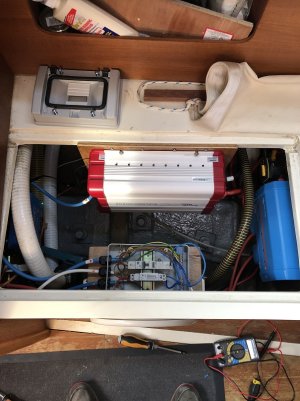
Simple LifePo swap sense check

Yes, and the Chinese Jk BMS is probably thr best BMS currently on the market. Your Aussie based German, .Andy from Off grid Garage on Utube tests the hell out of all the BMS and he reckons the Jk is the best. I have two of them.
If you want the best MPPTs, smart shunts, etc. Victron is hard to beat
Geem,

I have never doubted their, Victron's, quality, we had an inverter charger on Josepheline - nothing happened, it did what was said on the box, only remarkable because it was so dependable and predictable - if you like .. unremarkable. They are also a sort of 'one stop shop'. They have an enviable reputation with retailers world wide, or at least as far away as Australia. As Huawei is a serious competitor to Apple, much more complicated than designing and building a shunt, proven perfectly adequate and cheaper - so I wonder if there are not cheaper options than Victorn et al.

Sadly you pay for Victron's excellence and I wonder if there are not other sources of 'adequate' products that would allow more people to aspire to, say a Lithium house bank. Batteries are but an example, one could build ones own - but there are other sources of Lithium batteries (there do seem a lot in America).


If asked I might say X-Yachts build some of the best cruising yachts in the world but I accept many find a Benny, Jenny or Bav perfectly acceptable - and affordable. My complaint of Benny et al is that they don't seem to cater for the newbie, who is building the Sonata, Pandora, J24 allowing people a toehold (without complication and affordable) and who is building the reliable and affordable MPPT and shunt. You mention the Chinese BMS, you say best on the market - I'd hazard a bet there some pretty good shunts lurking in China

I want people to find a means to enjoy new horizons, like sailing, spending time safely at anchor in exotic places (like the Western Isles (or Caribbean) - they should not need the Rolls Royce you can get a lot of pleasure (so I believe) from a Suzuki Jimny.

As I believe the most expensive anchor is an excellent option - but there are cheaper ones that are perfect;y adequate.

Whinge over, apologies.

Jonathan
 
Geem,

I have never doubted their, Victron's, quality, we had an inverter charger on Josepheline - nothing happened, it did what was said on the box, only remarkable because it was so dependable and predictable - if you like .. unremarkable. They are also a sort of 'one stop shop'. They have an enviable reputation with retailers world wide, or at least as far away as Australia. As Huawei is a serious competitor to Apple, much more complicated than designing and building a shunt, proven perfectly adequate and cheaper - so I wonder if there are not cheaper options than Victorn et al.

Sadly you pay for Victron's excellence and I wonder if there are not other sources of 'adequate' products that would allow more people to aspire to, say a Lithium house bank. Batteries are but an example, one could build ones own - but there are other sources of Lithium batteries (there do seem a lot in America).


If asked I might say X-Yachts build some of the best cruising yachts in the world but I accept many find a Benny, Jenny or Bav perfectly acceptable - and affordable. My complaint of Benny et al is that they don't seem to cater for the newbie, who is building the Sonata, Pandora, J24 allowing people a toehold (without complication and affordable) and who is building the reliable and affordable MPPT and shunt. You mention the Chinese BMS, you say best on the market - I'd hazard a bet there some pretty good shunts lurking in China

I want people to find a means to enjoy new horizons, like sailing, spending time safely at anchor in exotic places (like the Western Isles (or Caribbean) - they should not need the Rolls Royce you can get a lot of pleasure (so I believe) from a Suzuki Jimny.

As I believe the most expensive anchor is an excellent option - but there are cheaper ones that are perfect;y adequate.

Whinge over, apologies.

Jonathan
Victron will network a number of MPPTs together via bluetooth and use a Smart shunt to ensure each MPPT has the correct battery voltage. Find a cheap fully programmable chinese shunt that will do that. This is an important feature when charging lithium on a boat. You need accurate voltage to ensure you don't charge too long and risk a high voltage shut down of the BMS
 
Find a cheap fully programmable chinese shunt that will do that.
They are out there, the problem is finding one, and finding things it can integrate properly with. Most of the cheap products are generic pattern parts designed first and foremost to be sold in bulk to systems integrators and OEMs. The idea here is that those people will take the pattern hardware, and sample firmware, and write their own custom firmware and apps to create an end user product. The part itself will perform basic functionality off the shelf, but may be buggy and won't integrate - but crucially it can be sold for the value of the part and hence is cheap.
Victron probably make their own patterns, but these won't be far off the generic stuff from a hardware perspective since they will still use the same SOCs and other components. The value add here is the firmware, integration, testing, distribution and global certification, creation of usable manuals in multiple languages, development of training materials and testing to ensure there are professionals able to install the stuff. All this adds cost, but personally I think there's a lot of value in that stuff for someone that wants to fit and forget then go out sailing. I hate waste so buying 5 different cheap things in the hopes of getting something that works is appalling to me, and Neeves example of the vendor saying dump it demonstrates that some of this stuff is literally manufactured waste.
 
I hate waste so buying 5 different cheap things in the hopes of getting something that works is appalling to me, and Neeves example of the vendor saying dump it demonstrates that some of this stuff is literally manufactured waste.

We were surprised that we were simply asked to keep it, and had our payment for the MPPT controller fully refunded. It is an example of waste - but we are not paying for it - it has cost us nothing but time to find out it is, or was, a controller specifically for Lead not Lithium as we ordered. We are not aware there is anything wrong with the MPPT controller it might be fantastic - its simply built for Lead not Lithium and specifically says LEAD ONLY. It underlines to me that these devices are cheap as chips, to make., and that the aggravation of a customer sending the unit back, to an office in Oz, and they then repacking it for the next person who orders one is too much of a hassle. Its also very good PR, balanced by the poor delivery of the wrong unit :(

I note the comment on poor translation - bear in mind these Chinese units are not built for us - they have a big enough internal market to keep them happy and busy. I'm lucky - my wife is fluent in 'Mandarin' and Cantonese and can read and write in both.

But I find it interesting or intriguing that the 2 mantras of Victron everything and Chinese rubbish is actually contradicted. Geem has mentioned that an investigation into BMS finds, though this investigation is one gifted amateur, that the Chinese produce the best BMS he tested. The best battery cells come from China, all your solar panels come from China - and most people who drive an EV - it comes from China and if its a not a Tesla - probably is managed using, exclusively, Chinese components. Some posting on these, Lithium, threads are using a Chinese shunt (without issue).

I am not rejecting Victron, and I read some very persuasive arguments on why I should open my mind (to Victron). I have time and the inclination to play. My Lithium kit has no purpose currently - other than occupying my time and stretching my mind.

Now I fully understand the ability for units to talk to each other might be advantageous - I don't know (and don't know if I need that level of sophistication). My ambition is to build a simple, cheap and acceptable Lithium bank - something that would fit in a box, maybe big box and that has a minimum of displays and the minimum need for owner input - if you like - as we are used to with a Lead battery bank.

I have the time and I know there are others here who would want me to enjoy success - as they too want a simple, unsophisticated Lithium bank. You can have it for a car - why not a boat? ........Of course a car is different. But if you can build it for a car, why not a boat.

You need accurate voltage to ensure you don't charge too long and risk a high voltage shut down of the BMS

My answer to this is crude, in the extreme. I note, I think, GHA is manually controlling his battery voltage and has chosen to cut off charging early, or at a lower voltage than many others. I'm doing the same knowing that if I cut off at 13.8v I'm not using the battery at full capacity - but I'm erring very much on the side of caution. I'm basing my battery voltage on the shunt.

I have been concerned that whilst I have a variety of voltmeters through my circuits - they all read differently. This raises the question of how accurate are the meters. Its something I need to address - in the meantime I'm being cautious.

But it also raises the same question of all, say, solar controllers - how accurate are the controllers (not everyone will be using a Victron MPPT).

Jonathan
 
Avoiding a high SOC,while not essential, is beneficial for the life of lithium batteries. Lead acid batteries have their longest life when kept at or around 100% SOC, but with lithium batteries around 60% SOC is ideal for battery life.

This is a major shift in battery management.

However, you need to ensure that lithium cells are at least occasionally balanced. Many BMS units will only balance at a relatively high voltage. It is therefore important to achieve this voltage at least occasionally.

Knowing the voltage where balancing commences is important. Generally this is above 13.8v. Batteries with external communication will report the balancing current as well as the individual cell voltages, enabling monitoring of these parameters. Especially if installing drop-in batteries without external communication at least make sure that the charging voltage occasionally reaches the balance voltage set point.
 
Last edited:
Avoiding a high SOC,while not essential, is beneficial for the life of lithium batteries. Lead acid batteries have their longest life when kept at or around 100% SOC, but with lithium batteries around 60% SOC is ideal for battery life.

This is a major shift in battery management.

However, you need to ensure that lithium cells are at least occasionally balanced. Many BMS units will only balance at a relatively high voltage. It is therefore important to achieve this voltage at least occasionally.

Knowing the voltage where balancing commences is important. Generally this is above 13.8v. Batteries with external communication will report the balancing current as well as the individual cell voltages, enabling monitoring of these parameters. Especially if installing drop-in batteries without external communication at least make sure that the charging voltage occasionally reaches the balance voltage set point.
I think the difficulty comes with cheap drop in batteries with no Bluetooth and passive balancers. The cheaper the batteries, the less likely the cells are to be matched and of high quality. In contrast, grade A cells suitable for use in EVs are likely to need less balancing as they are inherently better matched.
Cheap batteries have everything against them. Possibly mismatched cells, poor passive balancers and no Bluetooth so you can't see if there is a problem. By contrast, a set of grade A cells with active balancer and Bluetooth is far less likely to have problems, but if it does, you can actually see what it is causing the problem. A good BMS will data log every event the BMS manages. It will all be there in the data log. If your cheap battery switches off you don't know what caused it or if it will happen again. Was it a bad cell, a cell balance problem, a high temperature event, an over load. You may never know and it could repeat its self time and time again.
 
I think the difficulty comes with cheap drop in batteries with no Bluetooth and passive balancers. The cheaper the batteries, the less likely the cells are to be matched and of high quality. In contrast, grade A cells suitable for use in EVs are likely to need less balancing as they are inherently better matched.
Cheap batteries have everything against them. Possibly mismatched cells, poor passive balancers and no Bluetooth so you can't see if there is a problem. By contrast, a set of grade A cells with active balancer and Bluetooth is far less likely to have problems, but if it does, you can actually see what it is causing the problem. A good BMS will data log every event the BMS manages. It will all be there in the data log. If your cheap battery switches off you don't know what caused it or if it will happen again. Was it a bad cell, a cell balance problem, a high temperature event, an over load. You may never know and it could repeat its self time and time again.
Good point. The cheaper batteries have poorer matched cells, so achieving a voltage where the BMS initiates balancing is more important. Matched grade A cells require little balancing, but these are expensive.

The other consideration is the discharge/charge current. Most marine house batteries operate at relatively low discharge currents, at least compared to high demand applications such as electric propulsion. Lower currents help maintain the cell balance. However, there are exceptions such as boats using lithium batteries to operate bow thrusters etc.
 
May I interrupt this very interesting exchange with a practical question. I need to order the peripherals for my new system. 460AH LifePo4, max. continuous discharge and charge = 200A. Peak current = 400A. I presume the latter is if I were to connect up to eg starter, which I won’t be doing. In practice I doubt I will ever exceed 100A of charge or discharge. I am thinking 35mm2 cable from battery to distribution, protected by a 225 class t fuse, should be fine for the foreseeable. But should I be sizing for the peak current, in which case maybe 70mm2 cable and a 400A class t. Or something else entirely!?
 
Good point. The cheaper batteries have poorer matched cells, so achieving a voltage where the BMS initiates balancing is more important. Matched grade A cells require little balancing, but these are expensive.

The other consideration is the discharge/charge current. Most marine house batteries operate at relatively low discharge currents, at least compared to high demand applications such as electric propulsion. Lower currents help maintain the cell balance. However, there are exceptions such as boats using lithium batteries to operate bow thrusters etc.
Agreed. Bow thrusters, windlass, electric cooking and those choosing to rely on high amp alternator charging through an external regulator. Thr high current creates wider cell voltage differences. Good balancing then becomes important if you get the cells close to their upper voltage limit. Particularly with high current alternator charging, its possible that even active balancing has limited effect as the rapidly rising battery voltage will top out quickly. For such a system, setting the charge voltage slightly lower so a roque cell doesn't cause a BMS trip is prudent. In addition, an absorbtion time whilst the battery is held at say 14v for 30 mins makes sense, then drop to a float voltage of 13.4v, effectively no charge
 
Last edited:
You can have it for a car - why not a boat? ........Of course a car is different. But if you can build it for a car, why not a boat.
There are significant differences.

4WD vehicles are fitting lithium secondary battery banks, particularly in Australia where exploring the outback via 4WD vehicles is common. The beer still needs to kept cold, but warm beer is not a safety issue :).

If a LVD or HVD disconnect event occurs this is not a significant problem. Fridges will still keep the beer cold for some time. The important systems such as vehicle lights, trailer brakes etc are controlled by the vehicle start battery so are not affected by a lithium BMS shut down.

There is no safety issue with a lithium house disconnect on a vehicle.

Yachts typically need a more a robust house battery bank. Suddenly and without warning disconnecting important systems such as the autopilot, navigation lights and navigational instruments can have serious consequences. Protection from these adverse events can be easily incorporated. This protection is not needed on vehicle systems which makes the installation objectives of yachts and vehicles different for most users.

There are other significant differences in the wiring of of vehicle and marine electonics, particularly regarding earthing problems and the risk of stray current corrosion.
 
Last edited:
I have been concerned that whilst I have a variety of voltmeters through my circuits - they all read differently. This raises the question of how accurate are the meters. Its something I need to address - in the meantime I'm being cautious.
It actually raises the question if you know anything about Ohms law & voltage drop - the voltage is different at different nodes in the circuit.... that's why everyone keeps telling you how important it is to measure voltage AT THE BATTERY TERMINALS.

But it also raises the same question of all, say, solar controllers - how accurate are the controllers (not everyone will be using a Victron MPPT).

Jonathan
Irrelevant because they don't know what the voltage is AT THE BATTERY TERMINALS.

Sorry to be blunt but you're guessing stuff with seemingly virtually no conceptual grasp of what's going on....
 
It actually raises the question if you know anything about Ohms law & voltage drop - the voltage is different at different nodes in the circuit.... that's why everyone keeps telling you how important it is to measure voltage AT THE BATTERY TERMINALS.


Irrelevant because they don't know what the voltage is AT THE BATTERY TERMINALS.

Sorry to be blunt but you're guessing stuff with seemingly virtually no conceptual grasp of what's going on....
If you read my posts you will note that I am reading the voltage at the battery terminals. I'm not guessing anything

I don't expect the voltage to be the same on each display - but that does not mean each of the displays is accurate.

I don't like to be blunt but if you want to be critical read all the posts...before putting a finger to keyboard.

J
 
Last edited:
May I interrupt this very interesting exchange with a practical question. I need to order the peripherals for my new system. 460AH LifePo4, max. continuous discharge and charge = 200A. Peak current = 400A. I presume the latter is if I were to connect up to eg starter, which I won’t be doing. In practice I doubt I will ever exceed 100A of charge or discharge. I am thinking 35mm2 cable from battery to distribution, protected by a 225 class t fuse, should be fine for the foreseeable. But should I be sizing for the peak current, in which case maybe 70mm2 cable and a 400A class t. Or something else entirely!?
Stranded, something not quite right here. 400Ah at 12v is a huge current. Have you thought about going 24v?

If however, you are staying at 12v then you will need cables as thick as your thumb even for 200A. Here is a chart, but you must measure the "round trip" distance, so from batteries to widget and back again. Cable Rating Page There is also a voltage drop calculator half way down this page. I like 12v planet btw, very quick to dispatch orders. Voltage Drop Calculator | 12 Volt Planet. The length is the key thing here, so keep the cables as short as possible. I think our battery to inverter cable is a metre there and back. We have used 50mm for the inverter circuit and then a mix of 35/25/16 depending on what its doing. I don't see us using more than 120A at any one time for electric cooking. You may have a higher demand depending on what you want to run concurrently.

I get the 200A, what are you using that would have a peak of 400A, or is this the inverter spec? Most of us have kept lead-acid for the engine start battery. A small high quality LA battery is probably better than LFP for this, based on cost, how much power is actually used and how often.

Cables for 200A are still going to be heavy and difficult to work, you can use 2 x 100A cables to achieve the same thing btw. Just make sure they are both the same length. This makes it easier to run and do things like crimp lugs etc.

Photo of the galley and us trying to work out the RCBO and analogue kW meter AC wiring. Got there in the end when the supplier admitted the diagram in the Chinese instructions was wrong :rolleyes:
 

Attachments

  • Vango1.jpg
    Vango1.jpg
    205.8 KB · Views: 7
  • 230v AC.JPG
    230v AC.JPG
    195.2 KB · Views: 7
Last edited:
May I interrupt this very interesting exchange with a practical question. I need to order the peripherals for my new system. 460AH LifePo4, max. continuous discharge and charge = 200A. Peak current = 400A. I presume the latter is if I were to connect up to eg starter, which I won’t be doing. In practice I doubt I will ever exceed 100A of charge or discharge. I am thinking 35mm2 cable from battery to distribution, protected by a 225 class t fuse, should be fine for the foreseeable. But should I be sizing for the peak current, in which case maybe 70mm2 cable and a 400A class t. Or something else entirely!?
Your theory is sound. At this point its a bit of guesswork and feeling at to whether to upgrade the cable further. You don’t need to match the max current of the battery as long as you protect the cable and allow for your max draw and charge currents plus voltage drop in the wires.
Personally I went for 70mm from the battery to the fuse and main switch just so I never have to really think about it again. I can’t remember how big the class t was but definitely less than the 70mm can handle. Personally I feel 35mm is too small and you may upgrade some day as inevitably you add stuff later. It’s probably that size inside the battery though!
 
If you read my posts you will note that I am reading the voltage at the battery terminals. I'm not guessing anything

I don't expect the voltage to be the same on each display - but that does not mean each of the displays is accurate.

I don't like to be blunt but if you want to be critical read all the posts...before putting a finger to keyboard.

J
Did read all your posts, to be blunt, you just don't get it..... but think you do...

Sorry gang, this doesn't help, no more. But there's none s blind.🙄
 
Last edited:
Your theory is sound. At this point its a bit of guesswork and feeling at to whether to upgrade the cable further. You don’t need to match the max current of the battery as long as you protect the cable and allow for your max draw and charge currents plus voltage drop in the wires.
Personally I went for 70mm from the battery to the fuse and main switch just so I never have to really think about it again. I can’t remember how big the class t was but definitely less than the 70mm can handle. Personally I feel 35mm is too small and you may upgrade some day as inevitably you add stuff later. It’s probably that size inside the battery though!
🙏
 
Stranded, something not quite right here. 400Ah at 12v is a huge current. Have you thought about going 24v?

If however, you are staying at 12v then you will need cables as thick as your thumb even for 200A. Here is a chart, but you must measure the "round trip" distance, so from batteries to widget and back again. Cable Rating Page There is also a voltage drop calculator half way down this page. I like 12v planet btw, very quick to dispatch orders. Voltage Drop Calculator | 12 Volt Planet. The length is the key thing here, so keep the cables as short as possible. I think our battery to inverter cable is a metre there and back. We have used 50mm for the inverter circuit and then a mix of 35/25/16 depending on what its doing. I don't see us using more than 120A at any one time for electric cooking. You may have a higher demand depending on what you want to run concurrently.

I get the 200A, what are you using that would have a peak of 400A, or is this the inverter spec? Most of us have kept lead-acid for the engine start battery. A small high quality LA battery is probably better than LFP for this, based on cost, how much power is actually used and how often.

Cables for 200A are still going to be heavy and difficult to work, you can use 2 x 100A cables to achieve the same thing btw. Just make sure they are both the same length. This makes it easier to run and do things like crimp lugs etc.

Photo of the galley and us trying to work out the RCBO and analogue kW meter AC wiring. Got there in the end when the supplier admitted the diagram in the Chinese instructions was wrong :rolleyes:
Thanks Pete - yes, it was the 400A that was spooking me but I see now I should be sizing for what I will be using (with a margin), not the mythical power of the LifePo beast!
 
Did read all your posts, to be blunt, you just don't get it..... but think you do...

Sorry gang, this doesn't help, no more. But there's none s blind.🙄
Weirdly reassuring to see that your manners have not improved with your various spells away from the forum, where you keep teasing us with promises that you'll never return.

Reading some of the posts you have made in this thread, your comments above apply to yourself more than they do to Neeves, who has often said he doesn't really understand much of the Lithium debate, but is trying to learn.
 
But it also raises the same question of all, say, solar controllers - how accurate are the controllers (not everyone will be using a Victron MPPT).
Devices such as MPPT controllers read voltage at their input terminals. This is different to reading the voltage at the battery terminals because of the voltage drop in the cables, connections and fuses between the solar controller and the batteries. So the charging voltage set points will be at least slightly wrong (if any current is flowing) even if the controller uses an accurate voltmeter.

Charging voltages need to be reasonably accurate, especially with lithium batteries, so minimising or ideally eliminating this error is desirable. Unfortunately, with most inexpensive solar controllers the only steps that can be taken to reduce these errors is by mounting the solar controllers close to the batteries, using oversized cables, and minimising the number of connections, fuses etc between the battery terminals and the solar controllers (although one fuse is always required). These steps are not always practical.

Some regulators have a better system where the voltage at the battery terminals is directly communicated to the controller. The battery terminal voltage rather the voltage at the solar controller is used to determine when to start and stop charging. This is not essential, but is a worthwhile improvement, especially if mounting the controller away from the battery is unavoidable.

With the popular Victron solar controllers this is very easy and relatively inexpensive to do. If you install most of the Victron battery monitors, battery voltage (as well as the current entering the battery) can be communicated to the solar controllers. Alternatively Victron sell a small cheap (around £35) and easy to install accessory, (the Victron Smart Battery Sense) that will do this. This device also communicates battery temperature which is always helpful when charging lead acid batteries and is very important for those in colder climates (near freezing) when charging lithium batteries.
 
Last edited:
Top