John100156
Well-Known Member
Mind you, if the fuel cap is not tightened or has a poor seal..... simple solution, add it to SWMBO;s list of duties to check... if the boat stops, its HER fault!


I have a brief history of working in pharmaceutical. Every micro organisms (bugs) have a habit over time of becoming immune to the chemical treatment to kill them, so we used to rotate 3 different types of disinfectant.
For this reason I alternate every other fill.
Marine 16 which kills the bug, it doesn’t remove it but it does not go jellified and is consequently filtered out. This is the brown rust like gritty small deposits seen in the bottom of the filter bowl.
Fuelset. Which disperses the water where the bug grows at the demarcation.
This info I think I got from PBO article a few years ago
I have a background in the aviation fuel industry where the bug is a bit more concerning, In the end it comes down to house keeping ,keep the fuel water free and there can be no bugs, drain your tanks regularly remove water from water traps/sedimentors as it occurs.

mmmmmm sorry to disagree ...... but there are bugs that live in the fuel as well as the fuel - water interface .... generally those that live in the fuel are of the SRB type.
Do not forget as well that Bugs is a generic term that covers : Mould, Yeast and Micro-organisms .....
My business is fuel ... has been for quite a number of years and still today ... blending / treating / correcting ....

I have 2 long range tanks of over 200 L which are full and have been sat there for at least 2 years (previous owners) As these are mounted at the rear of the las there are effectively 3 of me standing on the bathing platform wondering why she planes nose up.
I have just built my polisher, as Superheat suggested with the water Sep/filter on the suction side. Have polished one tank for a couple of hours now. (30 micron) No water no sediment but fuel is cloudy so have stood a sample overnight and not changed, nothing settled. Going to change to a 10 micron today.
Would this fuel be polished enough to feed to main tanks? Or is it polluted, corrupted and beyond saving?
I would not so stupid as to advise you what to do with it ... not trying to be rude, but without analysis of the fuel - I cannot be sure what is causing the cloudiness.
Diesel has many ways it can turn cloudy ......
By long term storage and heat - causes it to darken and cloud up.
By moisture content and it emulsifying
By contamination from corrosion intank
..... you could try a sample and add Fuel Set or Marine 16 to it ... see what happens ....
............................................................................
THIS IS NOT RECOMMENDATION ... this is what I would do ...
I would dose down at high rate with additive ... leave for a few days ... then using long pipe ... suck out bottom of tanks ... to remove the water and heavier strata.
Put that aside ............. then pump out the tanks into large containers .....
What to do with it then ? I would check to see what the additive has done visually ... if it appears clearer - then blend back into service slowly making sure that I keep quality of my fuel good. My tank is 70 ltr ... so I would only be using 2 - 3 ltr per tank full ... ie about 30:1 ratio ...

On the big scheme of things, is it worth the three or four hundred quid that replacement fuel would cost.Cheers Refueler. Was going to PM but this is still relevant to polishing.
Understand you cannot advise without analysi.
After a bit of reasearch, have come up with likely emmulsified water. Heating gently presumable to flash off water
Or so add a few drops of petrol, presumably to dissolve wax if present.
Tanks are aluminium and currently have 400 in main tanks at 500
Cheers Refueler. Was going to PM but this is still relevant to polishing.
Understand you cannot advise without analysi.
After a bit of reasearch, have come up with likely emmulsified water. Heating gently presumable to flash off water
Or so add a few drops of petrol, presumably to dissolve wax if present.
Tanks are aluminium and currently have 400 in main tanks at 500
Heating will only remove suspended water ... without doing a distillation or adding de-emulsifier - the results from just heat would be poor. Adding petrol will not do anything ... other than make its CFPP / Pour Point lower.
400ltr is not funny ... and to dump it is in my mind sacrilegious !!
I would as previous - empty the tanks ..... add de-emulsifier and see what happens ...
Hurricane's point about sorting out a way to use the tanks once sorted is a good one - to avoid having fuel sit for so long.
If you cannot 'rotate' these tanks into use ... How were they designed to be used ?

Heating and adding petrol were only analysis tests.
Have gently heated a sample in an open pan (finger warm) and Went clear straight away and is still clear after 45 mins. Currently have closed bottle in the sun on a hot deck for 30 min and still cloudy (to confirm water needs to be flashed off.
Now researching de emulsifiers to take water out of solution to subsequently run through polisher to remove sedimented water
Was the price of fuel rising sharply at the time?One of the worlds major Oil Traders had a vessel loaded with 40,000 tonnes of Gasoil (diesel to you) ... vessel sailed and then sat at anchor of India before discharge.
Cargo was rejected due to cloudy visual state. Various tests were conducted and cargo sat rejected.
I was invited (when I still had my petro-chem labs) to test samples for this - to even try replicate the clouding.
One of the tests was devised by the Trader Client and named the XXXXX Turbidity test. (XXXX is name of client ... so I cannot name them )
Test :
Samples were : 2 x 1 litre from Load port, 2 x 1 litre from vessel after loading, 2 x 1 litre from vessel after rejection.
Kitchen blender ... add 1 litre of LOADING PORT sample and agitate for 10 mins. If it did not cloud - then agitate again for another 10 minutes. If still not cloudy - agitate continuously till cloudiness appeared.
Results :
1. Approx 1/4 ltr was sprayed across the lab ceiling on first switch on.
2. Lab benches and floor were sprayed
3. We could not get the sample to cloud up.
We tried everything and we could not reproduce the cloudiness of the ships samples. We heated it .. we added water ... we could not reproduce.
The Kitchen Blender was bought specifically for that job, a super duper do anything Kenwood system ... after - I cleaned it and its still at home !! Wife refused to use it for years !!
We were then asked to find answer to de-cloud the cargo. We managed to just scrape it in on colour standard after serious additive use.
I don't have your expertise but I HAVE been on my boat when the engine management system has reported low pressure from the fuel.400ltr is not funny ... and to dump it is in my mind sacrilegious !!
Was the price of fuel rising sharply at the time?
So, the longer they kept it the more valuable it was?
Sorry - just my cynicism.
I don't have your expertise but I HAVE been on my boat when the engine management system has reported low pressure from the fuel.
As mentioned above, this was actually due to bug.
We were about 100 miles from land at the time and I would rather not have that experience again.
So, chucking 400 litres out to be sure that you don't have a problem.
Especially when you KNOW that particular fuel is a bit dodgy.
Just seems to me to be a small price to pay for safety.
EDIT
Maybe burn it in the generator - that would be fairly safe.
OKThere are better ways of disposing of 400ltrs of fuel without throwing it away .. I appreciate and understand your position - but this guy is NOT at sea .. he has opportunity to sort that fuel to be able to blend it into 'fresh stock' and not be a problem.

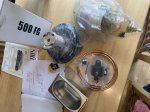
What model pump are you using?Well, hadn’t seen this post.. but quite apt, I just bought all this stuff to make a “Diy fuel polishing” kit. Had one on my last boat after having the bug. Not had with my Mitchell, apart from a few black spots around my racor this year when I changed the filter a couple of weeks ago. Hence...
Price paid for everything here £64. Going to mount on a bit of ply, not pictured here a few hose clips & fuel taps I have spare.. will post result.
View attachment 93469