Simple DIY diesel scrubbing?

Q for Refueler et al, hope OP don't mind:

As others, I have been using M16 for years, before that, I rotated different treatments and water dispersal products. My annual fuel turnover is low, one major trip a years requiring several tank refills, lots of short 18-26nm coastal hops or trips around the lagoon. Fuel looked clear when last inspected.

So, onto my questions: 1) Do you think it is worthwhile polishing fuel in tanks once a year? I would probably start with 30mic and then change to 2mic filters - I would be interested in the results, monitoring pressure drop, clean against challenged filters for both filter sizes? 2) Do you think water dispersal is beneficial or simply continue with M16?

I have excellent accessible drains at the base of each tank that already have lever operated gate valves so really easy to do on my boat, tank sizes are each 818L capacity.

Personally ?

If you have good access to drains ... periodic drain of a touch to be sure water is out.

If you are regularly using up / topping up fuel - then use of additive such as Fuelset or 16 IMHO should be good enough.
Its actually good to use up as much of the tanks 'existing' fuel if possible before adding more ... so you do not carry over any risk .... use of Fuelset / 16 again helps to mitigate this.

I am not against filtering fuel .... or 'polishing' as its got termed - but I don't do it and my fuel actually sits for long periods ... I just give it a dose of Startron now and again (reminds me - must get some more). Why don't I use company product ? That's owned by clients and under customs seal - so its easier for me to buy a retail bottle - even though that's about 10x the price !!
 
Update.
Polisher built.


B7F49B75-B78E-4DC1-B407-4FF90A9C05E4.jpeg
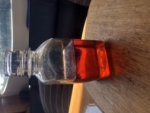
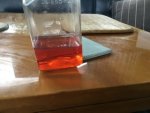
Sample 1. No precipitated water but cloudy

C0F11638-5281-4565-9B42-CFCB8D769BB7.jpeg
Same sample heated in an open pan till finger warm.
Went clear as water flashed off.
Conclusion, water emulsified in diesel.

560DDF62-2E10-4ABB-9892-442C85017336.jpeg
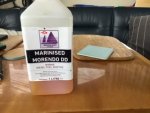
Added this stuff. Write up indicated it is a de-emulsifier. Note dose was for “normal” use and not for initial or for contaminated fuel.

Took boat out and bounced it around in a F6 over the weekend (this tank is separate from main tanks)
4 days later.......

8F151D51-451C-4EC9-AB56-17873BD6735B.jpeg
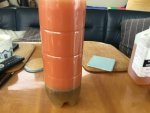
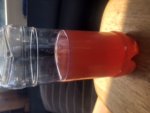
Sample 2. Initial pump run looked like soup

CDFF60CD-E821-41AA-8B14-CD2A6BCA5BBF.jpeg
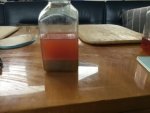
Sample 3. After 5 mins was just as cloudy as before treatment.
Sediment is from centrifuge bowl. Total water removed about a cupful.

DC11D236-F895-4F0C-8D58-ED1A2A0F10D9.jpeg
Sample 3 heated in open. Went clear, tilted to show slight sediment present

Conclusion:
Dosing obviously works as now getting water separated
Polishing works as centrifuge is removing water (and a few particles)
Still cloudy? Should have put in a higher dose as the dosage used is probably spent

Am running for an hour or so now, will re- dose

Watch this space
 
Sediment is from centrifuge bowl. Total water removed about a cupful.
A cupful of water in such a small amount of fuel is very abmormal. I'd be worried about a major leak of water into the tank. Have you tried putting a dip tube in to measure how much water settles out, or by draining from the bottom?
 
A cupful of water in such a small amount of fuel is very abmormal. I'd be worried about a major leak of water into the tank. Have you tried putting a dip tube in to measure how much water settles out, or by draining from the bottom?
This is from a long range tank that I gather from 2 previous owners has sat for at least 2 years and has been carried around in the lazerete holding the back of the boat down, as a rough guess about 10 jerrycans.
the outfeed is at the lowest point of the tank as there is no dip tube. It is from here it is pumped into the main tanks.
First polish revealed no sedimented water, just emulsified. Then dosed with de-emulsifier to give a cupful on first pump run a few days later.
 
This is from a long range tank that I gather from 2 previous owners has sat for at least 2 years and has been carried around in the lazerete holding the back of the boat down, as a rough guess about 10 jerrycans.
the outfeed is at the lowest point of the tank as there is no dip tube. It is from here it is pumped into the main tanks.
First polish revealed no sedimented water, just emulsified. Then dosed with de-emulsifier to give a cupful on first pump run a few days later.
So that's a cup out of a 200lt tank. Not so bad. I misunderstood.
 
The following is an interesting video from Separ, its the model of the primary fuel filter I have fitted on my boat, the cartridges go down to 10mic which I may use for polishing with 30mic in use:

Useful video from Separ
Yep same as mine as well - as you would expect.
And going back to our case of the diesel bug, none of the bug passed the Separ filters.
It was the Separ Filters that blocked.
My system has a pressure switch that detects low pressure fuel and it was this that alarmed us to the problem.
As you say, the 30 micron filters are the ones that we normally use in the system.
They are expensive but they do seem to do the job.
I have bought some MUCH cheaper filter cartridges to see if they work as well.
Separ original 30 micron filter cartridges (01030) are about £27 each - Inline Filters do a compatible for £8.01 +VAT
Our generator uses a smaller one (00530) and are about £21 each - Inline price is £5.13 + VAT
The Inline ones look similar so should be OK
Just thought these prices might be interesting.
 
Interesting, whilst I do like to buy OEM filters they are often re-badged and same filters sold for a fraction of the cost.

I will be building a polishing kit to take out (not this visit tomorrow, but later in July ), I will fit two suction pressure gauges, we can then compare the pressure drop with each clean filter. Can you find out the differential pressure that your switch operates, to tell when the filter is challenged?
 
You mean to tell me you haven’t cracked the MTU code yet and downloaded their software, after all I recall you spent days at the factory many years ago?

No problem, I will measure dP clean and challenged - it will depend on system configuration and flow rate likely specific to an engine but Separ may be able to give me an approximate drop when challenged.
 
Update.
Double dose of de-emulsifier, after 4 days fuel did not clear and no more water in the separator.
It was suggested that it may be petrol as this was sometimes added to stop fuel waxing if very cold, though modern additives have negated the need for this.
4 different people have sniffed and said without any prompting that it does have a faint smell of petrol.
So have now got 8 containers of cloudy diesel kicking around.
I am also told that I can feed this into main tanks at 10% rate.
However I am also also told that the petrol in the fuel will remove the wax coating on the 1st stage filters which is there to collect water and drain to the bottom of separator bowl.
Not so worried about the cost, it is just a pain to dispose of so much fuel
 
Update.
Double dose of de-emulsifier, after 4 days fuel did not clear and no more water in the separator.
It was suggested that it may be petrol as this was sometimes added to stop fuel waxing if very cold, though modern additives have negated the need for this.
4 different people have sniffed and said without any prompting that it does have a faint smell of petrol.
So have now got 8 containers of cloudy diesel kicking around.
I am also told that I can feed this into main tanks at 10% rate.
However I am also also told that the petrol in the fuel will remove the wax coating on the 1st stage filters which is there to collect water and drain to the bottom of separator bowl.
Not so worried about the cost, it is just a pain to dispose of so much fuel
Leave it to stand for a few weeks and see if it clears naturally. If it does pass it on to you nearest Corvette owner - he will get rid of it for you !
 
Top