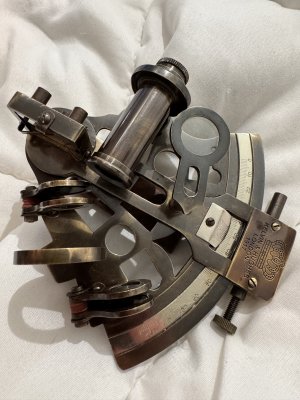
Sextant kelvin hughes london 1917

They were certainly constructed and sold as professional working instruments. Inside the case ( ? ) should be a 'collimation' or 'test' certificate showing the instrument errors at various intervals of arc.

Should that be missing, or if the device has been unused for years and possibly 'bumped', then it is advised to have it re-checked for accuracy/damage and a new table of errors provided for use in your sight reduction work.
 
The company was originanly Henry Hughes and Son and had their works at Hainault. In 1941 the London Fenchurch Street offices were destroyed by German bombing which led to a collaboration with Kelvin, Bottomley and Baird of Glasgow as Marine Instruments Ltd. The amalgamation was formalized in 1947 as Kelvin and Hughes Ltd., as part of Smiths Industries Ltd. The firm of Kelvin and Hughes Ltd. was liquidated in 1966 but the name Kelvin Hughes was continued as a division of Smiths Group Plc.

Seems strange then that yours is dated 1917, could it be 1947 or 1977?

The Hughes instruments in the early part of the centuary were considered to be marginally superior to the well known and excellent Heath instruments.

If you could attach or email me a picture I may be able to identify it for you. Is there a model or serial number on it? Is it a vernier or micrometer adjustment?
 
Aha, are these the ones advertised on Ebay? if so then they are a working reproduction but have not been fine tuned to be used in anger! As Oldbilbo mentions an Sextant to be used as a Navigation Instrument will have a certificate inside advising of known errors.
 
okay - any idea how well they work? i just want to learn to use a sextant out of interest. GPS is still favourite but maybe later on I'll invest in a proper working one
 
It looks like an India-made copy. Certainly not a "real" sextant and the 1917 date is almost 100 years out. If really cheap it would be interesting to see how far out the fixed errors are. If you buy one find someone with a proper navigation sextant and compare - easy enough to do almost anywhere you have several distant static objects.
 
Don't mean to be facile but... http://www.youtube.com/watch?v=CBiThaw7Pm0&list=FLQ-SlMw8erAJhNRBTnGwqcQ&index=5
This occured because I have recently been let down by the seller on a successful bid for a fleabay Ebbco, I instead invested my time in having a go at this. Bit like home made pasta, fun but pointless in all honesty, I did learn alot in the process though :)

Edit: Have a look at the Jester forum on here, there are some really good inputs from members about the Ebbco, ScallywagII's input is particularly sound advice IMHO!
 
Last edited:
I think that by now you will have realized that your sextant is not one manufactured by a recognised and reputable company and is probably a reproduction of recent date. No doubt perfectly functional and excellent to learn on.

If you are looking for further information I suggest you read a book by W. J. Morris called "The Nautical Sextant". It is a modern book mostly concerned with the restoration of sextants but it is a mine of information on the history, makers, development and use of sextants over the years.

I was given a sextant as a biscuit tin full of bits. It was an old Heath sextant and had obviously been retrieved from a wreck judging from the corrosion on all the parts. I have learned a lot by restoring it, although it will never be properly functional again as it is too badly corroded, but it is an interesting artifact to have as an ornament.

Incidentally, any sextant you see that is all polished brass is probably a reproduction for display/decorative purposes or has been restored incorrectly. Proper 'working' sextants were painted with matt or satin paint to minimise reflection of light from any surface.
 
Last edited:
i didn't go for the kelvin hughes sextant - as its from india i was wondering if they might have got some old ones left by the brits - the pic certainly doesn't look its highly polished but in light of above comments that's not likely.

as my sailing is always coastal it was academic anyway. thanks for all the advice.
 
....as my sailing is always coastal it was academic anyway. thanks for all the advice.

As I recall Marine Cadets would spend a year or more typically in the Home Trade ( i.e. coastal ) learning the rudiments of the working of a ship - including the use of a marine sextant for coastal fixing by Distance Off by Vertical Sextant Angle, Fixing by Horizontal Sextant Angles ( and Station Pointer ), and the right way to handle and look after the battered old ship's sextant.... before being allowed anywhere near a good one.

Part of the apprenticeship.... and part of mine.

There's a certain 'Minn' of this parish who will recall, I'm sure, those times.
 
As there is a big trade in ship breaking in India, there are occasional sales of old commercial sextants from the vessels being broken which appear on Ebay, but the trick is spotting the genuine articles from the dross. The particular type
(eg Tamaya), pukka box and optics report are good clues, but not foolproof!
 
Anyone know anything about these sextants? Are they working accurate instruments or just reproduction ornaments?

It is a minisextan a precision instrument, if the user have nessesary aknowledgement about navigation by celestical bodies the result will be good. I have one her for sale do you know anything about the price?
 
I’m just wondering if mine is a reproduction and if it’s accurate
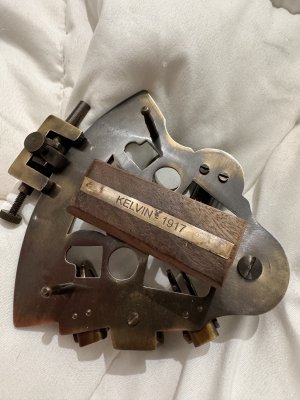
Repro copy, and not even a reproduction of a real sextant from 1917. It would be interesting to compare it's accuracy with a good sextant.

I have actually navigated with a basic Ebbco, though whenever possible I took half a dozen sights and averaged the results on graph paper. If you did this and checked the index error every time it was fine. The telescope was pretty junky though and as my eyes got older I bought a ex-US Navy sextant from 1941 with better optics that was much nicer to use.
 
I would worry about several things with the toy ones. One is - are the shades really good enough? Two is - are they even possible to align correctly? three is - is the angle scale really a scale or just a picture that looks like one?
 
It would be interesting to see if you could actually set the sextant up before even contemplating taking a sight. There are no adjustments available on the horizon mirror (I'd expect 2, for side and index error) and what looks like 3 on the index mirror (I'd expect 1, for perpendicularity). None of which will directly allow you to remove any perpendicularity error which is the fundamental adjustment of the instrument. Whilst you may be able to set the index mirror perpendicular to the plane of the instrument by messing about with the three screws you then have no ability to remove side error (if it exists which is quite likely) without compromising perpendicularity.

Normally, unless there is some gross deformation of the frame then perpendicularity and side error can be completely removed. There may remain a residual index error but that is recorded on the testing certificate (often decades out of date) or better, by the user establishing the extent of that error before taking a sight.
 

Other threads that may be of interest

Top