Setting rig tension on a masthead rig - single spreader

eddystone

Well-Known Member
Joined
18 Aug 2013
Messages
1,936
Location
North West Devon
Visit site
Have to admit I've shied away from adjusting my rig partly because it seemed "about right", lack of success with the Selden method using a folding metre rule and Vernier gauge and unwillingness to cough up for a rig tension gauge.

However I've now acquired a Sure Check rig gauge which is a lot cheaper (unfortunately gone on sale at Jimmy Greens since I bought it) and there a few things I'm not sure of. I've read a few guides and find the Selden one the easiest to follow.
I have open bottle screws with spit pin locking and flats machined at the top end and a babystay instead of fore and aft lowers..

1. I assume that you stop the rigging wire from turning by placing a spanner on the flats and turning the body of the bottle screw with a screwdriver/tommy bar?

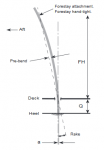
2. With regard to longitudinal tension, if one sets the correct mast bend by adjusting the backstay (forestay hidden by furling spar so nothing to adjust there) what if correct tension, say 15% doesn't give correct bend, 1 degree in my case)?

As an aside I've always thought my mast seems to have quite a bit of bend (from above the spreaders) and think I might find its a bit/lot more than 1 degree - is it possible for mast to acquire permanent bend through excessive backstay tension? Although I couldn't do any longitudinal checks out of the water as the boat is not chocked level, babystay tension does not seem excessive enough to pull that part of the mast forward. A few people, riggers and sailmakers, have looked over the rig in the last few months and not commented adversely.

3. Why is it necessary to slacken the cap shrouds and lowers right off before measuring latitudinal symmetry? It seems more logical to me to set the tension and then make slight adjustments to centralise the mast.
 
I am a heretic who says you do not need that huge standing tension on the rig. ie the 15% of max for the wire. In many cases the hull will flex under that load. OK so less static tension. I would suggest you firstly check the mast for vertical by suing the main halyard to compare distances to the gunwhale. If it is not vertical (central) then slacken the inner side stays a little and adjust the cap shrouds to get central by tightening one side loosening the other. End up with the chosen static tension.
Yes you hold the wire with a spanner or pliars on the flats and adjust the rigging screw.
Next tighten the inner side stays to get the mast straight in the abeam direction and again with some tension.
The fore and aft adjustment is often set while sailing to suit conditions. Firstly the fore stay length will dictate mast rake. Presumably you are happy with rake. Usually just a little backward. Back stay tension will provide forestay tension which in turn will reduce fore stay sag. (sag gives fullness to the jib) (not good in strong wind. The inner forestay also sometimes adjustable while sailing will give a forward bend to the middle of the mast. Usually this is against the aft pull of the intermediate side stays which will come from a chain plate aft of abeam the mast. So static collective tension of the intermediate side stays will contradict mast bend and must be overcome by static tension of the inner fore stay. More bend is good to reduce a bit the bagginess of the luff of the main sail. Straight mast for light winds. Some bend for strong winds.
Regarding the apparent bend in the mast above the spreaders. This may be permanent. Check with no tension on stays.
The desired bend will be symetrical above and bellow spreaders.
I have a fractional rig and I got at one stage a bend in the top after hooking the back stay on the top of a channel marker. (spit post we call them) Yes sailed too close. I managed to fix the excessive bend by fitting jumper struts. A bit like diamonds. Spreaders were made that were facing forward and about 90 degrees from one another. (and braced to one another. Wires ran from the mast top down to the main spreader bases. Thus when these wires were tightened they pulled the mast top against the baby spreaders to straighten the top of the mast. Worked OK until I got a new mast after doing the same trick with another marker post. (the madness of racing). Mostly though I would suggest unless the permanent bend is bad just ignore it. Try to minimise the permanent bend with inner fore stay and inner side stay tensions. ol'will
 
2. With regard to longitudinal tension, if one sets the correct mast bend by adjusting the backstay (forestay hidden by furling spar so nothing to adjust there) what if correct tension, say 15% doesn't give correct bend, 1 degree in my case)?

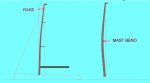
Agree with the comment that there seems a bit of confusion between mast rake and mast bend. Tighten the backstay until the forestay is the right tension then check the mast rake by using a weight on the end of the mainsheet. For the Sadler 32 it should hang around 20 cms behind the mast at deck level. I adjust the caps and lowers next (following the guide on the Selden website). Finally the baby stay adds the mast bend. 1-2 inches is recommended. Again use the mainsheet halyard but this time held close to the base of the mast and sight up to check the bend. You don't need much baby stay tension to introduce the pre-bend.

I'm not sure what to make of the permanent bend but if you start off with the baby stay slack you will see if the mast straightens.
 
I am a heretic who says you do not need that huge standing tension on the rig. ie the 15% of max for the wire. In many cases the hull will flex under that load. OK so less static tension.

Riggers say that many rigging failures are caused by rigging being insufficiently tensioned.
 
... As an aside I've always thought my mast seems to have quite a bit of bend (from above the spreaders) and think I might find its a bit/lot more than 1 degree - is it possible for mast to acquire permanent bend through excessive backstay tension? Although I couldn't do any longitudinal checks out of the water as the boat is not chocked level, babystay tension does not seem excessive enough to pull that part of the mast forward. A few people, riggers and sailmakers, have looked over the rig in the last few months and not commented adversely. ...

... I'm not sure what to make of the permanent bend but if you start off with the baby stay slack you will see if the mast straightens.

Oddly enough, I noticed recently – but not for the first time – the pronounced mast bend above the spreaders but believe it’s quite normal. It’s certainly more than 1 degree, and if it were the result of damage I think it would be noticeable in distortion of the mainsail track.
 
Top