
Seized seacock; tips to release?

yodave

Well-Known Member
Joined
31 Dec 2010
Messages
400
Location
up North
Visit site
blogaprilprep02.jpg


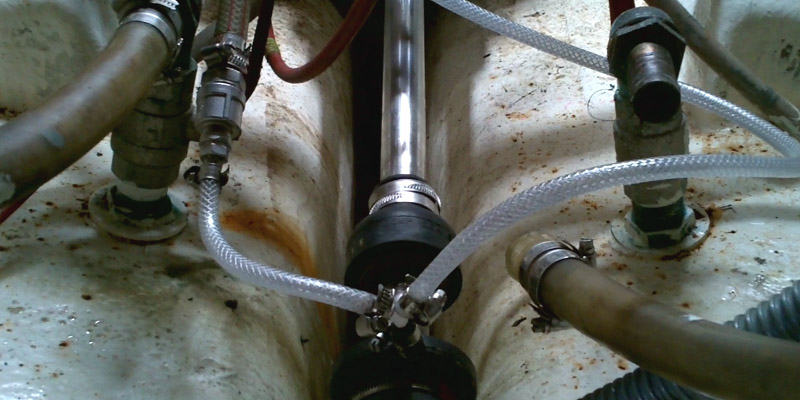
Hello, I have a seacock (cockpit drain) which isn't keen on moving. It's not all that easy to get to; it's the one to the left on the image above. Hitting the handle with a mallet might only break the handle. I believe that removing the handle and using a socket set could be a way of opening and closing the seacock.

We're on the hard just now, and I'd like to be able to open and close the cockpit drains easily this coming season. My question is about lubrication. Should I try to put some heavy duty grease up the drain from the outside before I try to close the seacock? If not, how do you lubricate a seacock (lubricating seacocks for dummies style)?

Oh, I realise that best practice would see me replacing the hoses with reinforced hoses (as with the smaller hoses visible in the image above), that's on my list too, but I've checked them and they appear to be in good condition. So that's for another day.

Replacing the seacock is an option, but I'd much prefer to bring it back to life as I already have plenty to do ahead of crane in.

Many thanks for any and all thoughts in advance.
 
It is a ball valve and probably seized through lack of action. There will be a build up of deposits around the edge of the opening in the ball which is preventing it from rotating. Spraying penetrating oil up the outlet may help free it. Operating the valve regularly reduces the chances of seizing.
 
Thanks Tranona, yes I think lack of use is the problem. Any idea whether I should try spraying WD40 up from the outside? ...or take the hose off and spray from the top down?
 
socket set no good as ball V/V`s have slots, depending on size small spanner might do it with firm pressure either way until it breaks free. Normally do not require greasing, BUT since you are ashore I would stick wood bung in hole and (pour enough to fill above V/V) hot soapy water down drain then try and fiddle with spanner. worth a try
 
Thanks Tranona, yes I think lack of use is the problem. Any idea whether I should try spraying WD40 up from the outside? ...or take the hose off and spray from the top down?
If you use a spray can with straw you will reach the same places from outside as you would from inside.
 
I was told not to use WD40 as it could damage the seals (not sure how true that is), but instead to use a PTFE type spray (Halfords sell them), BUT I find the PTFE dries quick before you've had a chance to move the seacock handle etc, so two people job really.
 
Problem is that the valve is open, so anything you pour or spray into it will just run out without ever getting to the ball. You could maybe try putting a bung in the skin fitting and filling from above with paraffin but it looks to me that the valves are chromium plated, which means they are brass ones. At the very least I would take them off to check thoroughly for dezincification and free off after soaking if they prove to be sound.
 
when I bought my boat I was there when the surveyor went through and tested all those things.
Her advice. the plastic ball valves have a tendency to siese up.

Apply a bit if heat with a heat gun. it worked. after which open and close now and again.
mine were siesed they freed up easily
 
when I bought my boat I was there when the surveyor went through and tested all those things.
Her advice. the plastic ball valves have a tendency to siese up.

Apply a bit if heat with a heat gun. it worked. after which open and close now and again.
mine were siesed they freed up easily

That makes sense. The metal body will expand with the heat more than the ball as it will be hotter. That will open up the cavity in which the ball rotates perhaps enough that there is little friction from the ball meaning all your force on the handle is working on the growth blocking the valve.

Anyone else tried this?
 
it looks to me that the valves are chromium plated, which means they are brass ones. At the very least I would take them off to check thoroughly for dezincification and free off after soaking if they prove to be sound.

For the small cost and short time taken to change it, I would just replace it. Also, as Vyv says, check the through hull for any sign of pink dezincification colour I had one break up recently although it hammer tested OK 12 months previously.
 
Can't you get a bit of tube or a box spanner over the handle to increase the leverage? As Nigel says work back and forth, once you get the smallest amount of movement, you've cracked it. In future, exercise all ball valves regularly.
 
Can't you get a bit of tube or a box spanner over the handle to increase the leverage? As Nigel says work back and forth, once you get the smallest amount of movement, you've cracked it. In future, exercise all ball valves regularly.

It doesn't always work. I managed to snap off handles a few times doing this. The shaft is bronze or brass and so pretty weak.
 
That makes sense. The metal body will expand with the heat more than the ball as it will be hotter. That will open up the cavity in which the ball rotates perhaps enough that there is little friction from the ball meaning all your force on the handle is working on the growth blocking the valve.

Anyone else tried this?

The coefficient of thermal expansion of most plastics is far greater than for brass/bronze, so you could argue that heating will make it worse!
 
The coefficient of thermal expansion of most plastics is far greater than for brass/bronze, so you could argue that heating will make it worse!

Definitely so. I would expect that the heat wouldn't get to the plastic (PTFE) seals very quickly and so this wouldn't apply. Perhaps a fast blast of heat is what is required to make this trick work. The specific heat capacity of PTFE is over 3 times that of brass, so that will help slow up the process.
 
Last edited:
If it were me, I'd:
. remove it from the boat and inspect it thoroughly as you free it up (lubrication and back/forth). There is not much worse than a seacock that you think is closing but isn't (don't ask me how I know but it did involve a 60 litre black water tank on the hard) .
. install the old/new one in a position that it is easy to reach, possibly even re-route the smaller hose out of the way, keep hands clear of the shaft?
. definitely replace that solid hose.
Andrew
 
Problem is that the valve is open, so anything you pour or spray into it will just run out without ever getting to the ball. You could maybe try putting a bung in the skin fitting and filling from above with paraffin but it looks to me that the valves are chromium plated, which means they are brass ones. At the very least I would take them off to check thoroughly for dezincification and free off after soaking if they prove to be sound.

If paraffin not available try a bung at hull outlet and top up with diesel.... it manages to shift most things if soaked for long enough.
 
I freed one up that had seized solid in the open position.
I squirted oil up from the outside, left it for a week and it still wouldn't budge.
In the end I took it home, soaked it on oil overnight and it was still locked up despite heating with a blowtorch.
Next morning,, I stood on the thing to hold it steady and forced the handle. The theory was that it was knackered anyway and if I broke it, I'd lost nothing.
Anyway, it gave slightly under tremendous pressure, that turned the ball just enough for me to get more penetrating oil down the side of it and by attacking it with boiling water, soap, oil and keep wiggling it I eventually freed the thing up.
Tested it afterwards by closing the ball and adding solvent above it, the idea there that its much less viscous than water so if that couldn't get through, it should be water tight.
The force required to turn the thing after breaking the seal made me realise that I would never have turned it in the boat, I think the hull would have given up first.
Depending on the price of a replacement, it may be more hassle than it's worth.

My (very lengthy!) thread is here if of interest: http://www.ybw.com/forums/showthread.php?343691-Seacock-stuck&highlight=
 
Last edited:
Thanks very much to all that have replied. pampas: I think your idea of blocking the exit and pouring soapy water down the drain is a good one if I leave the seacock in situ, but having read other replies I think I'm going to remove it/them. knuterikt: I've heard of the use of straw, but I'm not 100% sure how that works - however I now think the thing to do is to remove the seacock(s). Scubadoo: Thanks, I had heard that WD40 wouldn't damage the seals, but penetrating oils might eat away at them. vyv_cox: thank you for pointing out that the seacocks might be brass, which I understand is not the optimum solution. It's this piece of information that's fundamentally changed my approach to the problem. I'm not keen on having anything that's sub-standard as for the sake of £50 I'd much rather stay floating. Thanks for your input - I'll now need to understand what needs replacing. Is it the seacock and the skin fitting, or is it just a matter of unscrewing the seacock and rescrewing on a replacement?

Uricanejack, BigEmUp, nigel mercier, ghostly moron, sailaboutvic: Thank you all very much for your input, I'm currently thinking that replacement is the way ahead. I now realise that I need to regularly open and close the valves but I didn't know this when we first bought the boat. It's only now that I have a better understanding of the basics, that more detail on how our boat works is coming centre stage. GrahamM376 & Andrew G: Yes, I agree. Not sure it will take me a short time to change, as I'm not Mr DIY and don't really understand what the process is yet. Scotty_Tradewind: thanks for your input, as with soapy water, WD40 and penetrating oil, I think diesel would have been worth trying, but I'm now concerned about the material that the seacocks are made of, so think that replacement might be the most sensible approach. Murv: Thanks for the background info and link, that's really useful but like you I'm questioning the logic of trying to get a seized seacock back into working order when replacing it/them is probably the way ahead.

Thanks again to all including Tranona. Just to recap further to vyv_cox's comment, I'm concerned about the seacock material if it's brass. If it's simply a matter of unscrewing the seacock and rescrewing in a replacement that seems like the sensible thing to do. What I'm less keen on is tampering with the skin fitting as that seems a little more challenging (for the likes of me). While I'm at it I might as well upgrade the hose to a reinforced version as advised by Andrew G. Any further advice on what's required in terms of the process of replacement would be really useful.
 
Top