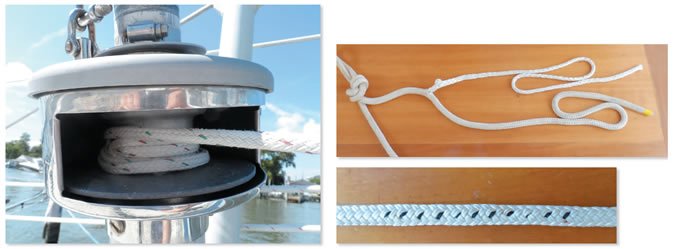
Sealing a de-cored furling line

Remember that a furler is always a foil. You should be able to blanket the sail and pull it down. I know this is obvious, but I've found my self forgetting this obvious truth. Most round-the-cans racers don't use furlers.
Yes, of course, but still a very scary thought having to deal with that on a black night offshore with the wind howling and 3 reefs already in the main..
 
.......................................
If you are winching hard enough to break the cover you are going to damamge the furler. If the force is that high there is a problem with your method or something is jamming. Try furling down wind, with the genoa behind the main. You should be able to hand furl in most conditions up to about 40'.

Why you post that against quote of me ??

I'm 64yrs old .. been on boats since I was 5yrs old ... lost count of how many boats I sailed with all manner of furlers - manual and powered ... hanked on sails ... entered AND won regattas .. organised regattas ...

I certainly do not know all ... far from it - but I do not need patronising stuff like that !!
 
True! This is what the line is sized for. But it is less than the sheet load because there is a good bit of line on the drum (leverage).

Would you like to put scales on each line and test that theory ..................

If that were true - then a chain block would be easier to operate if the operators chain was wound round the gypsy a number of turns. But funny enough it isn't.
 
Why you post that against quote of me ??

I'm 64yrs old .. been on boats since I was 5yrs old ... lost count of how many boats I sailed with all manner of furlers - manual and powered ... hanked on sails ... entered AND won regattas .. organised regattas ...

I certainly do not know all ... far from it - but I do not need patronising stuff like that !!

Relax.

The comment about not heat sealing the core was was directed to the quoted post, but the other comments did not relate to anything you said. I thought that was clear, but I should have prefaced the latter comments with "regarding comments by other posters:"

No intention of patronizing. Forums are a challenging media because responses tend to be brief.
 
Pointless comment ....

Plus of course go buy rope and watch the guy usually cut it with a hot blade that not only cuts buts melts to seal the ends.

In post #3 you said "I would a) heat seal the end of the core while its still outside before back in. " This is not the end the man at the store heat seals, this is the end of the core you just cut with a knife. It should then be tapered, milked back inside, and secured with a few stitches, but never heat sealed or cut with a hot knife. A hard spot in the line like that can weaken the cover by 20-40%, based on testing. Burries are always tapered.

fitting a furler line
 
Would you like to put scales on each line and test that theory ..................

If that were true - then a chain block would be easier to operate if the operators chain was wound round the gypsy a number of turns. But funny enough it isn't.

I have (rope clamp and load cell), and there is a reason this is generally true. When you first start reefing the diameter of the spooled line on the drum is considerably larger than the wrapped sail diameter, but this will very with the depth of the reef. However, the genoa sheet tension begins to decline as you reef, even though the wind speed has increased. It is at it's peak just before reefing begins. I've never struggled to winch in a reefed genoa the way I have struggled with a full sail, just on the verge of reefing.

If this were not true furlers would have to be a great deal larger, would they not, and people would break them frequently.
 
In fact, this is how it usually works out. You only need to remove enough core to get it to fit on the drum. You can always remove about 1/2, see if it works, and then remove more if needed before stitiching.
I wish you luck in trying to get the core exposed again after cutting and feathering a meter or two off of it, unless you attach a mouse line to it first ;)
or I suppose you could dig it out of the side of the sheath.
 
I wish you luck in trying to get the core exposed again after cutting and feathering a meter or two off of it, unless you attach a mouse line to it first ;)
or I suppose you could dig it out of the side of the sheath.

What?

You only taper about 6 inches, and pulling out the core a few feet farther up is the work of 30 seconds. I have done this before, just as I described, when I didn't remove enough core the first time.

Yes, of course you pull the core out through the cover. That is how the core is always removed, not through the end. You bunch up the cover, spread the yarns, and snag the core with a fid. This is why I said to do it before lock stitiching. Yacht double braids have relatively loose covers in part so that you can pull the core through the cover.

See 1:00 into this video. splicing video
 
I think a few people should bear in mind that what they are suggesting isn't necessarily obvious until you've actually done it.
 
With the greatest respect, I fail to understand the reason for the recommendation to lock the core to the cover. I have stripped out 1/3 core from three furling lines to date. In each instance i just wihdrew the core through the cover, cut off the surplus core close to the cover and then milked the cover to bury the remainder. Provided that the core is heat sealed or otherwise locked to the cover at the handling end of the line it won't stray far. As I see it, the compressing effect of the cover when under tension will prevent any bunching of the core. The core is never under any significant tension anyway as its only purpose is to give bulk to the line for ease of handling. Incidentally, my boat is 12m long and I always prefer to furl by hand, as i am less likely to impose undue strain on the sail in doing so.
Mike
 
With the greatest respect, I fail to understand the reason for the recommendation to lock the core to the cover.
I agree with this, what would the stitching actually achieve? If there is any strain between the core and the cover that gets taken up by the stitching that means some key thing is held by your sewing, it just doesn't seem to make sense.
I could imagine strain through the stitching separating the weave on the cover or the core though, and maybe creating chafe there.

I generally furl by hand, but on my current boat (37' username is old boat) and occasionally give it a turn on a winch if it's blowing a bit, but it doesn't seem quite right to do so. I've also found myself messing with the bloody thing on the foredeck, sometimes single handed, which isn't ideal, and presumably not how it was designed.
It's actually more of a problem when my wife is on as the amount of fretting she kicks up when something's not right on the foredeck is incredible.

True enough. Kind of like tying your shoes; dead easy... after you do it a million times.
It's what a forum is for innit.. and of course, people disagree about the finer points...
 
Many splices, including Amsteel bury splices (sometimes Brummel lock--same purpose), include lock stitching to prevent shifting during no-load periods. Is it vital? In some cases the splices can come apart due to handling. I've seen commercial eye splices that were not stabilized with stiching come completely apart in the wash during testing.

Does it matter in this case? Possibly not. For most, it is just a "best practice" thing. The core could bunch up a little, so why not eliminate the possibility? But I won't argue the point. Skip it and see how it works. I'll bet it works fine.

There is no strain on the stitching for the same reason the stitching is not vital. The core floats. No, there is no chance of cover damamge. If the stitching is done properly, with the stitches parallel to the cover yarns, there is no chance of chafe. Even if a few chafe through, the core is still stabilized. Done well, they are nearly invisible. Based on experience, these things just don't happen.

(The thread on the right is contrasting so that the stiching can be seen. Can you see the stiching where the line comes off the drum? It's there somewhere, I sewed it. Hood furler.)
p1a9arcmdu8q620n9c2sf2umr6.jpg
 
If the stitching is done properly, with the stitches parallel to the cover yarns, there is no chance of chafe. Even if a few chafe through, the core is still stabilized. Done well, they are nearly invisible. Based on experience, these things just don't happen.
I meant chafe in the cover rather than the stitching, but your experience is better than mine.
 
I guess that whether or not to stitch cover to core is down to personel preference, as there is no irrefutable evidence to suggest that one procedure is better than the other. However, whilst for the moment I will continue not to stitch, if stitching should prove to be a superior method I will be very pleased to modify my practice. Dogma is the enemy of progress.
MIke
 
Top