Sealing a de-cored furling line

Schwari

New Member
Joined
8 Jun 2020
Messages
5
Visit site
Hi all,

I’ve de-cored the end 2m of my furling line because it was too big for the furling drum – it was bunching up as I unfurled and I couldn’t unfurl the mainsail all the way.

De-coring was fine, and I’ve cut the core that I removed.

I’m now stuck about how to ‘seal’ the point of the rope 2m up, where the core begins again. If I just left it, would there be a risk of the core riding up/fraying/other dangerous movement?

So, presuming I need to seal that section:

Can I just use duct tape to wrap around that point?
Or do I need to burn it sealed – if so, how?
Or do I need to stitch it - if so, how? (I have no equipment for this, unless it's just a normal needle and thread).

Thanks for your advice!
 
Best is waxed sailmakers thread ... or a good alternative is carpet thread.

If you are stitching it - then you need to make sure the core gets stitched to the outer braided sheath in correct place. Otherwise it will move inside ..

I would a) heat seal the end of the core while its still outside before back in. b) take needle and thread (sailmakers needle is best and handy to have anyway) and then stitch the two together .. it doesn't really matter the format as you are pulling the thread tight and it should literally bury itself. But make sure it is passed through a number of times to be secure. Simply knotting it and pushing end inside with the core should do it.
 
Feather the core down, don't burn it to seal it as the burnt edge can cause wear, just milk it back down the outer sheath and put a couple of stitches in.
As for the end of the outer sheath, pull it tight to stretch it and reduce the diameter to minimum, wrap with paper masking tape, then cut 3 or 4 mm off the end with an old hot knife on a breadboard, or if you have a gas 'pencil' soldering iron with a cutter bit, then use that.
 
I just feathered down the core and made sure that it was sitting nicely in the outer braid. Takes a few minutes to make the hole disappear in the outer braid and that was it apart from reasealing the end. Cant remember how many years ago that was, and each winter it goes in the washing machine for a clean.
 
Best is waxed sailmakers thread ... or a good alternative is carpet thread.

If you are stitching it - then you need to make sure the core gets stitched to the outer braided sheath in correct place. Otherwise it will move inside ..

I would a) heat seal the end of the core while its still outside before back in. b) take needle and thread (sailmakers needle is best and handy to have anyway) and then stitch the two together .. it doesn't really matter the format as you are pulling the thread tight and it should literally bury itself. But make sure it is passed through a number of times to be secure. Simply knotting it and pushing end inside with the core should do it.
what If i just use normal thread and cotton? Or do i need to get the special stronger stuff?
 
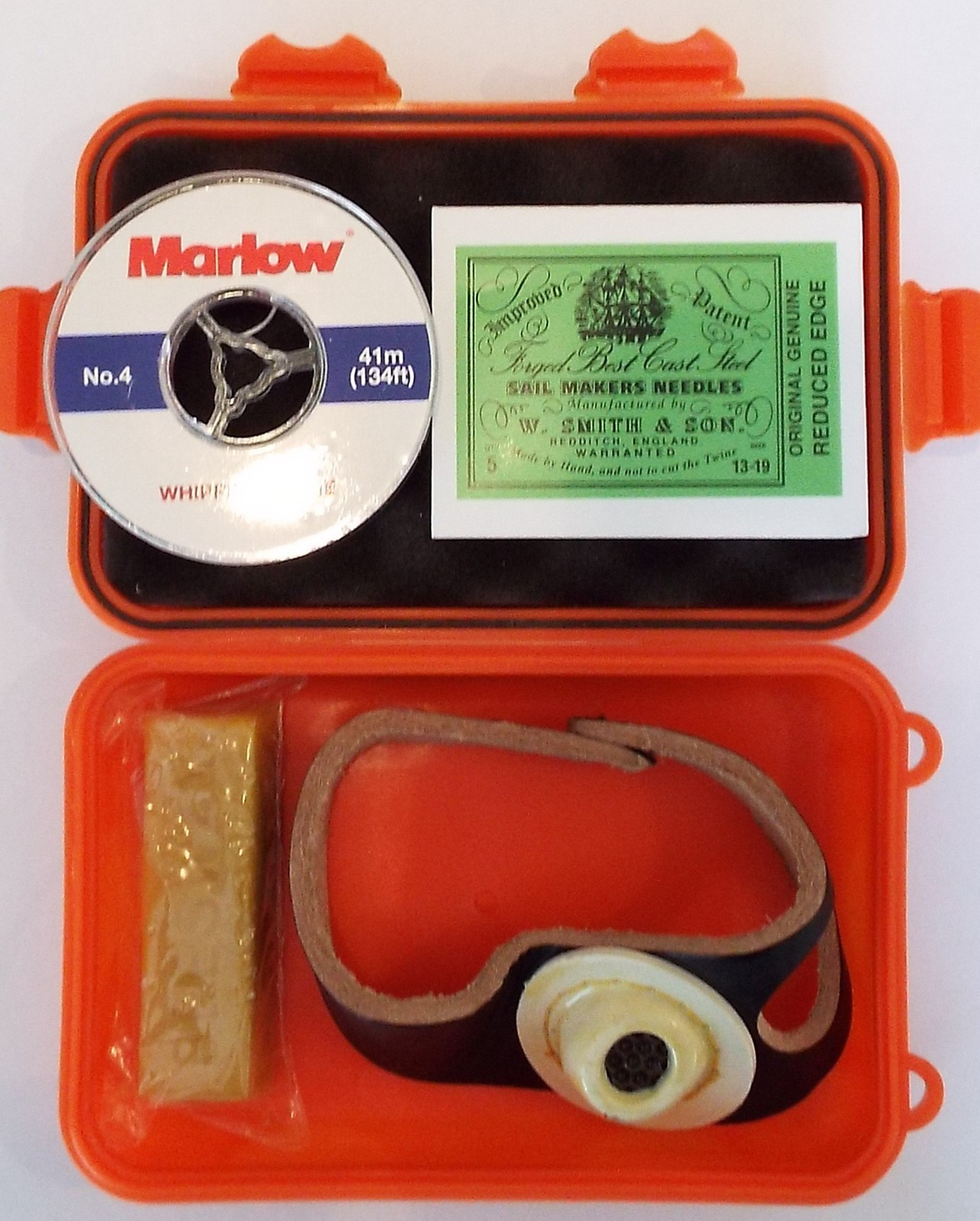
Sailmakers Repair Kit Inc 5 Needles RH Palm, Wax, Whipping Twine In A Sealed Box | eBay

s-l1600.jpg


Bit expensive ... but you should be able find similar in a Chandlers or online shop.

FYI - The Wax bar is only needed if you have plain unwaxed thread. Basically you thread the needle ... lay the thread on the wax .. place thumb on top of thread and pull it through so it coats with wax to give some weather proofing.

I do recc'd the Palm .. the hand item to help push needle through difficult material.
 
Hi
I was thinking of de-coring the bottom 2m of my jib furling line as it sometimes seems to jam when hauling the jib back in.
A reduction in friction would be most welcome (it isnt the bearings).

Did you find this worked for you?
Did you whip the line at the point where the inner core stops (as well as at the end)?
Are there any concerns about strength?

I whip my lines with waxed thread and they hold up well.

Thanks for posting

S
 
£25!
I have a palm but only use it rarely.
I use the waxed thread all the time.

I was using the link to show a kit ... I'm sure the parts can be bought cheaper and a small box can easily be found.

I must say though the Needles shown are the best .... I have same and they are about 30yrs old .. still good.

The Palm ... it may only be used 1 in 5x ..... but when needed - its worth its weight ... designed centuries ago ... still not bettered.

Thread ... I use Waxed as well when needed ... but I also have a large reel of thread used by factorys to sew 25kg bags ... from my days in Saudi ... (I was SABIC Inspector back in late 80's early 90's) .... same as Carpet Thread.
 
Hi
I was thinking of de-coring the bottom 2m of my jib furling line as it sometimes seems to jam when hauling the jib back in.
A reduction in friction would be most welcome (it isnt the bearings).

Did you find this worked for you?
Did you whip the line at the point where the inner core stops (as well as at the end)?
Are there any concerns about strength?

I whip my lines with waxed thread and they hold up well.

Thanks for posting

S
I spliced a few metres of dyneema into the end of the furling line, works great. Extremely strong with no real stretch in the dyneema part.
 
I was using the link to show a kit ... I'm sure the parts can be bought cheaper and a small box can easily be found.

I must say though the Needles shown are the best .... I have same and they are about 30yrs old .. still good.

The Palm ... it may only be used 1 in 5x ..... but when needed - its worth its weight ... designed centuries ago ... still not bettered.

Thread ... I use Waxed as well when needed ... but I also have a large reel of thread used by factorys to sew 25kg bags ... from my days in Saudi ... (I was SABIC Inspector back in late 80's early 90's) .... same as Carpet Thread.
Don't forget that the palms are handed so if left handed get a left handed palm !
 
I’ve de-cored the end 2m of my furling line because it was too big for the furling drum – it was bunching up as I unfurled and I couldn’t unfurl the mainsail all the way.

De-coring was fine, and I’ve cut the core that I removed.

Surely the core of a modern rope is the bit that provides most of the strength. And a reefed jib puts a huge strain on the furling rope.
It might make sense to remove a section of the outer cover of a dyneema rope, to make thinner - a very common technique on race boats, just leaving cover on bits handled by hand or held in stoppers. But surprised that anybody would remove the core of a safety critical rope.
 
...
I would a) heat seal the end of the core while its still outside before back in....

No, no, no. It is worth reinforcing that this is dangerous advice for any splice. There will be wear and it will weaken the rope invisibly.

Taper, milk inside, and then as he said, lock stitch over a several inch length using either waxed sail makers twine or a strand of cover.
 
Surely the core of a modern rope is the bit that provides most of the strength. And a reefed jib puts a huge strain on the furling rope.
It might make sense to remove a section of the outer cover of a dyneema rope, to make thinner - a very common technique on race boats, just leaving cover on bits handled by hand or held in stoppers. But surprised that anybody would remove the core of a safety critical rope.


That's fine when the core is braided .. but not all ropes are Braid on Braid .....
 
Top