seacocks

It comes back to being able to demonstrate that a boat is well maintained and seaworthy following a failure.

Generally an insurance Co will appoint a surveyor who will inspect the casualty and rely on the surveyors report, it is apparent to them when they see a well maintained or a neglected boat.

RCD calls for seacocks and skin fittings to be good for at least 5 years and in normal circumstances brass is except where there are stray currents or earth leaks when it can fail and I have seen brass fail at under 2 years.

Seven years seems a good yardstick.

Ball valve do gum up with scale and marine growth, the spindles are often rounded with movement following forcing, they should be visually inspected in place and a removal and inspection regime should be followed its surprising how many boats you see with brass fittings, or unidentifiable fittings, valves jammed, leaks, rusted steel handles, perished hose, kinked hose and corroded jubilee clips. This is the only thing keeping the water out.
 
As I have already said in another thread:

1/ Brass skin fittings and valves last only 5 to 7 years unless there are stray 240v currents present and then they last a lot less, so should be replaced at 5 to 7 years by good DZR units.

2/ DZR and bronze skin fittings and valves should be removed from the boat and dismantled and only in perfect condition re used, in reality a 7 year programme to refit new DZR fittings is a good practice.
M
Some Insurance Companies will look for wriggle room and partial pay outs only if the removal, dismantling and inspection is well overdue following an incident, 7 years is the recognised norm.

7 years? Never heard that before in 30 years of boating. And no insurance company I know of has stated that either.

Our sea cocks on Eos are original and therefore 26 years old, Blakes, and I have no intention of replacing them. And they passed muster in an insurance survey earlier this year.
 
Last edited:
It comes back to being able to demonstrate that a boat is well maintained and seaworthy following a failure.

Indeed. And since it is not common practice to remove bronze or DZR seacocks on a regular basis, not doing so does not imply that a boat was not well maintained.

Pete
 
I almost bought a boat last year, but unfortunately the survey pointed out several issues. One of these issues was the skin fittings which were five years old, all of them required replacement. It was difficult to see the damage because the fittings had been covered in layers of anti-foul. Once the anti-foul had been scraped away, the metal was the pink colour of dezincified brass. Now that might have just been on the surface, or it could have been all the way through. My surveyor informed me that the insurance companies are very keen on this now, and that they may not expect you to go to the extreme of dismantling your seacocks, but they would expect you to demonstrate that they had been regularly inspected.
 
I almost bought a boat last year, but unfortunately the survey pointed out several issues. One of these issues was the skin fittings which were five years old, all of them required replacement. It was difficult to see the damage because the fittings had been covered in layers of anti-foul. Once the anti-foul had been scraped away, the metal was the pink colour of dezincified brass. Now that might have just been on the surface, or it could have been all the way through. My surveyor informed me that the insurance companies are very keen on this now, and that they may not expect you to go to the extreme of dismantling your seacocks, but they would expect you to demonstrate that they had been regularly inspected.
who was the surveyor
 
Perhaps we need to start having logs that contain this information just in case. A simple tick box that says 'Sea-cocks and fittings checked and in good condition'. It might not be enough simply to do it, you might have to show that you have done it. This may apply to all critical parts.
 
Perhaps we need to start having logs that contain this information just in case. A simple tick box that says 'Sea-cocks and fittings checked and in good condition'. It might not be enough simply to do it, you might have to show that you have done it. This may apply to all critical parts.

Newspapers are useful for this type of thing, because if you include a front page in a photo, it easily dates the picture as not being older than the issue date of the paper. I have loads of photos of various things with people holding newspapers in front of them.
 
Perhaps we need to start having logs that contain this information just in case. A simple tick box that says 'Sea-cocks and fittings checked and in good condition'. It might not be enough simply to do it, you might have to show that you have done it. This may apply to all critical parts.

Always had a log of my all maintenance work, it is a good reminder what has been done and when, it will also help when it comes to selling the boat. For seacocks I take a picture with my camera which is dated for both internal and external including scrapping antifouling off to show condition etc.
 
All I was advised to do was log the fact I'd done it, but taking a photo sounds like a good idea.

Let's get real. How many people on here have bought a second hand boat that came with an album of service pictures ?

And before anyone says we're talking about insurance, how many insurance companies have asked for the service picture album?
 
Let's get real. How many people on here have bought a second hand boat that came with an album of service pictures ?

And before anyone says we're talking about insurance, how many insurance companies have asked for the service picture album?

Yep your right and I think you missed my point, but I take pictures for my benefit and as a record, if there was a dispute with the insurers you have evidence to hand. When it comes to selling the boat, a spreadsheet showing all what has been done is far more beneficial.
 
Detailed close inspection and replacement if required of skin fittings is sound winter preventative maintenance.

We had the heads/toilet outlet 1.5" skin fitting fail on us this time last year on our Fairline Targa 34 as we where coming into Lymington Yacht Haven having had a run down from the Hamble on a Friday night. When the alarms go off it certainly focuses the mind!

Thankfully having towels, soft wood bungs and a hammer to hand stemmed the flow of incoming water and the very swift return to the marina of the on-call hoist operator had us out and on the hard in double quick time. Thankfully no damage to the rest of the boat, the incoming water was contained to the bilges and the pumps did their thing.

A local engineer had new skin fittings installed and we were afloat again by Saturday lunchtime! The old ones were very pink!
 
The normal ones we see in order of occurance are:

The balls are solid and wont turn

Handles corroded or worn on the spindle so wont turn the ball

Leaks on joints ball Valve to ski fitting or elbow etc generally due to corrosion

Corroded Jubilee clips that have or about to fail

The ball valve snapping across the pipe ie either side of the ball, we have seen a few of these one was at about 18months old due to an electrical earth problem and is on Vyv Cox's website.
 
Detailed close inspection and replacement if required of skin fittings is sound winter preventative maintenance.

We had the heads/toilet outlet 1.5" skin fitting fail on us this time last year on our Fairline Targa 34 as we where coming into Lymington Yacht Haven having had a run down from the Hamble on a Friday night. When the alarms go off it certainly focuses the mind!

Thankfully having towels, soft wood bungs and a hammer to hand stemmed the flow of incoming water and the very swift return to the marina of the on-call hoist operator had us out and on the hard in double quick time. Thankfully no damage to the rest of the boat, the incoming water was contained to the bilges and the pumps did their thing.

A local engineer had new skin fittings installed and we were afloat again by Saturday lunchtime! The old ones were very pink!

Any photos for the website, please? I don't think I have any of 1.5 inch valves.
 
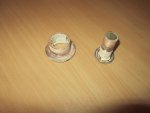
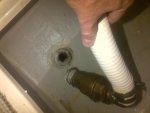
OK, so the the skin fitting started to weep and let water in just under / at the joint between the securing nut and the inside of the hull, it is this weeping that initially set off the bilge alarms and got the pump running and allowed us time to get towels, softwood bunges and the hammer to hand, when it sheered off it sheered flush with the inside of the hull leaving the nut and washer on the remaining threaded tail connected to the plastic / rubber pipework.

From the inside of the boat it all looked nice and bronze colour. From the outside of the hull it was all covered in a/foul.

You would only have spotted a problem by disassembling the fitting, scraping off the a/foul and inspecting or hitting with a hammer which would have sheered it off.

As for the age the boat was launched in 2004 and the incident happened in 2013 so the fitting had been in service for around 9 years, which ties in with the service life of circa 7 years quoted by others, as it turned out we were on borrowed time!

i think (i'm not an IT wiz) i have attached a couple of pics of the fitting after it failed, alongside the also replaced as it had gone pinkish but had did not failed toilet/heads inlet pipe which is 3/4"

i hope this helps.

Mike
 

Attachments

  • IMG_2806.jpg
    IMG_2806.jpg
    93.2 KB · Views: 1
  • IMG_0266.jpg
    IMG_0266.jpg
    84.6 KB · Views: 1
Top