franksingleton
Well-Known Member
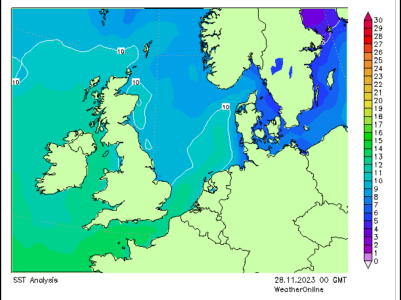
The Weatheronline SST charts seem no longer available. Is this a recent blip or a longer term problem? SST charts on PassadeWeather are still available.


Could it be connected to the Federal shutdown? Doesn't SST come from NOAA satellites?The Weatheronline SST charts seem no longer available. Is this a recent blip or a longer term problem? SST charts on PassadeWeather are still available.
Yes, I have looked at that in the past. For use when sailing the Weatheronline is more useful but the Passageweather version is equally as good. The WOL SST have been on their site for years. I was just surprised that the data were not there now.Could it be connected to the Federal shutdown? Doesn't SST come from NOAA satellites?
There were quite deep cuts to NOAA prior to the shutdown, including some impacting processing and distribution of satellite-derived data, turning off the pacemaker to save electricity stylee. I dunno if this service was affected though.Yes, I have looked at that in the past. For use when sailing the Weatheronline is more useful but the Passageweather version is equally as good. The WOL SST have been on their site for years. I was just surprised that the data were not there now.
Does anyone else have any suggestions? Or ideas why it is not now operational?
PassageWeather still has SST charts. ECMWF data coverage seems to show that all satellites are operational systems are functioning - including EUMETSAT.There were quite deep cuts to NOAA prior to the shutdown, including some impacting processing and distribution of satellite-derived data, turning off the pacemaker to save electricity stylee. I dunno if this service was affected though.
I have just been on the Weatheronline site and in the menu list on the left under "Weather Maps" it has a link to "Water". When I open that I can see numbers of options for coastal locations outside the UK and a relative few for coastal UK. Most of the other maps are not particularly heavily populated with data either. Is this the area that has changed?PassageWeather still has SST charts. ECMWF data coverage seems to show that all satellites are operational systems are functioning - including EUMETSAT.
I think this is a Weatheronline matter.
I have just been on the Weatheronline site and in the menu list on the left under "Weather Maps" it has a link to "Water". When I open that I can see numbers of options for coastal locations outside the UK and a relative few for coastal UK. Most of the other maps are not particularly heavily populated with data either. Is this the area that has changed?
I know you guys are interested in European waters, but I wanted to answer the question about NOAA in the shutdown.There were quite deep cuts to NOAA prior to the shutdown, including some impacting processing and distribution of satellite-derived data, turning off the pacemaker to save electricity stylee. I dunno if this service was affected though.
I know you guys are interested in European waters, but I wanted to answer the question about NOAA in the shutdown.
NOAA satellite data is considered essential, so it keeps going
A new geostationary satellite - GOES 19 - has become operational within the last few months, and GOES 18 is still operational.
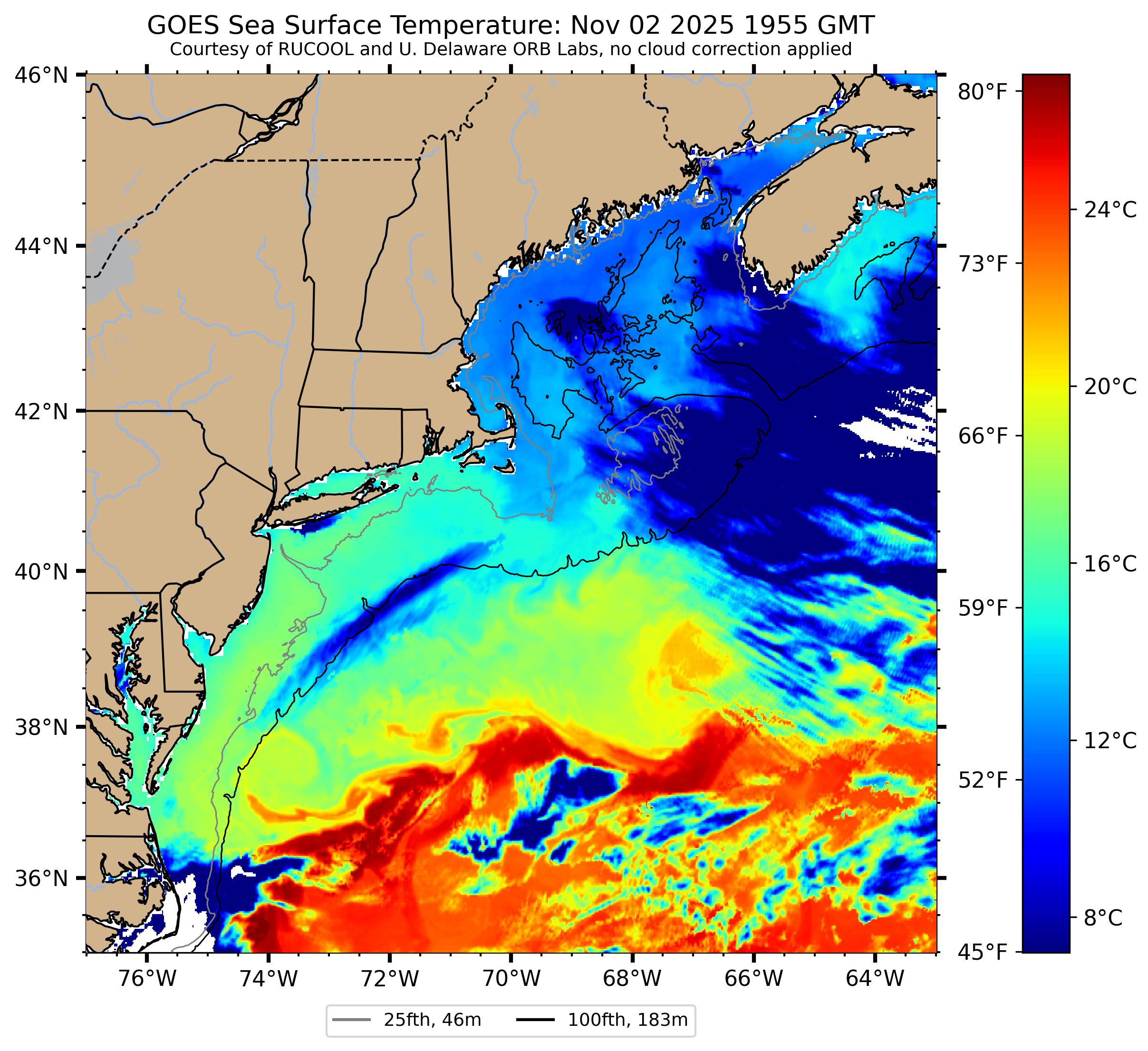
Here is a recent US East Coast composite. This is updated several times a day. Note that this is not de-clouded. The infra red sensor does not see through clouds, and a lot of the deep blue in this image - indicating cold - is cloud tops. Some products incorporate lower resolution microwave SST (which does see through clouds) but this does not.
Thank you. You have put considerable flesh on the bare bones of my #6.If you are having trouble finding SST images for European waters, NOAA has this viewer
NOAA CoastWatch Data Portal
it shows both NOAA and Copernicus EUMETSAT data.
You have to select the actual SST product you want on the left. I mostly download the raw data, so I don't use the viewer much, but I think you can draw contours and so on if you figure out the interface.
Basically, this is research and the most reliable source of information is academic oceanographic journals, which cover both data acquisition, theory and modelling. At the moment I would be sceptical of any popular exposition, as it will almost certainly be slanted according to the popularizer's views. But an effect is very likely, and results in the paradox that increasing global temperatures could result in the UK getting much colder!Frank could you tell me where is the best place to get information about how increasing sea temperatures are changing the ocean currents please.
There was an explanation published not that long ago but I can no longer find it.Basically, this is research and the most reliable source of information is academic oceanographic journals, which cover both data acquisition, theory and modelling. At the moment I would be sceptical of any popular exposition, as it will almost certainly be slanted according to the popularizer's views. But an effect is very likely, and results in the paradox that increasing global temperatures could result in the UK getting much colder!
The most recent thing I've seen (a few days ago) is about increased current strengths in the Arctic Ocean, driven by wind action on areas previously covered by sea ice.There was an explanation published not that long ago but I can no longer find it.
If I remember correctly then the melting of the glaciers and the added fresh water having an effect was talked about in the 1980s.
I am curious to know how the thinking has developed since then
I don't deserve the accolade, really! Most of my knowledge of ocean circulation is to do with the influence of the great Antarctic ice shelves, which are the source of Antarctic bottom water, the deep, cold counterpart to the surface currents. The basics are that the ocean circulation is driven by cooling at the poles, and heating at the equator. There are other influences caused by varying salinity - more saline water is denser than less saline water. But we do know that some systems, such as the North Atlantic Drift, are in very fine equilibrium and that comparatively small changes could disrupt them, resulting in Western Europe losing the warming effect. If you look at other places around 50°N or S, you'll quickly see how anomalous our mild climate is!I cannot add anything useful. I suspect that AP knows more than I. Ocean modelling is an order of magnitude more complex than atmospheric modelling. Global warming is bound to affect ocean currents but there must still be considerable uncertainties. If you want to see the latest work, then ask ChatGPT to give you a list of recent papers on the effect of global warming on ocean currents. I guess that these would be beyond me now but might be comprehensible to a younger mind.
Also getting information about how is extracting power from the wind changing our weather?Frank could you tell me where is the best place to get information about how increasing sea temperatures are changing the ocean currents please.