Sailrite

Sorry - maybe I should explain.

In my dinghy sailing days, I used to sail a Hurricane catamaran - in fact, I still have it.
In my local sailing club, a group of us got together to design and make spinnakers.
I used to profile the spinnakers on the PC and output the designs to a guy in Fareham who had a huge flatbed laser cutter.
We would then stick the parts together using double sided (venture) tape that is designed for that purpose.
And then to finish the job, I used the wife' very expensive Pfaff sewing machine.
Spinnaker fabric is dead easy to sew using a domestic machine.

In our last house, my wife and I used to own a marquee which was made from heavy PVC.
I made quite a lot of additions to the marquee but the domestic machine struggled with it.
It isn't just the machine's ability to "punch through" - the machine has to be able to move the fabric through the sewing head uniformly.

So, thats my experience plus a few other little jobs here and there - covers for a trailer and a trampoline (a huge disaster) for the Firebird catamaran that I once owned.

When we bought the Sealine T51, I bought most of the covers but made a few bits here and there - a front screen cover for example.

Then when the Princess 67 came along, she was new so it has taken a few years before things have needed replacing.
I replaced some of the small ones using the domestic machine but as you will see from the beginning of this old thread, I eventually decided to buy a Sailrite and make my own covers.
That was nearly 2 years ago.
Since then, I have had failures and successes.
Most of my failures have been in using cheap fabrics.
For example that grey fabric lasted for just over a year - not good.
So last year, I resorted to using exactly the same PVC material that came with the boat.
And I really like this white PVC. It has two sides - the finished side has a "kind of" linen feel to it.
Indeed the manufacturers call it a linen finish.

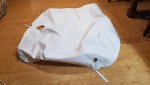
Here are some pics of tests pieces that I've made.
I often make up a few tests before doing a job.

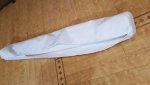
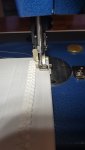
This pic shows the linen effect of the white PCV - you can also see in this photo just how uniform the Sailrite is at stitching.

View attachment 106955

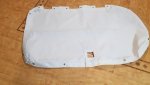
And this pic shows a "mockup" that I did to work out how the canvas door zips would work.
Again note the stitching - and in this case, the sewing machine had to sew THROUGH the zip as well.

View attachment 106956

That all said, you have want to do these things.
Just doing them to save money is part of the issue.
Wanting to make something with you own hands is probably more important.
Thanks for that, just to change the subject slightly and tap into your experience, is it possible to do away with zips altogether and just use Velcro?
 
Thanks for that, just to change the subject slightly and tap into your experience, is it possible to do away with zips altogether and just use Velcro?
I suppose so but zips are dead easy to sew if that was your concern.

The original Princess cockpit covers had zips covered by flaps held in place with Velcro.
When I made my grey covers, I copied the design but the Velcro can be a PIA to undo when you are entering the boat.
So, the latest set of covers that I made use a simple zip like the mockup in the photo above.
And they were much easier to make.

Most of the zips that I do are bought by the metre and I attach the sliders accordingly.
I finish the closed ends of the zips using a hot knife to fuse the links.
On the open end of the zips I use little plastic stoppers that you can buy - push them on, rotate them 90 degrees and then they snap into place.
Makes for a nice tidy finish to the zip.

Where you need to separate the zip (for example two panels need to be stored separately) you can buy "Open Ended" zips which come complete with a slider and stops.
But you need to order the specific size for the job you are doing.
They are the kind of zip you will find on a jacket.
In my case, I ordered "Open Ended" zips for the zips between the cockpit side panels and the back panel.

Sewing "Open Ended" zips are as easy as the continuous zips.

The only thing that you have to keep in mind is making sure that one side doesn't become offset or you will get crinkles or even worse, each side won't match.
In the Sailrite videos, they go to great lengths to make registration marks to avoid this.
But I have developed my own technique.
Using my zip process, I can do all the sewing on the left side of the sewing machine without having to force fabric through the gap to the right of the sewing head.

So, to recap, zips are the fun bit - I use them all the time
Here's an example of a bag that I made a couple of weeks ago.
The bag is for a new cockpit privacy screen that I made using some fine mesh.

BbAguk.jpg
 
I suppose so but zips are dead easy to sew if that was your concern.

The original Princess cockpit covers had zips covered by flaps held in place with Velcro.
When I made my grey covers, I copied the design but the Velcro can be a PIA to undo when you are entering the boat.
So, the latest set of covers that I made use a simple zip like the mockup in the photo above.
And they were much easier to make.

Most of the zips that I do are bought by the metre and I attach the sliders accordingly.
I finish the closed ends of the zips using a hot knife to fuse the links.
On the open end of the zips I use little plastic stoppers that you can buy - push them on, rotate them 90 degrees and then they snap into place.
Makes for a nice tidy finish to the zip.

Where you need to separate the zip (for example two panels need to be stored separately) you can buy "Open Ended" zips which come complete with a slider and stops.
But you need to order the specific size for the job you are doing.
They are the kind of zip you will find on a jacket.
In my case, I ordered "Open Ended" zips for the zips between the cockpit side panels and the back panel.

Sewing "Open Ended" zips are as easy as the continuous zips.

The only thing that you have to keep in mind is making sure that one side doesn't become offset or you will get crinkles or even worse, each side won't match.
In the Sailrite videos, they go to great lengths to make registration marks to avoid this.
But I have developed my own technique.
Using my zip process, I can do all the sewing on the left side of the sewing machine without having to force fabric through the gap to the right of the sewing head.

So, to recap, zips are the fun bit - I use them all the time
Here's an example of a bag that I made a couple of weeks ago.
The bag is for a new cockpit privacy screen that I made using some fine mesh.

View attachment 106968
When any of my cushions covers fail it’s always the zip. So one of my dreams was to eliminate them from the boat exterior. However, you have given me a new found respect for the humble zip! Thank you for sharing your knowledge
 
Is the main difference between a domestic sewing machine and one that will handle canvas the gears and so on ? I have acquired an old electric Singer sewing machine, the serial number suggests it's 50+ years old. Any use or chuck it in the nearest skip ?
Try it. I use an old Singer 201k to which i added an electric conversion kit. Cast iron frame , metal gears, goes through 6 layers no problem.

I use it to make sun covers & constant renewal of seams destroyed by the UV in the Med.

No question the Sailrite will be better, for instance i dont have a zigzag etc, but if you have it & it's in good condition use it. Heavy enough to form part of your exercise routine ?
 
Try it. I use an old Singer 201k to which i added an electric conversion kit. Cast iron frame , metal gears, goes through 6 layers no problem.

I use it to make sun covers & constant renewal of seams destroyed by the UV in the Med.

No question the Sailrite will be better, for instance i dont have a zigzag etc, but if you have it & it's in good condition use it. Heavy enough to form part of your exercise routine ?
Ok will do, one question do I need canvas ? needles ?
 
No question the Sailrite will be better, for instance i dont have a zigzag etc, but if you have it & it's in good condition use it. Heavy enough to form part of your exercise routine ?
Interesting comment about Zig Zag stitching.
I bought the Sailrite LSZ-1 machine which is the Zig Zag model.
And I have not used Zig Zag on any of my projects.
However, by being the Zig Zag model, the LSZ-1 has the ability to offset the needle to the left, right or just keep it in the centre.
I find this feature really useful and use it all the time.
Zips for example, I use the standard foot and offset the needle towards the plastic part of the zip which works out to be the best place to sew the zip on.
See in this pic

Offset Needle.resized.rotated.jpg

SWMBO's Pfaff has a neat feature - it will do 9mm wide stitches and its ZiG Zag process is Zig Zig Zig - Zag Zag Zag
If you know what I mean - multiple stitches within the zig zag.
This was a great feature when I was making the spinakers but I haven't found a good use for it in other projects.
And, of course, the Sailrite is way better at the heavier fabrics.
 
That would be great. Thank you
This is the thread that I use - clicky: Dabond - Thread V92 Polyester White UV 2500m
Other colours available

Needles were from Ebay - clicky: Sewing Machine Needles Schmetz FULL RANGE in stock Standard,Leather,Quilting etc | eBay

They are Schmetz Type 130/705H Size 110/18. Only broken one in 4 years & that was entirely my fault.

I have no connection to above sellers.

If you havn't got an instruction manual they are available on Ebay, you will definitely need one. It will take a while to become familiar with the setup to get the stiches right.
 
This is the thread that I use - clicky: Dabond - Thread V92 Polyester White UV 2500m
Other colours available

Needles were from Ebay - clicky: Sewing Machine Needles Schmetz FULL RANGE in stock Standard,Leather,Quilting etc | eBay

They are Schmetz Type 130/705H Size 110/18. Only broken one in 4 years & that was entirely my fault.

I have no connection to above sellers.

If you havn't got an instruction manual they are available on Ebay, you will definitely need one. It will take a while to become familiar with the setup to get the stiches right.
Thank you very much appreciated. I think we will be constrained a while longer so may as well try something new and useful.
Thanks again.
 
This is the thread that I use - clicky: Dabond - Thread V92 Polyester White UV 2500m
Other colours available

Needles were from Ebay - clicky: Sewing Machine Needles Schmetz FULL RANGE in stock Standard,Leather,Quilting etc | eBay

They are Schmetz Type 130/705H Size 110/18. Only broken one in 4 years & that was entirely my fault.

I have no connection to above sellers.

If you havn't got an instruction manual they are available on Ebay, you will definitely need one. It will take a while to become familiar with the setup to get the stiches right.
Actually, I have had awful service from Solent Sewing Machines.
That Dabond V92 thread is, indeed, the thread that I have used in the Sailrite.
But I have had better service from PT Winchester see here:-
"Sunstop" bonded polyester V92/M30

To get the best value results, it needs to be a bonded polyester thread - V92 for industrial machines like the Sailrite and probably V69 for domestic machines.
When using our domestic machine I would use V69 - still strong thread but thinner so that it passes through the needle easily.

On the subject of needles.
Industrial needles have a round shaft and can be installed in any orientation - PLEASE NOT THAT THEY DONT WORK WHEN THEY AR PUT IN THE WRONG ORIENTATION.
Domestic machines on the other hand have a flat face machined into the needle shaft so that can only be located one way round.
Make sure you get the correct style.
 
Actually, I have had awful service from Solent Sewing Machines.
That Dabond V92 thread is, indeed, the thread that I have used in the Sailrite.
But I have had better service from PT Winchester see here:-
"Sunstop" bonded polyester V92/M30

To get the best value results, it needs to be a bonded polyester thread - V92 for industrial machines like the Sailrite and probably V69 for domestic machines.
When using our domestic machine I would use V69 - still strong thread but thinner so that it passes through the needle easily.

On the subject of needles.
Industrial needles have a round shaft and can be installed in any orientation - PLEASE NOT THAT THEY DONT WORK WHEN THEY AR PUT IN THE WRONG ORIENTATION.
Domestic machines on the other hand have a flat face machined into the needle shaft so that can only be located one way round.
Make sure you get the correct style.
Hurricane, I need your brain power again ! I am almost ready to order a Sailrite LSZ-1 (the 220v model with European plug). Without the table. What would you suggest in the way of spares and extras?
 
Hurricane, I need your brain power again ! I am almost ready to order a Sailrite LSZ-1 (the 220v model with European plug). Without the table. What would you suggest in the way of spares and extras?
Ooooo
Great - it goes without saying that if you need help, you only have to ask.
Timbad on this forum has already done the same as you are thinking - I think I may have convinced him.
But he has the advantage that he lives close to me here in the UK and his boat is only a few yards away from mine in SC.

IMO, the LSZ-1 is definitely the machine to go for (rather than the cheaper LS-1)
Both Timbad and I bought the more expensive Premium package.
The important extras over the Plus package are:-
1. The Monster II flywheel - I fitted min as soon as I got the machine so I don't know how good it is without the Monster II flywheel
2. LED light fitting - you could get one of these from Ebay but you WILL need a light and this one is as good as any.
3. The Swing Away binder - You can see mine working in the video that I posted earlier - sewing binding onto the edge can be difficult to get it looking good. The Swing Away binder attachment isn't the complete answer but with the right materials, you can get a nice job. The Premium package comes with a 1" Swing Away binder attachment but it isn't easy to find 1" binding material. I think Timbad has bought some 22mm binding and he found a Chinese Swing Away binder on Ebay. Maybe he can comment because I think the Ebay needed a little tweaking to get it to fit.

I didn't want to muck about so I bought the Premium pachage.
I think Timbad bought some other stuff from Sailtire (popper guns etc) that he added to his Sailrite order.

I hope that helps.
None of these things are easy - you have to learn.
All I can say is that I am happy to help where I can.

One of my biggest successes this year has been to find a good supply of the white linen PVC but you have to buy it in 25m rolls.
It comes 2180mm wide and is very heavy.
That said, it isn't expensive (£5.53 per linear metre) so that makes it £2.54 per sq metre.
You have to buy 25m so that comes out at £138.25 plus carriage and VAT
A 25m roll would probably last you a long time.
I've also been using webbing instead of binding.
That was another of my mistakes - I bought cheap webbing and it failed in the Med sun.
I have now found a UV stable herringbone webbing which is thinner than normal webbing and works really well in the Swing Away binder attachment.

As I said to Timbad, I am happy for you to learn from my mistakes.
 
Ooooo
Great - it goes without saying that if you need help, you only have to ask.
Timbad on this forum has already done the same as you are thinking - I think I may have convinced him.
But he has the advantage that he lives close to me here in the UK and his boat is only a few yards away from mine in SC.

IMO, the LSZ-1 is definitely the machine to go for (rather than the cheaper LS-1)
Both Timbad and I bought the more expensive Premium package.
The important extras over the Plus package are:-
1. The Monster II flywheel - I fitted min as soon as I got the machine so I don't know how good it is without the Monster II flywheel
2. LED light fitting - you could get one of these from Ebay but you WILL need a light and this one is as good as any.
3. The Swing Away binder - You can see mine working in the video that I posted earlier - sewing binding onto the edge can be difficult to get it looking good. The Swing Away binder attachment isn't the complete answer but with the right materials, you can get a nice job. The Premium package comes with a 1" Swing Away binder attachment but it isn't easy to find 1" binding material. I think Timbad has bought some 22mm binding and he found a Chinese Swing Away binder on Ebay. Maybe he can comment because I think the Ebay needed a little tweaking to get it to fit.

I didn't want to muck about so I bought the Premium pachage.
I think Timbad bought some other stuff from Sailtire (popper guns etc) that he added to his Sailrite order.

I hope that helps.
None of these things are easy - you have to learn.
All I can say is that I am happy to help where I can.

One of my biggest successes this year has been to find a good supply of the white linen PVC but you have to buy it in 25m rolls.
It comes 2180mm wide and is very heavy.
That said, it isn't expensive (£5.53 per linear metre) so that makes it £2.54 per sq metre.
You have to buy 25m so that comes out at £138.25 plus carriage and VAT
A 25m roll would probably last you a long time.
I've also been using webbing instead of binding.
That was another of my mistakes - I bought cheap webbing and it failed in the Med sun.
I have now found a UV stable herringbone webbing which is thinner than normal webbing and works really well in the Swing Away binder attachment.

As I said to Timbad, I am happy for you to learn from my mistakes.
Thanks for this and your offer of continuing help! I will check their premium package. I was hoping to source all the materials locally, there is a risk that I could get charged duty for American imports (I’ve been charged 100% in the past). Whatever happens I expect to pay VAT. So I don’t want too large an order. Definitely will order the bigger flywheel (I wonder if I can order it with only the monster fly? I’ll give them a call).
I have lots of research to do! I actually don’t know what webbing is and I only think I know what a binder is (but not a ‘swing away’).
Things like poppers, I will check if they are metric or not (if that matters).
Lots to do?
 
Really interesting thread. I bought an ancient cast iron heavy domestic machine last year with the intention of repairing our covers, or maybe making some new ones. Done a few little jobs and can see the potential, I like the idea of buying a more capable machine as I suspect it will make the job much easier, and more enjoyable. I will have a look at the links above. One question, how do you template up for new covers? Would simply using the old ones to mark out the new ones work, or is there a better way?
 
One question, how do you template up for new covers? Would simply using the old ones to mark out the new ones work, or is there a better way?
A very good question.
Most of the covers that I make are at home here in the UK.
But the boat is in the Med so your question is very relevant.

Any new covers, I template using Clear Fifertex
Here it is from Solent Sew
PE Fibertex 183cm Patterning Material (4 colours)
BTW - it is the same stuff that I use for templating the teak decks.
In the following link, there is a Sailrite video that shows how to make a helm station cover using the template material like the stuff above.
How to Make a Boat Helm Cover - Sailrite

Here is my console cover made using the techniques from the above video:-
20200406_101948.resized.jpg

When I make my templates, I always take lots of photographs like this one that I took during templating that same console cover.
20190521_161116.resized.jpg

I want to change the webbing on above console cover but we have had a funny year this year so I just got the templates out again and made another one.
So this one is waiting to go out whenever I can.
20201112_163732.resized.jpg

Along with another hatch cover - actually, I brought this one back for reworking - hence the poppers already fitted.
20201112_163940.resized.jpg

But if I have an old set of covers, I generally cut the old ones up and use the bits as templates.
The problem with this technique is that the old covers will have usually shrunk.
So, I usually add an amount as I'm making the new ones.
This is a huge problem because you don't know how much to allow for the old covers shrinkage.
It would be easy is I could pop down to the boat and check!!!
So, where I can, I modify the design to have tolerances built in.
For example with cockpit covers, I usually build in a larger than usual bottom border so that when the covers get to the boat, there is some tolerance where the "Lift the Dot" fittings attach.
Of course, the Lift the Dots are fitted on site when the exact dimension is known.
Just before Christmas, I finished making (in the UK) a new set of cockpit covers - I will report on how successful they have been when I next go out to the boat.
 
Just reviving this thread - again
This is the new cockpit privacy screen - now made from some strong mesh so it can stay up in stronger winds than our old one.

20210710_110832.resized.jpg

I made it at home using the old privacy screen as a template but it just so happened to be EXACTLY the right size to support this:-
Put up for the England/Italy match - shame about the result!!

20210711_195228.resized.jpg

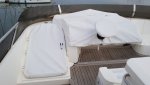
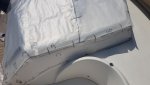
Note in that last pic, the tender also has a new cover - made from the same Princess white PVC fabric.
 
Just reviving this thread - again
This is the new cockpit privacy screen - now made from some strong mesh so it can stay up in stronger winds than our old one.

View attachment 119520

I made it at home using the old privacy screen as a template but it just so happened to be EXACTLY the right size to support this:-
Put up for the England/Italy match - shame about the result!!

View attachment 119521

Note in that last pic, the tender also has a new cover - made from the same Princess white PVC fabric.
Might an England flag not have been appropriate rather than the Scottish/UK one in your pic? :unsure:
 
Top