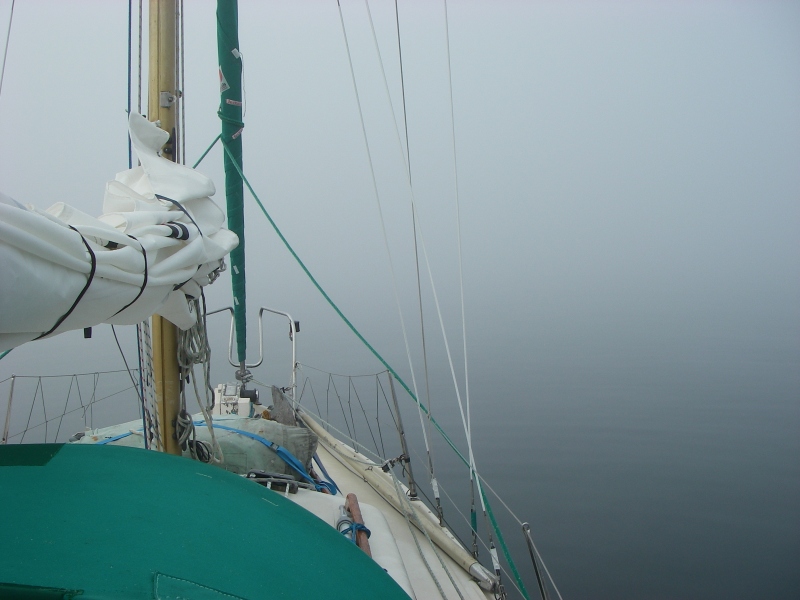
sailing in the fog - stories

dylanwinter

Well-Known Member
Joined
28 Mar 2005
Messages
12,954
Location
Buckingham
www.keepturningleft.co.uk
The idea of sailing in the fog is quite frightening

made slightly less frightening now that we have GPS

while out on the humber after filming in the mist around Trent falls the fog suddenly rolled in

I knew that if I stuck to the south shore with the ebb tide underneath me I would eventually come across a racing mark - then I could turn North until I hit the north bank - and then along the bank until I found the sailing club entrance

I could not see any banks for a short while - but was amazed at how quickly the racing mark appeared

I was never really lost - but for a while I could not say precisely where I was

ebb tides, lots of banks... I had to do a bit of sounding with the peastick

anybody got any fog based anecdotes they fancy sharing?


https://www.youtube.com/watch?v=YDS3b7eujNc
 
Last edited:
valuable lesson learned

MAny years ago (pre GPS) I was heading west in the Straights of Juan de Fuca. The Straights divide Canada and the USA and are about 100 miles long and 10 miles wide. Down the center is a VTS zone with a local zone shoreward of that.

Being a pre-GPS era navigation was by RDF and visual bearings plotted on a chart.

We were heading home (Portland Oregon) from the San Juan Islands and a dense fog settled in on the straights. Our plan was to tack in toward shore till we eeached the 60' mark and then tack out to the 250' mark. This would keep us out of the rocks and away from the VTS.

All was well for a while as we made our way toward Neah Bay where we intended to spend the night before heading south to the Columbia River Bar.

At various times we heard fog horns. At one point I spotted the aft end of a tug heading deeper into the fog and vanishing from sight. The tug might have been 400' ahead of us.

I also saw a TOW CABLE coming off his stern with the tow hidden from sight....

I'm not sure all of what I said bat part of it was Tack Now! Visions of having the keel cut off by the tow cable and then run over by the tow ran through my mind.


We went into shore and anchored in about 30' of water and waited out the fog. That was as close as I have ever come to death in a fog.
 
MAny years ago (pre GPS) I was heading west in the Straights of Juan de Fuca. The Straights divide Canada and the USA and are about 100 miles long and 10 miles wide. Down the center is a VTS zone with a local zone shoreward of that.

Being a pre-GPS era navigation was by RDF and visual bearings plotted on a chart.

We were heading home (Portland Oregon) from the San Juan Islands and a dense fog settled in on the straights. Our plan was to tack in toward shore till we eeached the 60' mark and then tack out to the 250' mark. This would keep us out of the rocks and away from the VTS.

All was well for a while as we made our way toward Neah Bay where we intended to spend the night before heading south to the Columbia River Bar.

At various times we heard fog horns. At one point I spotted the aft end of a tug heading deeper into the fog and vanishing from sight. The tug might have been 400' ahead of us.

I also saw a TOW CABLE coming off his stern with the tow hidden from sight....

I'm not sure all of what I said bat part of it was Tack Now! Visions of having the keel cut off by the tow cable and then run over by the tow ran through my mind.


We went into shore and anchored in about 30' of water and waited out the fog. That was as close as I have ever come to death in a fog.

They don't call it the graveyard ofthe pacific for nothing...
 
.
Fog on the Portuguese coast

Mon 18th/Tues 19th Sept 2006 - Povoa de Varzim - Nazare (112nm

Vessel: Albin Vega (27ft) - no radar or AIS, 'blipper' radar reflector on the mast

After re-aapraising the weather we abandoned our planned trip to Porto and set off South for an overnight sail to Nazare. The synoptic charts show the remains of one of the recent hurricanes sweeping up this coast on Wednesday/Thursday, bringing strong South-Westerlies and big swell . . . if we stay in Povoa we will probably be stuck here for a week, and this marina might be a bit uncomfortable in the predicted weather.

Kathy did a bit of shopping, I had a shower and we got the boat ready, then we set off on what was to turn out to be a pretty miserable sail. It started fabulously, broad-reaching in sunshine at five and a half knots in perfect sea conditions . . . but within half an hour we were in thick fog, still sailing with the Navik in charge. Pot markers loomed out of the mist everywhere, and in fact we ran over the pick-up rope on one of them, the ball on the end of the rope banging against the hull. Kathy's fishing line caught it for a second then rode over it. These pot markers can be found up to ten miles offshore and in up to 60m of water to our certain knowledge . . . maybe even further.

fog.jpg


We came out of this particular fogbank after about two and a half hours, just North of Leixoes. We had lunch and watched a few ships come out of this busy port and turn North or South inshore of us. By four fifteen the fog was back, gradually getting thicker. By six thirty I calculatd we were crossing the shipping track from Leixoes to the separation zone off Cabo Carvoeiro. It was round about now that the shackle holding the mainsheet horse to the track broke as we rolled and snatched, and the boom swing outboard suddenly . . . luckily it was not very windy, and the problem was solved with our last shackle of a suitable size.

Half an hour or so later we had the eerie experience of being passed by an unseen ship in the fog . . . we heard its engines, but saw nothing. Hopefully they could see us. We spoke to Roamer on the VHF - they have AIS, and could confirm that all the big ships they had seen had altered course to avoid them, proving someone is on the radar. A Norwegian boat with radar, Nano, confirmed that we were giving a radar signature at five miles, which was reassuring as we had never asked anyone to confirm our radar signature before. Fog has been an unwelcome but almost daily feature since Camarinas . . . at home we would not dream of spending money on radar - fog is almost unheard of - but for a trip down this coast it would be very comforting.

The wind dwindled to three or four knots, so we put the engine on to motorsail out of the main shipping track. As it began to get dark we reverted to sailing, but after a very nice meal of sweet and sour chicken I took down the main and we reluctantly went back to motoring with a scrap of headsail to steady the boat. Kathy got her head down for a bit while I dropped the sprayhood and peered into the fog in the hope that I might see a marker in time to avoid running it down. With Fairwinds' keel and rudder configuration it would be hard to catch a rope while motoring, but at sea the unlikely is a regular occurence. Luckily the wind came back up - not strong, ten knots or so from the North, putting us on a dead run. The tricolour's stern light cast a shadow of the backstay on the fog behind us, a strange sort of seagoing brocken spectre. Around half past eleven a most unwelcome glow through the thick fog meant something was there, and a large ship duly appeared, scared us then merged back into the gloom, all in maybe three minutes - although it felt longer.

By four o'clock we were just North of Cabo Mondego and thought we could see the lights of a whole load of boats inshore of us . . . but as the fog gradually cleared they turned into very welcome shore lights. Round the cape we encountered the fishing fleet out of Figuera de Foz, who played fisherman's tricks on us, whistling on channel 16 and rushing up and down in a series of random and confusing high speed manoevres in close proximity. We didn't want to play and turned out to sea for a mile or so . . . our nerves were strained enough by now.

Once it was light enough to see pot markers again - just after seven o'clock - we put the engine on, wanting just to get in somewhere and relax. At ten thirty we talked to Roamer. They were already in Nazare and warned us that the marina was very full and that we might not get a berth if too many other boats got in ahead of us. We could see two other boats outside of us, and not relishing the thought of having to continue another thirty miles to Peniche we 'put the hammer down' and made six and a half knots for the remainder of our trip, tying up in a very snug berth beside a local boat just after midday.

- W
 
One Saturday about 5 years ago decided to go to Portpatrick for lunch with my mate Bill. Left Bangor around 10am with a favourable forecast but as we passed the Copelands we entered dense fog. Now this was my first experience of fog and it has always been a source of personal terror. But, as I'd been sailing for a number of years decided to push on for the experience. Raised the reflector and double checked everything else with my RYA handbook and continued. Charts and GPS were then utilised to fix a position and course and I was so scared checked many times. Really thought everything was in order. When we got within 5 miles of Portpatrick it dawned on us that we may not see the harbour entrance! The fog had persisted that long. Anyhow, a call to directory of enquiries on the mobile got us the harbour house hotel and a very helpful waiter informed us that he could see a clear harbour and a mile or more out to sea. So with (over) confidence in my chart work we kept our course. Around the time when we should have sighted the harbour Bill raised his concerns that something was not right. We were within a mile of a very dangerous shore, in very dense fog, and essentially lost. We slowed right down and I went back to the chart table and realised we were about a mile north of the harbour. As I stuck my head out of the companionway to give Bill the new course I could see him peer into the fog. Thats when I turned to see where we were headed and that's when the fog cleared and that's when the wall of rock appeared possibly 100 yards away though it seemed closer. I yelled to Bill to clear course and we did a 180 degree turn. Both shaken we gathered ourselves and eventually entered Portpatrick. When we left 2 hours later the fog was still there the whole way back but the fear was gone. The wariness though will never leave. The following week I bought a chart plotter as I totally lost confidence in my chart work.
 
Can be scary.

The second year I had my boat I left Bembridge for Chichester one sunny day ( May-day bank holiday IIRC ) and ran into a real pea-souper .
All was quiet at first but then something that sounded very large came round the ledge heading pretty much for where I was.
Luckily. perhaps, the last job I'd done that winter was to fix the radar reflector in the rigging.
It was the only time in 30+ years I have used my fog horn !!!
I had in fact passed close in front of a cross channel ferry ... sufficiently close to see it pass a few cables astern of me ........ very very slowly.
In those days Chichester bar had an RDF beacon on it ... but it had been damaged during winter storms and was not working. That was the only time i might have made good use of my Seafix !

I eventually followed a depth contour into Chichester Harbour. Once beyond East Head it was clear and sunny again!

Faffing about though I'd missed the tide to get onto my mooring so picked up another to wait for the night-time tide........ by then it was thick fog again and very nearly had to wait until the next day. Just peeped out as I was about to climb into the sack and discovered the fog had cleared again.


Ran into thick night-time fog on a trip to Honfleur a year or two later. As the sun came up and the fog thinned we found ourselves surrounded by an almost becalmed racing fleet. Seine Bay race or something IIRC.
( three days later we came back in force 9 winds .. Interesting but not enjoyable!)

Coming back from the west country once it was foggy all the way from just out from Salcombe to the Needles. Very uninteresting, and luckily uneventful, passage that was!
 
Last edited:
when i used to fish calshot spit i used to tie up in cowes to save the trip back to portsmouth----woke up one morning to thick fog----after a couple of hours i got fed up with waiting for it to lift-----crept out to the harbour entrance and listened ----heard nothing so set off the couple miles to calshot----didn t have a compass----it had been stolen but when you do the same journey everyday you just know where you are and i was confident i didn t need one----the boat kept a nice straight line so i stood at the bows with my pump fog horn hooting and listening----suddenly something big was hooting back----there was no point in stopping and i couldn t tell where it was coming from and then i suddenly saw a tank landing ship politely stopped in the water----i passed 50 yards in front of his bows----it was either the sir lancelot or the sir galahad----i think of that day whenever the falkland war is mentioned regards lr
 
This was my first experience of thick fog and I still remember it clearly. Sorry it's a bit long winded.

I think that this took place around 30 years ago when we owned a Tomahawk (25' with a 7HP Vire 2-stroke inboard). It was settled weather and we had spent the night in Port Erroll, a tiny harbour North of Aberdeen. We'd met up with Jim Forrest on his 26' boat (Rose's Rival) and were both heading back home to the river Forth.

Jim's engine failed about 2-3 miles outside Port Erroll and we began to tow him and were managing around 3knots. Everything was fine until we were about 1.5nm out from the Aberdeen harbour approach buoy and then the fog closed in. I just had time to get a decent fix using the hand bearing compass before visibility dropped below 1 mile. I shouted to Jim that we'd keep going South. We were pretty much on the Aberdeen approach and it was 50:50 whether to head straight for shore or SW towards Girdle Ness. The latter took us South of the approach and the coastline was pretty straight from there apart from a bay at Nigg. By the time we estimated that Girdle Ness was about 0.5nm away the fog had closed in even more so we couldn't make out the headland. We aimed for where the steep cliffs would be past Nigg and turned to follow the coast. By this time the visibility was less than 50m and it remained at that or worse for he rest of the day. My wife helmed for the whole time and we gave Jim updates by shouting to him when he came to the bow every so often. It was dead calm with no wind and we were able to keep the tow very short. Even so, we could only just see his bows at the end of the line so vis. must have been 20-30 metres.

Navigation was tricky because:
1) We were only making about 2.5kts and that meant the tide was a significant factor
2) The depth remains pretty constant close to shore until 20-30m (or less) from the shore
3) There are odd rocks off the coast (normally so close to shore that they'd never be considered a problem)

We proceeded South for another 14 miles and I kept updating the chart with DR allowing for guesses about tidal effects. I managed about 2 "fixes" in the next 5-6 hours and they consisted of one blip in depth and one view of clifftop. The depth change confirmed we were passing one slightly shallower patch. The cliff top was rising up in a direction that agreed with a contour on the chart. Vertical sextant angle wasn't possible because I could only see a bit of clifftop with fog underneath.

After about 5-6 hours of crawling down the coast I reckoned that we must be slightly past Stonehaven harbour and so turned 90 degrees to head for shore. I didn't want to turn too early as that would take me into the rocky bay above Stonehaven. Far safer to go further South, head for shore and creep back around the headland and into the harbour.

Good plan but I only expected to travel around 200m before sighting the shore. When I hadn't seen anything after 0.3nm Jim was getting a bit nervous (& so was I, but trying to sound confident). The fog suddenly cleared a bit and we could see a harbour wall ahead. I headed towards it and realised that we were inside the harbour at Stonehaven. We'd managed to get inside even though the entrance is only around 80m wide and you have to turn slightly right to avoid some rock about 40m from the wall.

Jim thought that this was due to my expert navigation and I hadn't the heart to say that I hadn't a clue where we were until the harbour wall appeared. Just a matter of luck and I couldn't do it again if I tried. All I knew was that we must be less than 0.5nm from Stonehaven and almost certainly clear of rocky bay to the North.

I've had plenty of other encounters with fog over the years and this year we had fog about 50nm offshore but had Radar, MARPA, AIS, DSC etc. It still makes me nervous and careful but that's probably a good thing.
 
Last edited:
Pre electronic charting.

Nothing dramatic or exciting,underway in a MoBo heading west in the Swale in thick fog and creeping along under radar.
Listening Ch74 to make sure nothing big is moving.
Radar fails and message on radio announces ship coming east into Swale bound for Ridham Dock, edge over to shallow water to stay out of way.
Look at compass and discover have turned 180 degrees and are heading in the opposite direction back the way I have come.:(
 
My most memorable fog experience was during a X-Channel RORC race. ~ mid way across fog descended, but unusually we could keep sailing, making 6.5 kts on the log. Eerie slience though.

After 30 minutes the silence was punctured by the growing noise of some big engines. The sound grew louder very quickly - whatever it was was going fast. 20s later, we just catch sight of the Poole-St. Malo high speed cat doing 30 kts 300 yards abeam. We didn't have the nous to radio the ship to see if had us on radar - we were too shocked - and to be honest I'm not sure I wanted the risk of knowing!

A few years later I was travelling on one of the ferries and thought it would be instructive to visit the bridge to see if they would have seen us - it being a clear day. Anti-terrorism paranoia had set in and apparently one had to apply three months in advance with forms signed by all your grandparents. On the return trip however, they laft the bridge access door open for the whole trip!
 
The idea of sailing in the fog is quite frightening

made slightly less frightening now that we have GPS

while out on the humber after filming in the mist around Trent falls the fog suddenly rolled in

I knew that if I stuck to the south shore with the ebb tide underneath me I would eventually come across a racing mark - then I could turn North until I hit the north bank - and then along the bank until I found the sailing club entrance

I could not see any banks for a short while - but was amazed at how quickly the racing mark appeared

I was never really lost - but for a while I could not say precisely where I was

ebb tides, lots of banks... I had to do a bit of sounding with the peastick

anybody got any fog based anecdotes they fancy sharing?


https://www.youtube.com/watch?v=YDS3b7eujNc

19 ft Caprice with Seagull Century on the back, November, Bristol Channel, no wind, quite thick fog, cross-tide compass course that could not fail within about 4 miles to hit a 2 mile wide shallow sandy bay with a steep to headland at one side. Plan was to start leadline sounding as approached coast, when in about three fathoms turn and follow soundings till you saw the very steep to headland, from there easy to follow course to home mooring even in fog.

The gas foghorn had frozen up with ice inside the diaphragm after the first few puny blasts an hour ago, so I'd given that up. Zero electronics on board - only rich people with 25-footers had echo sounders, and radios were for the super-rich with 32 ft boats.

Stopping the Seagull every few minutes to listen, for ages no problem, then on one stop I head a deep, distant, bonk-clank of a very big diesel. Couldn't identify direction. Gave it another 30 seconds on course and stopped again. Big engine sounds seemed closer, but no wash sounds. It was probably on a course within 30 degrees of mine - nothing big there at that state of the tide could possibly be going any other way. So I knew roughly where to look for it. Logically I should also alter course 60 degrees, so did so, making about a knot as the boat carried her way.

Should I run the engine and have immediate power to alter course on seeing it, at about 4-5 knots, or leave the engine stopped to hear it and pull the cord to start it if needed - it would 100% start on one pull, but it might take five seconds to get useful way on to manoeuvre?

And while I pondered this, there was the nagging knowledge that the longer I faffed around stopped the more dubious my landfall would be. Tried the foghorn again - one brief squawk then a rude gargle noise as it froze.

What would you do? Run the very noisy engine or not?
 
Last edited:
Three tiimes:

Once when a teenager in Yarmouth on an autumn sunday morning and needing to get back to Itchenor and went to leave. The harbour person actually tried to stop us leaving (2 on board, 25 footer), but we headed East slightly then N to a very shallow contour and followed it until it started to lift slightly as we round spithead.


Same crew a few years later had to be back at work from Cherbourg to the Solent. Fog patches, but they where wrong it was fog patch of the thickest I have ever been in from about 6 mile N Cherbourg to about the same of the Needles, Heard the ships, smelt the ships, felt the wake, but we where just in the cockpit with lifejackets on and fenders rigged horizontally around the boat. We did have a locata watchman and the little LED blinked so we could track the ships going by, but I do recall one not changing noticably but we didi not see it. It was very scary and my instructions to the crew where if we are hit the first we will see of it is up there and to try and hold on as long as possible; did we need to get back well my mate did end up CEO of rather a big company.

From Brest to L'Aberwrac with three other yachts, it was sufficiently foggy that my wife was at the chart table using the yeoman to call out courses to each buoy up the river, and got well up the river before seeing any land.

Now with radar, AIS and chart plotter it has to be a real pea souper before I won't go.
 
Trevose head

The fog dropped fast as we rounded Trevose head,going on 9 in evening into Padstow (30 secs between the 2 pics same view) . Took us and hr to get into the gate by then the sun had gone down and was black as a black thing . we could not see Trevose light at all even though we were under it ! We went past two small warships in the entrance doing a crew change we saw them on the AIS but no sign of the ships although we got buzzed by what we think was one of there ribs, doing a not very responsible, 20knots or so, we did see their, what seemd like a million candela search light about 10 secs before they just missed us !

edit We were inside the Quies off Bull point when the fog arrived
 
Last edited:
Two stories:

1991 Single handed out of Ramsgate towards the Medway, inshore route off Margate thick fog could hardly see beyond bow of the boat, very creepy when on your own, no GPS just paper charts. Sounded into shallow water, anchored and waited it out for about four hours until it cleared enough,by then had missed the tide.

1999 delivery trip of new boat, to me Gosport to the Medway left Portsmouth in OK vis, no wind, but fog came down in Looe? channel, had gps so carried on motoring slowly (old dolphin two stroke). Decided to go into Brighton. When off Brighton stopped the engine to have a listen for the sound signals on the entrance heard them, but then engine wouldn't start, I had been running so slowly I had fully discharged the the batteries, and no power for lights or VHF Drifting in fog, no wind just off Brighton. Used mobile to tell Coastguard we were drifting off Brighton in fog with no power. They phoned back a few minutes later to say there was a lifeboat in the area would we like a tow? Towed into Brighton, where it cost me a taxi to halfords for two new batteries!
 
dead horse

WE had fog at Trent falls while anchored ten or 15 years ago . Not really a story but we got a rotten wooden ladder wrapped round our anchor chain followed a few seconds later by a potentially explosive, floating dead horse!
 
traffic and fog

it is really the worry about getting run down

I think it is time I bought a decent radar reflector

are the flat ones still supposed to be any good

fortunately on the Humber I can usually find shallow water

I figure I am safe when the echo-sounder is showing 1.5 meters

but you still have to cross the channel


I would have put it up if I had one

very re-assuring stories about ships avoiding yacht blips

D
 
Another Caprice tale, bought mine on Ebay, it was tied up to a jetty on Oare Creek near Faversham, I needed to bring her round to Folkestone. Son was over for a few days and we decided on a day when we could use the double tide to bring it the 60 or so miles. Son had borrowed a GPS; the previous day we brought her to the end of the Creek for an early start at high tide (very limited tidal window); next am at 6.00 we arrived to find thick fog, unable to see across the narrow creek, I said no go, although I tend to take more risks than son, he said it was the last opportunity that year and anyway we had a GPS. We got into the Swale and found GPS was u/s, but continued with a good compass and charts and buoy hopped all the way with buoys coming up on the nose 50 yards ahead. maximum visibility was half a mile all the way. Only saw one fishing boat and a SeaFrance ferry, which took avoiding action - we had radioed Dover as we passed. Of course we were motoring, but had our sails up for what little help they might give us.

Reading some of the foregoing I think we got away with it very lightly; son got his head down for an hour in the am and I did likewise afternoon.
 
Last edited:
it is really the worry about getting run down

I think it is time I bought a decent radar reflector

are the flat ones still supposed to be any good

fortunately on the Humber I can usually find shallow water

I figure I am safe when the echo-sounder is showing 1.5 meters

but you still have to cross the channel


I would have put it up if I had one

very re-assuring stories about ships avoiding yacht blips

D


Having a radar reflector at sea is one of the few things that are mandatory. See SOLAS V regulations.
http://www.direct.gov.uk/prod_consu.../@dg/@en/documents/digitalasset/dg_185781.pdf

http://www.rya.org.uk/infoadvice/regssafety/pleasurecraftregs/Pages/SOLASV.aspx

You should also have a copy of the Lifesaving hand signals on board and prepare passage plans where appropriate. :D

As for the effectiveness of the different types of radar reflector see tha QinetiQ report compiled for the MAIB enquiry into the loss of the Ouzo.

http://www.maib.gov.uk/cms_resources.cfm?file=/Radar reflectors report.pdf
 
Last edited:
Top