Saildrives and shafts.

doug748

Well-Known Member
Joined
1 Oct 2002
Messages
13,924
Location
UK. South West.
Visit site
I see a number of new Jeanneau models are now fitted with shafts rather than saildrives. The conventional forum view was either:

Shaft drives were of the past and dated technology (oh gosh) .

or

Saildrives were only fitted to new boats because it suited the manufacturers and boosted their profits (stinkers).


Can anyone suggest why this has come to pass?

.
 
Possibly a new shaft drive that does not drip or need attention OR people are waking up to the real cost of replacing sail drive rubbers which works out to several £ per week ( which should rightly stop them being specified on new boats )
 
I wonder how much cost a saildrive actually saves? The unit must itself cost a fair bit more than a shaft, and the savings perhaps come from the reduced labour in moulding the shaft log. Perhaps Jeanneau have found a way to streamline that, e.g. dropping in a pre-moulded unit, that swings the balance back to favouring the shaft drive?

(FWIW I'm definitely in the luddite camp here, and see sail drives as an unnecessary complication/expense, despite the arguments that be contrived in their favour).
 
The problem is that you don't find saildrives in older boats, so they must be the work of the devil - inferior/more expensive/less reliable/too complicated*. As we all know, yacht design peaked somewhere around 1970, just before the infernal saildrive was invented - I mean, the stupidity of effectively sticking an outboard engine leg through the hull of a boat is there for all to see and it was obvious from the beginning it would never catch on - consigned to history in 1980 I believe. They are also totally unsuitable for seaworthy, proper, long-keel designs with skeg hung rudders on the trailing edge of the keel - the ONLY way to build a blue-water boat!!!

* delete as prejudice dictates.
 
Last edited:
Perhaps a couple of charter companies requested shaft drives for maintenance or cost reasons? They drive the volume sales.

However, I thought sail drives might continue as can offer the expensive upgrades of rotating drives to provide side thrust.
 
But seriously: package, cost, engine manufacturer incentives, customer choice? .... most likely a mix of all 4. .... the SO 51 and 54 are offered with the option of Saildrive or Shaft.

Shaft: must be accurately aligned, noise/vibration, stern gland leaks, prop drive not parallel to water surface (prop walk), elongated package, weight further from CoG.
Saildrive: Seal maintenance cost, risk of galvanic corrosion, shaft seal leaks, complexity.

When I repowered and replaced my MD-2030 with a D1-30 it was a very simple drop in replacement - whole unit complete with saildrive - no alignment needed and I got a complete new drivetrain from prop to engine - bit like buying a new outboard.
 
I am very happy this boat has a proper shaft drive - Never liked or trusted the Saildrive on previous boatie. The cost of the gasket was steep , anode replacement a pain and the water inlet on the leg was a hotel for mussels and even a razor fish..
 
I think both have their detractions that have lasted far too long!
Fouling and sailing drag , ugh. Servicing effort access dismantling and expense ..

I would love to have an outboard ‘ leg’ on the stern linked to the steering .
Just think:
No fancy folding propellors ,
No anodes,
No fouled water coolant inlet,
No alignment issues ,
No ‘saturation’ corrosion....
Less internal mechanical vibration
Or noise .
As to manoeuvring:
Crabbing backwards into a tight marina berth, Sir ? No problem
Combine with a bow thruster and...Painless and hassle free , “ park it on a dime”, every time?
 
Shaft: must be accurately aligned, noise/vibration, stern gland leaks, prop drive not parallel to water surface (prop walk), elongated package, weight further from CoG.
Saildrive: Seal maintenance cost, risk of galvanic corrosion, shaft seal leaks, complexity.

When I repowered and replaced my MD-2030 with a D1-30 it was a very simple drop in replacement - whole unit complete with saildrive - no alignment needed and I got a complete new drivetrain from prop to engine - bit like buying a new outboard.

Sums it up well. For buyers of new boats, and for those with deeper pockets, sail drives are no problem.
For those of us with older boats the simplicity and ruggedness of a shaft cannot be beaten. I'll take the risk of a weeping stuffing box any day over the worry of a permanently immersed aluminium casting full of gears, protected by oil seals which must function perfectly. Not to mention the main gaiter itself.
Perhaps I have been put off by my experience in trying to buy a boat. The only one I viewed that had a saildrive, the owner had bonded it to the rest of the underwater fittings, turning it into a very expensive anode. It was not pretty.

How many fishing boats do you see with saildrives?
 
Sums it up well. For buyers of new boats, and for those with deeper pockets, sail drives are no problem.
For those of us with older boats the simplicity and ruggedness of a shaft cannot be beaten. I'll take the risk of a weeping stuffing box any day over the worry of a permanently immersed aluminium casting full of gears, protected by oil seals which must function perfectly. Not to mention the main gaiter itself.
Perhaps I have been put off by my experience in trying to buy a boat. The only one I viewed that had a saildrive, the owner had bonded it to the rest of the underwater fittings, turning it into a very expensive anode. It was not pretty.

How many fishing boats do you see with saildrives?

Not many old ones or smaller ones - but azimuth thrusters (Z-Drives) which are found on increasing numbers of commercial ships are effectively saildrives that rotate - something you could not achieve with a fixed shaft/prop arrangement.

Another freezer/longliner recently delivered to the West Coast, the 184-foot Northern Leader, broke new ground when it introduced azimuthing stern drives to the North Pacific fishing grounds. Those drives, called z-drives because of their configuration, offered the new boat greatly increased maneuverability. The drives on the Blue North take that concept to another level. The Schottel-supplied units make use of two propellers each, one forward and one aft, turning in the same direction and separated by a deflection plate to smooth out the flow.

Game Changer: F/V Blue North
 
Shaft: must be accurately aligned, noise/vibration, stern gland leaks, prop drive not parallel to water surface (prop walk), elongated package, weight further from CoG.
Obviously depends on boat geometry, but I thought that shaft forced the engine to be near the CoG. Whereas a saildrive can actually be forward of the engine if it is desired to have the engine far aft to keep the accommodation clear...
 
My previous boat had a shaft. I replaced the rear engine mounts and did the re-alignment myself. It can't be hard for an experienced boat builder.

Also the Volvo lip seal never leaked in the 15 years that I had the boat.

How real are the perceived problems with shafts?
 
Not many old ones or smaller ones - but azimuth thrusters (Z-Drives) which are found on increasing numbers of commercial ships are effectively saildrives that rotate - something you could not achieve with a fixed shaft/prop arrangement.


Game Changer: F/V Blue North
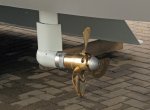
You could have one of these rotatable saildrives. I saw it on a boat in Germany, though a French design I think.
 

Attachments

  • 2011 show (225) copy.jpg
    2011 show (225) copy.jpg
    697.9 KB · Views: 16
long-keel designs with skeg hung rudders
I've yet to see an arrangement like this as the hundreds I've seen always have the rudder hung on the end of the keel. Why make a rudder vunerable by putting it on a skeg?
I do know a skeg hung exists somewhere though as pics were posted here.
Saildrives and pods do have their advantages but 20 yrs down the road for a budget concious owner they can be a scary proposition.
 
Last edited:
The big reason for the saildrive‘s popularity with builders is the ease is instillation and the smaller footprint in the boat. The claims of mechanical complexity are overstated: after all they use what is effectively and outboard motor leg to deliver the drive, adding little to the complexity of the gear train. Yes, there’s the pain of diaphragm replacement but I paid €750 for my last replacement (and that was at the 16 year point....) so not all that expensive.
Shaft drive is marginally less complex but then there’s all the fun of aligning the various components so that they don’t vibrate. By the time you’ve added in the need for a seal where the shaft exits the boat possibly a p bracket and cutless bearing, the components and servicing begin to add up.
I‘ve dealt with both over the years and prefer the extra space and ease of maintenance of the Saildrive over shaft drive and the fiddly bits. Easiest of the lot of course is an outboard.....
 
Obviously depends on boat geometry, but I thought that shaft forced the engine to be near the CoG. Whereas a saildrive can actually be forward of the engine if it is desired to have the engine far aft to keep the accommodation clear...
It depends how long your shaft is (as with so many things in life). You can put the engine up in the bow if you want - not common though.
 
Top