Saildrive oil plug

PabloPicasso

Well-Known Member
Joined
12 Feb 2010
Messages
3,041
Visit site
My new to me boat is out of the water for the winter. So I decided to change the oil in the 120s volvo saildrive.

My biggest flat bladed screwdriver would not grip the drain plug slot. Even after the usual taps and attempts to clean the slot in the drain plug head (it was the one that I used on my old boat with no issues) So what to do?

After a couple of tries to pack the slot failed I decided to take a radical approach.

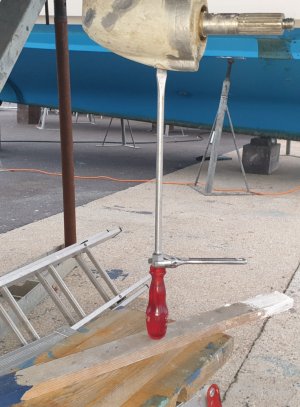
With a light hammer I bashed on the end of the screwdriver blade. This flattenned the blade just enough for it to grip the slot snugly.

Then with a pal using an adjustable wrench at right angles to the screwriver blade the plug loosened.

Worked for me. Hopefully it may help someone else struggling to undo a saildrive drainplug (which is not the best design ever 😒)

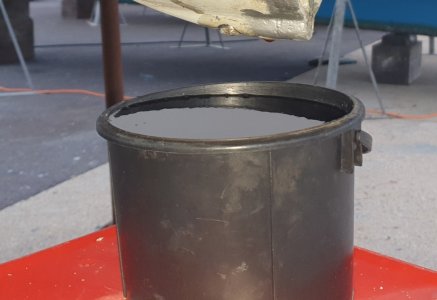
The oil was a very dark colour so definately did need changing, even though it was a clear golden colour on the dipstick.
 
A bit late to suggest, but the other option to put pressure on the screwdriver could be to support the end of the handle on a platform with some wooden wedges... just to start it off..

Screenshot_20260322_205130_Gallery.jpg
 
Can be quite tricky to fill if you try to do this through the large plastic ‘filler cap’.
On my old boat's saildrive there was a large round black filler cap. On this newer one there is only the dipstick plug/hole, maybe an inch in diameter.

I decant a ½ litre of new oil at a time into a small jug, use a funnel, and just take my time and pour slowly.

I could see how trying to refill directly from a 5 litre can would be difficult though.
 
A bit late to suggest, but the other option to put pressure on the screwdriver could be to support the end of the handle on a platform with some wooden wedges... just to start it off..

View attachment 208155
That is a good idea too. Especially if on your own. I borrowed someone to hold and turn the wrench while i pushed up on the screwdriver.

My screwdriver did not have a hex shape by the handle so the wrench gripped the blade (at the top in your pic). Also meant torque was applied nearer to where it was needed so was easier to keep the screwdriver in line with the turn.
 
On my old boat's saildrive there was a large round black filler cap. On this newer one there is only the dipstick plug/hole, maybe an inch in diameter.

I decant a ½ litre of new oil at a time into a small jug, use a funnel, and just take my time and pour slowly.

I could see how trying to refill directly from a 5 litre can would be difficult though.

If you put a funnel in the dipstick hole it fills really easily, for years I did it the hard way through what I assumed was the filler cap.

Access wasn’t great in our case so pouring in slowly was really fiddly.
 
Three points
1. Replace the plug screw with an Allen headed one to make it easy next time ( I just turned a o ring groove into a pan head machine screw) and don’t over tighten
2. Line your drain bucket with a new rubble sack. The oil can be lifted out in the bag and recycled and you don’t have to clean the bucket
3. Make sure the drain bucket goes right up to the sail drive and preferably covers it. This is because any wind will blow the thin trails of gear oil all over the place if there is any chance of it doing so.
 
An impact driver with a good screwdriver bit is your friend for these plugs. A 1/2" drive impact driver and the right size bit starts at £30-40.

I saw one once where the lower unit had been written off by a dealer as the plug head was destroyed and would not come out. The owner declined the replacement (hardly surprising) and instead pulled out the bearing housing every couple of years to drain the oil - unorthodox, but effective! 😂It cost him a few quid in seals, and it not a technique I could recommend.
 
The thread on my 120S-E drain plug is far too big for a common screwdriver. I use a metal ruler, which fits perfectly, which doesn’t slip and an adjustable spanner to grip the ruler. Very easy to remove every time. Usual caveats apply around cleaning the Antifoul out of the groove first and the fact it’s not ideal for the ruler (or is it rule?!) so use an old one you’re not measuring things with anymore. Oh and for peace of mind and a couple of quid always order a new o ring.
 
Top