
RYA Yachtmaster ocean

Just how accurate does the watch have to be to get a reasonable fix? Presumably there will be a second or two error in taking the sight to logging the time anyway- Or will there? Is that part of the skill? How inaccurate is a typical sub £100 casio watch over a month? Does one need to buy one of these ridiculously over priced all dancing things that measures how far one has walked to the heads in the night? I have never actually tested one as I prefer an analogue dial.
Just pressing the buttons can put one 10 seconds out & doing it whilst holding a sextant would be awkward. Transferring it , somehow, from a stopwatch is, I am told , the alternative, but a faff . I assume it would involve going below to transfer the time adjustment after every sight- Or does it? I do not know, having never tried it.
You get an assistant standing by you with the watch (showing time including minutes and seconds) and you say ‘now’ as you shoot the sight. They write the time down while you lower the sextant without altering anything and read off the observed altitude. Easy peasy.
You can do it by yourself but you end up counting elephants as you lower the sextant to look at the watch. The sun moves 15 degrees every hour. That’s 27 miles around the equator every second by my calculations. Getting the time as accurate as possible produces the most accurate of position lines…
 
That’s 27 miles around the equator every second by my calculations. Getting the time as accurate as possible produces the most accurate of position lines…

Really? Seems way too high.
The earth is 21000 NM around the equator so it moves 1/24th of that each hour= 901 NM.
Each minute it moves 1/60th = 15Nm
Each second it moves 1/60th = .25NM or one mile of error for every 4 seconds the time is out.

27 miles a second would make astro navigation impossible! Even if you could time your sight to within 1/2 second you would always be 13.5 miles out!
And the way to time your sights singlehanded is to have a stop watch that records lap times. Then tape it to the sextant handle so you can operate the 'button' with your index finger (like a trigger) while you hold the sextant with your thumb and other fingers.
 
I think you're right Mr Motor Sailor (and is one of the reasons why the Increments and corrections has got 4 minutes of time equating to 1 degree (or 60NM)

However, the topic of timing did spark some interest in me, so I did the following experiment...
Eddystone lighthouse at 12:00pm today - with Sun Declination of 20deg 37.2 (n.b. this was the correct declination at this time)
Eddystone lighthouse at 12:04pm today - with the same Sun Declination of 20deg 37.2

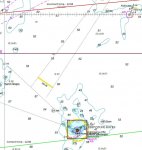
i.e. exactly the same Ho, but with two clocks reading different times. The result was that I was about 4 miles out on the incorrect time. The attached picture shows this, with the green PL being the correct one at midday and the dark PL being the calculated from the clock which is 4 minutes out.
 

Attachments

  • Untitled.jpg
    Untitled.jpg
    108.9 KB · Views: 21
Last edited:
Really? Seems way too high.
The earth is 21000 NM around the equator so it moves 1/24th of that each hour= 901 NM.
Each minute it moves 1/60th = 15Nm
Each second it moves 1/60th = .25NM or one mile of error for every 4 seconds the time is out.

27 miles a second would make astro navigation impossible! Even if you could time your sight to within 1/2 second you would always be 13.5 miles out!
And the way to time your sights singlehanded is to have a stop watch that records lap times. Then tape it to the sextant handle so you can operate the 'button' with your index finger (like a trigger) while you hold the sextant with your thumb and other fingers.
My apologies. I’ve just been out to a rather nice dinner and came home and I got my km and miles mixed up followed by a stupid maths error.

I’d googled ‘circumference of the earth and got 40,000 km. Divide this by 24 is 1666 km/hour divide by 60 is 27 km divide by 60 seconds is 0.43 km per second which is approximately 0.25 nautical miles moved by a heavenly body over the equator every second.
 
Just how accurate does the watch have to be to get a reasonable fix? Presumably there will be a second or two error in taking the sight to logging the time anyway- Or will there? Is that part of the skill? How inaccurate is a typical sub £100 casio watch over a month? Does one need to buy one of these ridiculously over priced all dancing things that measures how far one has walked to the heads in the night? I have never actually tested one as I prefer an analogue dial.
Just pressing the buttons can put one 10 seconds out & doing it whilst holding a sextant would be awkward. Transferring it , somehow, from a stopwatch is, I am told , the alternative, but a faff . I assume it would involve going below to transfer the time adjustment after every sight- Or does it? I do not know, having never tried it.

I use two, sub £20 digital watches for celestial navigation. About 4 weeks prior to a passage I’ll set both against a time signal and monitor how they behave over the following weeks. This gives a calibration curve. Typically 1 second per 7-10 days. Could argue to use 3 watches….?

There is a fairly easy to gain skill in taking the sight and recording the time, not difficult. It’s normal to take, say, half a dozen sights over, say, 15 minutes. These are plotted and an appropriate time and sextant angle, Hs, chosen for the calculations.

On an average day, running a fix from overnight DR, forenoon sun, sun Meridian Passage and afternoon sun, equates to about 20 sights. A 20 day crossing gives a lot of practice!

Accuracy? What’s the purpose of celestial navigation? Firstly, to ensure that you don’t hit something sticking out of the water (land ?) and secondly to shape the course towards the destination. A few miles here or there is no big deal when crossing an ocean.
 
You get an assistant standing by you with the watch (showing time including minutes and seconds) and you say ‘now’ as you shoot the sight. They write the time down while you lower the sextant without altering anything and read off the observed altitude. Easy peasy.
You can do it by yourself but you end up counting elephants as you lower the sextant to look at the watch. The sun moves 15 degrees every hour. That’s 27 miles around the equator every second by my calculations. Getting the time as accurate as possible produces the most accurate of position lines…
I've always wanted a clock/watch that you could just freeze the time display. I've looked and looked without avail. I've also looked for clock apps with the same function. Technically feasible but not much call for it, I suppose.

I've always practiced with my sextant in the back garden using the sun's reflection in a dish of oil. No correction for eye height and no rocking boat, and no log errors to run up or back to the noon sight. I got great accuracy counting from the sight and adding to the clock time, but I'm not confident of the same under real-world conditions.
 
My bedside alarm clock, battery operated, cost £4.99, never needs adjusting. It has fallen on the saloon floor and broken into individual wheels but still continues to keep good time. If I were using it for navigation, I'd keep it in a padded box but I'm sure it would be good for astro nav.
The renowned Captain Slocum used a tin clock with one hand which he bought in Baltimore for one dollar on his round the world adventure. I don't think he used conventional astro nav though.
 
I've always wanted a clock/watch that you could just freeze the time display. I've looked and looked without avail.
That's why traditionally you use a stop watch as a 'deck watch'. You never take your primary time source (chronometer) out of it's storage let alone on deck.

You simply start your stopwatch going at a convenient moment in time on the chronometer (to make the arithmetic easy) and then use the lap function to record each 'lap' as you take your sights. The time of the sight will then be 'frozen' for you to record along with the sextant reading, but the stop watch will still be ticking away for you to record the subsequent sights. Adding the lap times to the original chronometer start time gives you the sight time in GMT.

I tape the cheap electronic stopwatch to the sextant and hold both in my left hand. The bloke who taught me used his Omega Speedmaster with the elasticated strap slipped over the wooden sextant handle. As that was clearly the 'way to do it', I bought the same watch when we arrived in Hong Kong. Thought I was being so smart when I sold it at a profit a few years later when quartz watches were becoming all the rage and the arrival of a Walker Transit Sat Nav on board had consigned all this astro malarkey to the dark ages. Unfortunately I now have to leave the room when they start talking about the value of Speedmasters on the Antique Roadshow.
 
Hi chaps,

Just jumping in on this thread to ask about the YM Ocean logbook requirements. I plan to do a backwards approach to this course - do the passage, then the shore based course, then the exam/oral.

I'm experienced enough to be able to pull this off, and I already know how to do celestial nav, so logistically this route will make the most sense for me, as well as being fast.

Can anyone tell me what sort of format the examiner is looking for the logbook from the ocean passage? Does he/she want daily noonsites? + AM/PM running fix? +Stars and planets?
I'm sure all of the above would impress them but I'd rather not be shooting 5x daily if I can help it.
Additionally do they want a copy of the ships log, or do I create my own?

Thanks in advance for any advice, and apologies if this info is somewhere obvious on the RYA website but I cannot find it anywhere

Lewis
 
An independent quartz based clock (ideally that you’ve monitored the rate) would be fine. Astro is a ‘get you home’ skill/technique when lightening strikes or you have catastrophic power failure. I’ve got a wind up chronometer but so what. A Casio watch will do.
Agreed. One of the questions I was asked was how did I ensure the accuracy of my watch. I was able to show that my digital watch lost 2 seconds per month following the last synchronisation - I tracked my watch for two months before departing and made notes in my navigation notebook . As the example sights were 7 days into the passage the loss was <1 sec so I did not adjust in my calculations.
 
Hi chaps,

Just jumping in on this thread to ask about the YM Ocean logbook requirements. I plan to do a backwards approach to this course - do the passage, then the shore based course, then the exam/oral.

I'm experienced enough to be able to pull this off, and I already know how to do celestial nav, so logistically this route will make the most sense for me, as well as being fast.

Can anyone tell me what sort of format the examiner is looking for the logbook from the ocean passage? Does he/she want daily noonsites? + AM/PM running fix? +Stars and planets?
I'm sure all of the above would impress them but I'd rather not be shooting 5x daily if I can help it.
Additionally do they want a copy of the ships log, or do I create my own?

Thanks in advance for any advice, and apologies if this info is somewhere obvious on the RYA website but I cannot find it anywhere

Lewis

The examiner is looking for evidence that you are to be able to navigate oceans using traditional means and arguably more importantly how to manage a yacht prior to, during an ocean passage. The sights explanation took about 10 minutes of the hour or so chat - rest was on victualling, boat systems ocean current etc. I proved a written expanded technical narrative to the log..

The examiner will be trying to prove your be able to establish your passage is authentic. My examiner told me a story when he examined potential Ocean candidate who gave a details of passage that the examiner was on. The boat was too small to hide!
 
Hi chaps,

Just jumping in on this thread to ask about the YM Ocean logbook requirements. I plan to do a backwards approach to this course - do the passage, then the shore based course, then the exam/oral.

I'm experienced enough to be able to pull this off, and I already know how to do celestial nav, so logistically this route will make the most sense for me, as well as being fast.

Can anyone tell me what sort of format the examiner is looking for the logbook from the ocean passage? Does he/she want daily noonsites? + AM/PM running fix? +Stars and planets?
I'm sure all of the above would impress them but I'd rather not be shooting 5x daily if I can help it.
Additionally do they want a copy of the ships log, or do I create my own?

Thanks in advance for any advice, and apologies if this info is somewhere obvious on the RYA website but I cannot find it anywhere

Lewis

Pages 69 and 70 of the Yachtmaster Scheme Syllabus and Logbook, G158/21A, give full details. This link gives the same info and will lead you to the application form.

RYA Yachtmaster Ocean Exam
 
It's a qualifier for the Ocean Yacht Master exam - for which a major aspect is global meteorology and passage planning. You need to ask = not yet ready. Actually, it's trivial passage which can be done at any time of the year.
Might be trivial but I’m not coming after September or before April.
 
Just how accurate does the watch have to be to get a reasonable fix? Presumably there will be a second or two error in taking the sight to logging the time anyway- Or will there? Is that part of the skill? How inaccurate is a typical sub £100 casio watch over a month? Does one need to buy one of these ridiculously over priced all dancing things that measures how far one has walked to the heads in the night? I have never actually tested one as I prefer an analogue dial.
Just pressing the buttons can put one 10 seconds out & doing it whilst holding a sextant would be awkward. Transferring it , somehow, from a stopwatch is, I am told , the alternative, but a faff . I assume it would involve going below to transfer the time adjustment after every sight- Or does it? I do not know, having never tried it.
Ideally one would have a nice Rolex Oyster date just. certified as a chronometer.
However I found a Seiko Automatic was much more economical and good enough. I got tiered of getting new batteries ect and have returned to a Nice Seiko Automatic.

The trick is to check it regularly Round about the same time every day and keep a record. Particularly the change or rate.
traditionally a chronometer was kept in a box with a thermometer. Since temperature could affect the rate. Wound at the same time every day. Until quartz became the standard. Of course with a watch on your wrist, it would be subject to greater variety.
so if you fail to get an accurate check you can still figure out the accurate time.
of course a decent quartz Seiko or similar will be very accurate.

I don’t know what the RYA require to impress their examiners.
I would call the failure to check your chronometer error an error in principle. While I would probably accept using GPS for DR as a valid navigational practice to check GPS by comparing to an observation.
Although I suspect the RYA purpose is to show you can run up a DR
Next question how do you check the error. WWV is still operating
or you could just use the GPS but be aware Ive know GPS to be wrong. On a few occasions. I’m in the habit of checking daily.
 
Really? Seems way too high.
The earth is 21000 NM around the equator so it moves 1/24th of that each hour= 901 NM.
Each minute it moves 1/60th = 15Nm
Each second it moves 1/60th = .25NM or one mile of error for every 4 seconds the time is out.

27 miles a second would make astro navigation impossible! Even if you could time your sight to within 1/2 second you would always be 13.5 miles out!
And the way to time your sights singlehanded is to have a stop watch that records lap times. Then tape it to the sextant handle so you can operate the 'button' with your index finger (like a trigger) while you hold the sextant with your thumb and other fingers.
Actually the equator is the only latitude which is a great circle so every minute around the equator is is equal to one nautical mile. Of course nautical miles vary with latitude but ? Close enough.

however it’s the rate of change of longitude which maters. 15 deg per hour or 1 degree every 4 minutes . or 15 minutes of longitude every minute
so 15 minutes/60 seconds
0.25 minutes of longitude per second.
the actual distance willvary with the actual latitude or more corectly declination of the sun. The N S change would be in declination and error produced small the actual E W change of distance would be Departure but the calculation to resolve the spherical triangle use difference of longitude or more correctly termed local hour angle so distance doesn’t matter.

So the error in time per second would affect the local hour angle by 0.25 degrees for every second of error.
It’s enough to be significant
So accuracy in the measurement of time is important if you want accurate observation. An error of a second or two is tolerable and probable no more significant than other observational errors.
It takes practice,
it can be done by oneself by counting.
Accuracy improved with an assistant taking the time.

Even on a good day, I wouldn’t have bet on my actual accuracy being better than 2 miles. Some days I might have done a bit better but all things considered that was about as good as it got.
Many a day it wasn’t that good, depending upon the conditions,
Back in the day, I was actually quite good at it.
I used to give my official noon position to the nearest whole minutes of latitude and longitude.

Even doing sttars I wouldn’t quote better.
 
I use two, sub £20 digital watches for celestial navigation. About 4 weeks prior to a passage I’ll set both against a time signal and monitor how they behave over the following weeks. This gives a calibration curve. Typically 1 second per 7-10 days. Could argue to use 3 watches….?

There is a fairly easy to gain skill in taking the sight and recording the time, not difficult. It’s normal to take, say, half a dozen sights over, say, 15 minutes. These are plotted and an appropriate time and sextant angle, Hs, chosen for the calculations.

On an average day, running a fix from overnight DR, forenoon sun, sun Meridian Passage and afternoon sun, equates to about 20 sights. A 20 day crossing gives a lot of practice!

Accuracy? What’s the purpose of celestial navigation? Firstly, to ensure that you don’t hit something sticking out of the water (land ?) and secondly to shape the course towards the destination. A few miles here or there is no big deal when crossing an ocean.
I used to try and take three good sight in quick succession. over about a minute or so. It would be a bit quicker if I had a helper.
I used two different technics. As my mood changed. I don’t think I got better results one way or the other.

one was to pre set my sextant angle to a whole minutes at 5 or 10 minute intervals hand take the time when sun was on the horizon.
Would take 3 by taking them close together the azimuth wouldn’t change by more than a degree and I would take a mean of the intercepts.
or other days because I felt like it I would adjust the sextant until I felt it was just as perfect on the horizon as I felt I could and repeat 3 times. Again the azimuth wouldn’t have changed much and I would average the intercepts.

I never did decide which worked better.

I never lotted the results .. I always calculated a sun run noon fix.
I would calculate my ITP from my DR with practice I could do it faster by travers tables than using a calculator.
Run the ITP to Noon. for Noon DR. By calculation again I was quicker by travers tables. than a Mercator by calculator.

My Obs Noon Lat. I would also run to noon.
when compared to my DR noon lat my PL would put my PL would cross my Obbs no later
forms a nice little triangle .the C correction is basicaly a tangent ratio so tan D lat will give you the d long or acutely the departure to your noon long.
the difference between d long and the departure was Usually small enough to ignore.

I liked to time my morning sight to get a P/L close to north south to give me a good longitude so when the suns azimuth would be close to 90 or due east. Most 2nd mates if they had thier wits about them would make sure apparent noon wasn’t until after noon so they didn’t have to get up to early. So I often settled for a less than ideal longitude. With a mid to late morning observations.

Another technique some guys used. Take a series of shight 3,2 and 1 hour before noon, and run them all to noon. I never really liked it,

of course it’s just a running fix and all a bit of a fudge, One way or another we always ended up in the right place.
In later days we had the old transited sat Nav but still went through the whole routine every day.
Although the tradition was both of us taking our observation together sometimes the 2nd mate would just use my morning observation rather than get up early.
I never did sail with GPS.

I did keep up with my time signal tradition every morning. if nothing else it provided a good excuse to be listening to the radio.
 
Ideally one would have a nice Rolex Oyster date just. certified as a chronometer.
However I found a Seiko Automatic was much more economical and good enough. I got tiered of getting new batteries ect and have returned to a Nice Seiko Automatic.
Rolex Oyster-- You must be joking :rolleyes: My father gave me mine in 1973. He bought several from Bravingtons, by Kings Cross, that year to give to some staff at Xmas as a thankyou. I still have the instruction manual. 30 years ago I went to buy a new strap & the Rolex dealer in Burlington arcade wanted £ 325. I declined :eek:
Mine went back for cleaning & re timing a number of times at great expense & still never kept time. Currently several minutes a day inaccurate. Just like a very expensive Omega my mother bought my father about the same time. It was so bad he only wore it a few times.
 
Last edited:
Top