
RYA/MCA compliance with the ITU?

ulix

New Member
Joined
18 Sep 2023
Messages
11
Visit site
Hi,

Just wanted to check, and maybe someone can give me a bit of guidance.
I have an RYA/MCA SRC Licence and wanted to know if anyone is aware of who I can contact regarding the compliance of my licence with Regulation 47 of the ITU. Specifically, I am looking for a letter that states my licence (RYA/MCA SRC licence) complies with ITU Article 47. I’ve already contacted the RYA, and they referred me to the MCA. The RYA also provided a letter stating that they comply with the standards set by the MCA (can also be found online). However, when I contacted the MCA, they referred me back to the RYA.

As I understand it, the MCA would need to confirm that they comply with Article 47 of the ITU, specifically because the MCA is the authority in the United Kingdom, and since the UK is a member of the ITU, the UK must comply with ITU regulations. This responsibility has been transferred to the MCA. Who would be able to help me with this? Is it the RYA or the MCA? In my opinion, it should be the MCA, as they are the ones issuing the SRC licences.

Any advice or direction on this would be greatly appreciated!
Thanks

PS: Sorry for the inital wrong forum - appreciate if it could be deleted. Thanks!
 
You're a level removed from the Radio Regulations.

ITU Radio Regulations cover the General and Reduced Operators certificates and allow signatories to agree to lesser requirements for certain situations.

CEPT then harmonised a Short Range Certificate exam for "radio personnel on board vessels sailing in sea area A1 which use the frequencies and techniques of the GMDSS on a non-compulsory basis"

You could email CEPT and ask its status.

https://docdb.cept.org/download/4419
 
Thanks, @st599. Not sure if CEPT can actually help in this case?

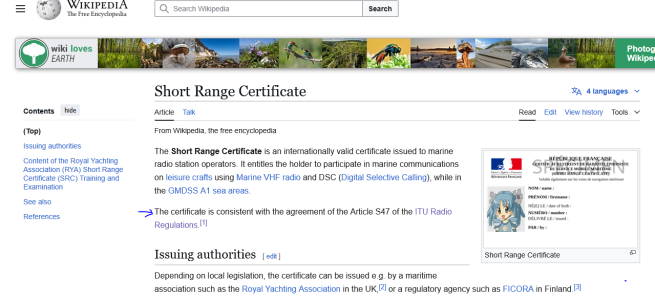
The Wikipedia article on the Short Range Certificate mentions: "The certificate is consistent with the agreement of Article S47 of the ITU Radio Regulations." That’s exactly what I’m trying to verify.

However, as I understand it, CEPT can only confirm the content and intent of their harmonised recommendation. They don’t speak on behalf of individual governments or institutions like the MCA or RYA. So wouldn't it ultimately be the MCA, as the UK's competent authority and ITU member representative, who needs to confirm that the RYA/MCA-issued SRC is compliant with Article 47?


Appreciate any clarification.
 

Attachments

  • src.PNG
    src.PNG
    286.5 KB · Views: 1
Hi,

Just wanted to check, and maybe someone can give me a bit of guidance.
I have an RYA/MCA SRC Licence and wanted to know if anyone is aware of who I can contact regarding the compliance of my licence with Regulation 47 of the ITU. Specifically, I am looking for a letter that states my licence (RYA/MCA SRC licence) complies with ITU Article 47. I’ve already contacted the RYA, and they referred me to the MCA. The RYA also provided a letter stating that they comply with the standards set by the MCA (can also be found online). However, when I contacted the MCA, they referred me back to the RYA.

As I understand it, the MCA would need to confirm that they comply with Article 47 of the ITU, specifically because the MCA is the authority in the United Kingdom, and since the UK is a member of the ITU, the UK must comply with ITU regulations. This responsibility has been transferred to the MCA. Who would be able to help me with this? Is it the RYA or the MCA? In my opinion, it should be the MCA, as they are the ones issuing the SRC licences.

Any advice or direction on this would be greatly appreciated!
Thanks

PS: Sorry for the inital wrong forum - appreciate if it could be deleted. Thanks!
Surely OfCom is the ultimate regulatory body for UK licensing of radio frequencies? It delegates to the MCA and RYA, but OfCom is the ultimate body responsible for adherence to ITU regulations.

Our ship's licenses are issued directly by OfCom, of course.

What country is asking for this?
 
I am looking for a letter that states my licence (RYA/MCA SRC licence) complies with ITU Article 47.

Sorry, I can't help, but just out of curiosity, what do you need this for? Just personal interest or something else?
 
I'm trying to get my SRC certificate recognised in another country (Germany). I've spoken with the responsible examiner, and they mentioned that my SRC licence needs to comply with Resolution 40 for it to be accepted. I believe this is a mistake on the examiner’s part, as Resolution 40 refers to the ICC and is not related to VHF radio. I think they actually meant Article 47 of the ITU Radio Regulations.

I have written to Ofcom, but I'm not sure if they will reply, as I haven’t received any confirmation that they even received my email.

I have now written twice to the MCA, and they referred me back to the RYA, whereas the RYA refers me to the MCA.
There doesn't seem to be much coordination or communication between the different institutions.
 
I recall a spat a few years ago with Germany refusing to accept the RYA certificate as theirs was a way OTT 2 day course. The RYA course and certificate were then revised to include what the Germans objected to. Suspect the non response from the RYA/MCA reflects the fact that it is (from their point of view) now a non issue. I cannot imagine the RYA certificate not being fully compliant with all ITU regulations. Your German examiner's seeming ignorance of the appropriate international agreements is telling!
 
Is the bit you need not covered by the paragraph below the Secretary of State’s signature on the reverse? Rather than second guessing that he means 47 when he said 40 why not ask him to confirm (perhaps in writing) what the current document is missing? That might trigger him to go and check the actual requirement rather than asking various bodies to confirm something he hasn’t asked for.
 
@Tranona I couldn't agree more.

It's honestly hilarious — the examination process in Germany is a complete joke. The exam consists of written, oral, dictation, and translation parts.

The dictation is done word by word, painfully slow — incredibly frustrating for anyone fluent in English. I’ve never encountered anything like that in real radio communications (at least not in the UK). It feels entirely disconnected from any realistic VHF usage. Anyway, I’ll leave it at that — it honestly makes my blood boil… (I also hold other UK certificates that aren’t accepted either.)

@ylop I have a German SRC licence on hand, and it clearly states that it complies with Article S47 of the ITU. I’ve written to the examiner exactly as you suggested, but I expect him to eventually correct himself. That’s why I’m also pursuing the other route in parallel (RYA/MCA), as they tend to take quite a while to respond.
 
@Tranona I couldn't agree more.

It's honestly hilarious — the examination process in Germany is a complete joke. The exam consists of written, oral, dictation, and translation parts.

The dictation is done word by word, painfully slow — incredibly frustrating for anyone fluent in English. I’ve never encountered anything like that in real radio communications (at least not in the UK). It feels entirely disconnected from any realistic VHF usage. Anyway, I’ll leave it at that — it honestly makes my blood boil… (I also hold other UK certificates that aren’t accepted either.)

@ylop I have a German SRC licence on hand, and it clearly states that it complies with Article S47 of the ITU. I’ve written to the examiner exactly as you suggested, but I expect him to eventually correct himself. That’s why I’m also pursuing the other route in parallel (RYA/MCA), as they tend to take quite a while to respond.
What does it say in white on blue under the SOS signature. Depending when it was issued that will have changed but the current words say it was issued under the Radio Regulations amongst other things. It doesn’t cite S47 - but it’s saying “all” of them…
 
I recall a spat a few years ago with Germany refusing to accept the RYA certificate as theirs was a way OTT 2 day course. The RYA course and certificate were then revised to include what the Germans objected to. Suspect the non response from the RYA/MCA reflects the fact that it is (from their point of view) now a non issue. I cannot imagine the RYA certificate not being fully compliant with all ITU regulations. Your German examiner's seeming ignorance of the appropriate international agreements is telling!
The UK didn't meet the requirements of the CEPT harmonised SRC, the German course did. The UK then changed the course to meet them.

The UK course will probably need to be updated when Ofcom finally updates requirements due to VDES.
 
@st599, do you have any information or references about your statement that the UK changed the course?

I have contacted two exam commissions, and interestingly, they gave me conflicting information. There seems to be a lot of confusion and ignorance on this topic.
For example, they referred me to this document: ECO Documentation
The main point they raise is this: “The German administration reserves the right to not recognize a certificate issued by another administration under substantiated circumstances.” They claim this applies in my case, despite my SRC certificate explicitly stating compliance with ITU and CEPT ERC/REC 31-04.

Additionally, the narrative is that the RYA never responded to the German authorities’ information requests - which is why the certificate isn’t accepted. However, it seems they may not realize that the RYA might not be the correct institution to contact for such inquiries in the first place.
 
The UK course was a 1 day course taught and examined by one person. It's now longer and requires a separate examiner.
 
However, it seems they may not realize that the RYA might not be the correct institution to contact for such inquiries in the first place.

Most of the world views the RYA as a members club for recreational sailors, rather than the quango that it effectively is for this certification. Persuading them otherwise will likely be expensive as it'll require lawyers with no guaranteed results. (I've been through similar in other countries).

If you're looking for commercial recognition then it'll be easier and cheaper to do either the German SRC if your German is good enough - and given the simplicity of these courses it doesn't have to be very good - otherwise the GOC 5 day course will be recognised under the STCW conventions.

The whole SRC should be rethought generally, given how light the content is. Something like a non-expiring GOC would be more worthwhile generally.

Another thought, is that a Maltese or Cypriot SRC might be more acceptable to an EU state and might be done in English. Although I have been told, in other countries, that qualifications should match either the nationality of the individual, the flag state, or the coastal state to be recognised.
 
The VHF course goes in to great detail on correct proword usage, but completely fails to explain how to correctly install, test and maintain a VHF.
 
The VHF course goes in to great detail on correct proword usage, but completely fails to explain how to correctly install, test and maintain a VHF.
I did earlier this year a VHF refresher, aimed mainly at DSC at the club and they went into testing, mainly using the DSC.
A lot of people nowadays, don't seem to have a clue about installation and pay 'professionals' to fit kit, so that plus maintenance would be a waste of time on a course.
 
I did earlier this year a VHF refresher, aimed mainly at DSC at the club and they went into testing, mainly using the DSC.
A lot of people nowadays, don't seem to have a clue about installation and pay 'professionals' to fit kit, so that plus maintenance would be a waste of time on a course.
Judging by the questions on here about seeing zero output after using a choc block on co-ax, I disagree,
 
The VHF course goes in to great detail on correct proword usage, but completely fails to explain how to correctly install, test and maintain a VHF.
Why would you need to understand how to 'correctly install, test and maintain a VHF' for a certificate to use the VHF?

Do you need to understand how to install, test and maintain a PC/tablet/mobile phone or motor vehicle to use it?
 
Top