Running 1GM10 without alternator belt

merjan

Well-Known Member
Joined
21 Jun 2022
Messages
134
Visit site
In the alternator belt on the 1GM10 snapped underway, I would normally be rushing to try to fit the spare belt. However it occurred to me that the belt only drives the alternator, and it might be much better to carry on and do that in a port, assuming it’s nearby. I’m wondering if I’m missing anything here, and whether that’s actually a bad idea.

PS The water pump is shaft operated.
 
All you'll potentially end up with is a flat battery, but if the loss of charge light is linked to the oil pressure and over temperature warning alarm on the 1GM10 panel then you'll end up with a headache too.
 
The battery will be discharged slowly but the rate will depend on what loads are on it. The warning light load is very small.
If the battery were to become completely discharged, or switched off, the other warning lights and buzzer would not work similarly other engine instrumentation .
Domestic loads will be supported by the house battery, assuming it is all a separate circuit, until it goes flat.
 
Surely you have a secondary charging system, solar etc. To the best of my belief a diesel does not need electricity to keep running unlike a petrol engine with spark plugs. The battery should not run down that quickly if you are careful on what is switched on.
 
Thanks for the replies! Probably I wasn't clear but I was wondering if there would be any harm done to the engine in a non-obvious way, but as far as I understand that wouldn't be the case.
 
I was wondering if there would be any harm done to the engine in a non-obvious way, but as far as I understand that wouldn't be the case.


Running the engine without the alternator belt will actually give you (a little) more power.
That would be the only effect.
If you have an electrical system where the start battery and house battery are isolated( the only way to go) you will be fine.

gary
 
Last edited:
I had an alternater and subsequent battery failure on my old Volvo Penta. Started Ok but by the time I tried to VHF the exit lock at Bristol we had no power.

We set of the 6 miles down the Avon looking nervously back at the Coast Guard Cutter following us down the Avon in the darkening gloom. Needless to say our handheld was also flat and in the dark we couldnt find the torch. Engine fine but nerves taut by the time we picked up our mooring
 
Thanks for the replies! Probably I wasn't clear but I was wondering if there would be any harm done to the engine in a non-obvious way, but as far as I understand that wouldn't be the case.
Only in an indirect way as the result of having no warning or alarm for loss of oil pressure or overheating.
.
 
Nope, no issues. I've done it before.
You can start the engine using the starting handle (if you have one) if your batteries are flat also. Honestly the 1GM10 is closer to a steam engine than a modern engine :). Part of the charm...
 
1GM10s tend to eat alternator belts. I'm not sure if this is rust on the pulleys or the fact that the two pulleys appear to be different widths as the belt sits lower in one of them. They usually wear out leaving black dust everywhere rather than suddenly breaking. Make sure spare is the right size as there were two different sizes depending on the engine number as the alternator pulley size was changed to put less load on the engine when starting.

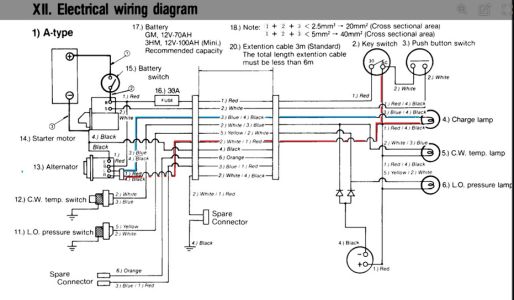
I don't think the alarm sounds from the charging light as it only appears to be connected to the oil and temp lights.

1755859571478.png
I estimate that I could keep going for at least a day as I have only small loads and all LED lights. No different to sailing for a day with the engine off. I have a separate temperature alarm on the exhaust elbow which would probably still produce an asthmatic alarm down to about 6 volts.
 
My alternator seized on my Lombardi 10 hp once and an almost flattened the battery trying to start the engine. I only realised at the last minute so I cut the belt and fortunately the engine cranked over and started
I motored out of Ostend harbour and hoisted the sails and sailed all the way to Bradwell with no electric at all. No autopilot No nav lights ( it was overnight) no nav instruments no gps and most importantly for the Thames estuary no echo sounder
I sailed to Bradwell with the engine still ticking over and motored in. When berthed I stopped the engine & tried a re start and there was not enough to turn even a hot engine over
The point of this is that as long as there is fuel a diesel engine will run without electricity
 
Those lithium jump starter packs are pretty cheap these days - there’s plenty under £50 on Amazon that’ll start a boat engine easily. Worth having for a bit of piece of mind.
 
My alternator seized on my Lombardi 10 hp once and an almost flattened the battery trying to start the engine. I only realised at the last minute so I cut the belt and fortunately the engine cranked over and started
I motored out of Ostend harbour and hoisted the sails and sailed all the way to Bra
1GM10s tend to eat alternator belts. I'm not sure if this is rust on the pulleys or the fact that the two pulleys appear to be different widths as the belt sits lower in one of them. They usually wear out leaving black dust everywhere rather than suddenly breaking. Make sure spare is the right size as there were two different sizes depending on the engine number as the alternator pulley size was changed to put less load on the engine when starting.

I don't think the alarm sounds from the charging light as it on

dwell with no electric at all. No autopilot No nav lights ( it was overnight) no nav instruments no gps and most importantly for the Thames estuary no echo sounder
I sailed to Bradwell with the engine still ticking over and motored in. When berthed I stopped the engine & tried a re start and there was not enough to turn even a hot engine over
The point of this is that as long as there is fuel a diesel engine will run without electricity
Suspect this may not be true with a modern common rail engine, such as one might find in a recentish car.

Have no experience of these, dont much want any, and cant give you any marine examples, but I;d be surprised if at least some builders havnt taken the opportunity to install something entirely dependent on a steady 12V supply to function
 
Those lithium jump starter packs are pretty cheap these days - there’s plenty under £50 on Amazon that’ll start a boat engine easily. Worth having for a bit of piece of mind.
I believe those are not usually LithiumIronPhosphate, though, and are thus perhaps potentially a bit unsafe to keep on a boat.

I suppose if you had, say, a BBQ unit mounted on the pushpit, overhanging the water, that'd perhaps be OK.

You can get supercapacitor versions that are inherently safer, though more expensive, and offer longer life, but any dedicated unit you can buy is likely to be well overspecified for a 1GM10.

I've wondered about adding a smaller (big but not "super", whatever that would mean numbers-wise) capacitor to supplement rather than replace the battery(ies), which might allow me to better use a traction style deep cycle battery (2 Trojans in series, for example) as dual purpose, but I havnt seen this discussed from brief searches, which mostly turn up big engine starters.. Biggest capacitor I have is 55 microfarads, whereas I'd guess (and this is just a guess) something in the Farad range would be required to make any detectable difference.

https://pdfs.semanticscholar.org/60e8/55495b5529e3654780593a0a15c5b2d05d81.pdf

This is more DIY, but seems to be something of a work in progress. There seems to be some risk of alternator damage from high inrush current, similar to LiPo4 charging, which I would hope the off-the-shelf supercap starters address.

 
Last edited:
Once the engine has started, you could turn the "ignition" key off to depower the warning lights/buzzer. In fact you can usually start the engine with the power off just by shorting the main high current power lead to the starter solenoid lead next to it on the back of the starter motor.

Stop the engine with the decompressor or emergency stop lever on the side.
 
Once the engine has started, you could turn the "ignition" key off to depower the warning lights/buzzer. In fact you can usually start the engine with the power off just by shorting the main high current power lead to the starter solenoid lead next to it on the back of the starter motor.

Stop the engine with the decompressor or emergency stop lever on the side.

You can turn the key off but my manual warns against this stating the alternator may be damaged if you do.

My 1GM10 exhibited symptoms of a failing starter motor with just the solenoid clicking rather than the engine turning over when the starter button was pressed and I traced this to a corroded fuse half buried in the wiring harness of the starter circuit.

Shorting the starter terminals exactly as you describe with a pair of long nosed pliers proved there was nothing wrong with the starter motor itself and some Googling revealed this is a known fault which can be cured by adding a relay to the solenoid circuit rather than powering the solenoid directly from the starter button.

Being a bit of a lazy b'stard and having a pair of long nosed pliers in the tool box I have yet to do this.
 
You can turn the key off but my manual warns against this stating the alternator may be damaged if you do.
Turning the key off on a 1GM just depowers the alarms and start button (see circuit diagram)
Turning off the main battery isolator could possibly damage the alternator although you may get away with it.
Other engines will be different and you may lose other functions such as the stop solenoid.
 
I believe those are not usually LithiumIronPhosphate, though, and are thus perhaps potentially a bit unsafe to keep on a boat.

I suppose if you had, say, a BBQ unit mounted on the pushpit, overhanging the water, that'd perhaps be OK.
If you cannot keep it on a boat would you keep it at home and why would BBQ ing it make it safer
 
1GM10s tend to eat alternator belts. I'm not sure if this is rust on the pulleys or the fact that the two pulleys appear to be different widths as the belt sits lower in one of them. They usually wear out leaving black dust everywhere rather than suddenly breaking.
Could be non-optimal belt tension.

Latterly, on my ancient Taiwan car, I took to "tuning" the belt tension by alternator output at fast idle with a multimeter (to 14.2V IIRC) which gave an objective measure and seemed a lot easier than the alternatives.

I suppose if the alternator was deficient in output this could lead to overloaded bearings, but I didn't have any issues with it, and cant think of any obvious reason why it wouldn't work with a 1GM10.
 
Top