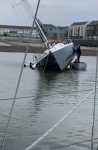
Run aground in Brightlingsea

Perhaps I'm overly cautious but I'm mildly astonished that peeps calculate their clearances to 0.1m!

Nominally, our draught is 1.7m so that's 2m right there. And then I'm never happy with less than 0.5m safety margin so unless it's pretty much zero risk if I touch (e.g rising tide and soft mud) I'd approach anything in the 2.0m to 2.5m clearance with extreme caution

As I well know from getting on and off our former mud berth, the actual tide can vary significantly from the predicted. In my own experience by as much as half a metre!

Upriver that of course and affected by all sorts of factors - atmospheric pressure, how much rain there'd been, wind direction etc. Get a high pressure system overhead after a dry spell with a stiff Westerly holding back the tide and a predicted 5.3m (ample to access our berth) could turn out to be only 4.8m (nowhere near enough) although that was extreme. But a variation of 0.2 to 0.3m was far from unusual

Maybe I am too cautious but then spending a tide on our side would be extremely embarrassing :)
 
The draft as listed in a boats specs may well be incorrect when it is loaded with cruising gear and/or is some decades old and the hull has absorbed a fair weight of water! I was astonished when we were lifted out and the crane operator told us the weight, it was a couple of tons more than the spec!! Builders give data relating to a boat with nothing onboard except what they have supplied, no water, no fuel and certainly none of the “stuff” that we all seem to accumulate. ?
And some boats, like my Moody 31 are notorious for drawing a bit more than the builder specified!
 
Perhaps I'm overly cautious but I'm mildly astonished that peeps calculate their clearances to 0.1m!

Nominally, our draught is 1.7m so that's 2m right there. And then I'm never happy with less than 0.5m safety margin so unless it's pretty much zero risk if I touch (e.g rising tide and soft mud) I'd approach anything in the 2.0m to 2.5m clearance with extreme caution

As I well know from getting on and off our former mud berth, the actual tide can vary significantly from the predicted. In my own experience by as much as half a metre!

Upriver that of course and affected by all sorts of factors - atmospheric pressure, how much rain there'd been, wind direction etc. Get a high pressure system overhead after a dry spell with a stiff Westerly holding back the tide and a predicted 5.3m (ample to access our berth) could turn out to be only 4.8m (nowhere near enough) although that was extreme. But a variation of 0.2 to 0.3m was far from unusual

Maybe I am too cautious but then spending a tide on our side would be extremely embarrassing :)
While the astronomical part of the tide is very predictable, meteorological effects can often alter the actual height of the tide quite considerably and unpredictably as there are non-local effects (a low pressure on the other side of the North Sea can affect the tide on this side). There are also effects caused by the basin dynamics; again they are pretty much unpredictable, at least without the use of a VERY complex model and a supercomputer!

I totally agree that anyone relying on the tidal prediction being good to tenths of metres will certainly go aground sooner or later.
 
Perhaps I'm overly cautious but I'm mildly astonished that peeps calculate their clearances to 0.1m!

Nominally, our draught is 1.7m so that's 2m right there. And then I'm never happy with less than 0.5m safety margin so unless it's pretty much zero risk if I touch (e.g rising tide and soft mud) I'd approach anything in the 2.0m to 2.5m clearance with extreme caution

As I well know from getting on and off our former mud berth, the actual tide can vary significantly from the predicted. In my own experience by as much as half a metre!

Upriver that of course and affected by all sorts of factors - atmospheric pressure, how much rain there'd been, wind direction etc. Get a high pressure system overhead after a dry spell with a stiff Westerly holding back the tide and a predicted 5.3m (ample to access our berth) could turn out to be only 4.8m (nowhere near enough) although that was extreme. But a variation of 0.2 to 0.3m was far from unusual

Maybe I am too cautious but then spending a tide on our side would be extremely embarrassing :)
 
Tbh I usually start to worry when we see 2 M but when we ran aground at Brightlingsea there was little option. The sounder showed 1.8M in the channel then quickly dropped to 1.4 hence we were aground. We had strayed just a few meters out of the channel. I knew the tide was rising so not overly worried but radioed the HM just to give him a heads up that we were likely to be there for a while. As I said he kindly came and pulled us off. They are always super helpful at Brightlingsea I find.
 
Tbh I usually start to worry when we see 2 M but when we ran aground at Brightlingsea there was little option. The sounder showed 1.8M in the channel then quickly dropped to 1.4 hence we were aground. We had strayed just a few meters out of the channel. I knew the tide was rising so not overly worried but radioed the HM just to give him a heads up that we were likely to be there for a while. As I said he kindly came and pulled us off. They are always super helpful at Brightlingsea I find.

I hit the putty going into Brightlingsea in the middle of the flippin channel! The groove has probably filled in by now :D

It was pretty close to low water but as it was neaps I reckoned I could get away with it and per my previous cautiously pootled in slowly. Then gave the venerable Merc a big handful of throttle when we ground to a halt! Worst case was gonna be waiting for the tide, we weren't into falling over territory
 
I'm a bit mystified by the concern expressed about going aground on soft mud. On sand or shingle it's a different matter especially in a seaway. It seems to me that metrication brought an excess if caution in this area as 0.1m doesn't sound a lot but 6 inches under the keel feels plenty. Of course there's a difference between passage planning, when predictions are all you have, and sailing where we're all spoilt by dcho sounders with a digital read out rather than temperamental flashing rotating neons which disappear when the sun comes out.

Anyone who has raced a yacht in an east coast estuary knows the importance of short inshore tacking when you need to make progress against the tide - to be efective, at 0.5m under the keel, you need to be thinking about tacking back towards the shore. Of course, sometimes a gully will mislead you as you sail up it, nearly to the river wall, only to slide to an ignominious halt as you tack back out but, if that doesn't happen occasionally, either you know the river like the back of your hand or you're not trying hard enough! The biggest penalty is to miss the dvening in the bar, if it was the ebb you were fighting and the only damage is to your ego.

Peter.
 
I'm a bit mystified by the concern expressed about going aground on soft mud. On sand or shingle it's a different matter especially in a seaway. It seems to me that metrication brought an excess if caution in this area as 0.1m doesn't sound a lot but 6 inches under the keel feels plenty. Of course there's a difference between passage planning, when predictions are all you have, and sailing where we're all spoilt by dcho sounders with a digital read out rather than temperamental flashing rotating neons which disappear when the sun comes out.

Anyone who has raced a yacht in an east coast estuary knows the importance of short inshore tacking when you need to make progress against the tide - to be efective, at 0.5m under the keel, you need to be thinking about tacking back towards the shore. Of course, sometimes a gully will mislead you as you sail up it, nearly to the river wall, only to slide to an ignominious halt as you tack back out but, if that doesn't happen occasionally, either you know the river like the back of your hand or you're not trying hard enough! The biggest penalty is to miss the dvening in the bar, if it was the ebb you were fighting and the only damage is to your ego.

Peter.
Racing brings its own pressures. I don't think that we often grounded, but then we probably weren't trying hard enough, which is why I have so few trophies. There was one delightful occasion when we had a club outing to WMYC in the days when it was more exclusive. Halfway through the meal a very bedraggled crew turned up, having made it by dinghy after grounding on Thirslet Spit, in the days when it had a beacon. The boat was Novat, an Arpege owned by the redoutable Tim Coode-Bates. I clearly remember him introducing himself to me in the club with "Hello, I'm Tim Coode-Bates. I'm an alcoholic, you know".
 
Another yacht aground at Brightlingsea last night actually same place we touched. Falling tide so stuck till late last night. T
We motored past them at about 630, but our smug feeling disappeared when we went aground in between the Cindery and St Osyth pontoons.
All was not lost as the youngsters caught a lovely Bass while we were waiting.
 

Attachments

  • 7777B7F6-DE84-4947-9AF8-C754B3547754.jpeg
    7777B7F6-DE84-4947-9AF8-C754B3547754.jpeg
    856.7 KB · Views: 57
I'm a bit mystified by the concern expressed about going aground on soft mud. On sand or shingle it's a different matter especially in a seaway. It seems to me that metrication brought an excess if caution in this area as 0.1m doesn't sound a lot but 6 inches under the keel feels plenty. Of course there's a difference between passage planning, when predictions are all you have, and sailing where we're all spoilt by dcho sounders with a digital read out rather than temperamental flashing rotating neons which disappear when the sun comes out.

Anyone who has raced a yacht in an east coast estuary knows the importance of short inshore tacking when you need to make progress against the tide - to be efective, at 0.5m under the keel, you need to be thinking about tacking back towards the shore. Of course, sometimes a gully will mislead you as you sail up it, nearly to the river wall, only to slide to an ignominious halt as you tack back out but, if that doesn't happen occasionally, either you know the river like the back of your hand or you're not trying hard enough! The biggest penalty is to miss the dvening in the bar, if it was the ebb you were fighting and the only damage is to your ego.

Peter.
I have a fin-keel, coupled with a fairly shallow canoe body; of my 1.5 m draft, the keel is more than a metre. If I go aground (and stay aground), I'm going to spend a tide at an angle of 45 degrees. That would make most of the facilities on the boat unusable, and there would be no places where one could rest. So, if I ground and dry out, I'm in for a pretty miserable several hours. And if, by some mischance, I end up leaning downslope when the tide is out, it could be even more than 45 degrees, and if the edge was really steep, I could even end up at 90 degrees, with the danger of flooding as the tide returns. The latter is unlikely, but certainly possible. For me, grounding is an avoidable hazard, and as I don't race, I would be firing up the engine in the situation described above. An acceptable hazard while racing is not acceptable for the lone cruiser!
 
  • Like
Reactions: Bru
Hi AP,

When getting it wrong cruising, I've slept reasonably comfortably at 45 degrees with an anchor laid out, lying in the angle between the base and the back of any diwnhill berth works surprisingly well. However, I have to agree that any other activity on a boat at 45 degrees is at best uncomfortable, rather like the first half of a typical Fastnet race where few competing boats are any more upright than that, but without he banging and crashing. Those of us who own Bill Dixon design boats are spoiled by their relatively upright stance when performing to their optimum upwind.

Peter.
 
Hi AP,

When getting it wrong cruising, I've slept reasonably comfortably at 45 degrees with an anchor laid out, lying in the angle between the base and the back of any diwnhill berth works surprisingly well. However, I have to agree that any other activity on a boat at 45 degrees is at best uncomfortable, rather like the first half of a typical Fastnet race where few competing boats are any more upright than that, but without he banging and crashing. Those of us who own Bill Dixon design boats are spoiled by their relatively upright stance when performing to their optimum upwind.

Peter.
In my case, the companionway would be dangerous at a substantial angle.; the cabin sole is about 5 feet below the threshold of the hatch. As I've spent a week recovering from a cracked rib as a result of falling down the companionway while on an even keel tied up alongside, I am, understandably, very cautious about negotiating the companionway! Capricious sails pretty upright; indeed, if she heels too far the helm loads enormously and she rounds up. Reefing early is a Good Idea.
 
We motored past them at about 630, but our smug feeling disappeared when we went aground in between the Cindery and St Osyth pontoons.
All was not lost as the youngsters caught a lovely Bass while we were waiting.
Often thought about trying to catch something to eat whilst sailing. I have two rods but almost invariably forget to bring bait. Didn’t see you last night but watch out tomorrow because we are leaving? camera at the ready.
 
RimwFb6.jpg
 
Top