
Rules: Overtaking at the Start Line

Now Voyager

New Member
Joined
7 Mar 2016
Messages
12
Visit site
Hi

We had an interesting race on Saturday.

Just before the start, our cat arrived early at the line so we slowed and were crawling the last few yards. Then in the final seconds, and don't ask how, another boat, came from behind, drew up on our lee side, started luffing us and shouting "Water".

Snag was, we were so close to the starboard mark by now that we couldn't have tacked without hitting it (and it's a permanent mark with concrete in it). Also the leeward boat was so close that had we tacked it's possible we might have hit it.
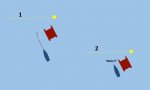
Yacht Race Diagram.jpg

I'm just a beginner but my understanding is that neither the mark-rounding rules nor the overtaking rules apply at the start. So am I right in thinking we were in the wrong? Or is there another over-riding rule about collisions?

As it turned-out the other boat didn't protest us, and in fact it was going so fast that it crossed the line early and was disqualified!
 
On my phone so short reply.

If this went to a protest it would hinge on when they established their overlap. To cut to the point if they didn't establish their overlap until you were so close to the buoy that you could not tack without hitting it, then they cannot force you to hit it.

If however when they established their overlap and altered course towards you (hails mean absolutely nothing in the rules, especially "water" in this situation.) you could have gone the wrong side of the mark either by tacking or just going up, then you fouled them.
 
The leeward boat has right of way and until he crosses the start line he can luff you. However he has to give you room to keep clear. If as seems likely from what you say, one of the start marks was also an obstruction he has to give you room to keep clear of that as well, assuming that you really cant tack behind it.

But why was he shouting "water" ? Is there another mark close to him on the left?
 
There were boats to its lee, although it all happened so fast and there were so many things to consider that I'm not sure what those other boats were doing exactly – or how close they were. Perhaps they were luffing him/her.
 
Ok, more considered reply.

Whilst the catamaran is clear ahead of the mono rule 12 applies.

12 ON THE SAME TACK, NOT OVERLAPPED
When boats are on the same tack and not overlapped, a boat clear
astern shall keep clear of a boat clear ahead.

So initially the Catamaran is ROW. Catamaran also has no obligation to anticipate that she will become the give way boat, unless she does so by her own actions. So in this case she has no obligation to react to the approaching mono until the mono has established an overlap to leeward.

Once the mono has established an overlap to leeward rule 12 ceases to apply, and rule 11 applies.

11 ON THE SAME TACK, OVERLAPPED
When boats are on the same tack and overlapped, a windward boat
shall keep clear of a leeward boat.
So the Catamaran must now keep clear of the mono.

Now at a normal mark, rule 18 would apply, and the inside boat would have the right to round the mark. However, we note that
SECTION C
AT MARKS AND OBSTRUCTIONS
Section C rules do not apply at a starting mark surrounded by
navigable water or at its anchor line from the time boats are
approaching them to start until they have passed them.

So no mark room protection. But.....

15 ACQUIRING RIGHT OF WAY
When a boat acquires right of way, she shall initially give the other
boat room to keep clear, unless she acquires right of way because of
the other boat’s actions.

and
16 CHANGING COURSE
16.1 When a right-of-way boat changes course, she shall give the other
boat room to keep clear.

So when the mono became overlapped she must give the catamaran room to keep clear. So, for example, acquiring your overlap 1 foot to leeward but sailing much higher does not pass that test.
In addition, when the mono changes course towards you, she must again give you room to keep clear. If your rudder is over and you are not deliberately spilling wind, so you should have the ability to turn, that is you meeting your obligation.

But this is all about the buoy. When you need to react to the leeward boat, then the room that they need to give you to keep clear will include the room required not to hit it. This is because the definitions of room is
Room The space a boat needs in the existing conditions, including space to
comply with her obligations under the rules of Part 2 and rule 31, while
manoeuvring promptly in a seamanlike way.
and rule 31 says
31 TOUCHING A MARK
While racing, a boat shall not touch a starting mark before starting, a
mark that begins, bounds or ends the leg of the course on which she
is sailing, or a finishing mark after finishing.
Plus of course it is not seamanlike to crash into things...

That does not however mean the room to pass the right side of it, or the room to stay behind the line before the start, it just means the room not to hit it. So if they shut the door on you whilst you still had the room to pass the wrong side of it, either by luffing or tacking, then tough. If however, they only establish their overlap at a time when you have no ability to pass the wrong side of it (and normally this would mean your bows passing it) then they must give you the room required not to hit it.
 
Brilliant! Thanks! I'll read and absorb before further reply.

You're also allowed to defend your position before the overlap is gained, so you can come down to close the gap on them, of course with the proviso that you give them the room/opportunity to keep clear. Have someone looking aft at the start to warn you of boats that are thinking of gaining an overlap to leeward in time for you to react and close the door.

And of course, tacking at the start should be avoided if you can do so. Getting yourself onto port with a dozen boats bearing down on you could be stressful. It's normal just to luff up a bit if forced up. With a normal start (rather than I flag/black flag etc.) if you're forced over the line you can still get back below it and start without being OCS.
 
You're also allowed to defend your position before the overlap is gained, so you can come down to close the gap on them, of course with the proviso that you give them the room/opportunity to keep clear. Have someone looking aft at the start to warn you of boats that are thinking of gaining an overlap to leeward in time for you to react and close the door.

And of course, tacking at the start should be avoided if you can do so. Getting yourself onto port with a dozen boats bearing down on you could be stressful. It's normal just to luff up a bit if forced up. With a normal start (rather than I flag/black flag etc.) if you're forced over the line you can still get back below it and start without being OCS.

Ah now we're getting into the tactics, rather than just the rules interpretation. But yes, you're absolutely right, and this particular start strategy that the OP adopted has little to recommend it, especially in a mixed multi/mono fleet where it's likely that the cat will be slow to accelerate off the line from stationary, and not able to point as high as the monos starting to leeward. I think I'd be tempted to start at the pin, unless the boat end was just far too favoured to ignore, in which case I'd have planned on being slightly late but at speed and looking to tack off asap unless I got very lucky with a lane.
 
It seems likely that the OP's cat was overlapped with other leeward boats further along the line. Hence already needing to be keeping clear of those.

Also, a cat 'crawlng the last few yards' might start to make a lot of leeway, and might be percieved as altering course towards the mono.
Once the mono is overlapped, the cat must immediately do what it can to keep clear, which I guess would be to sheet in.

Was the mono calling for water from the other leeward boats, treating a slow moving cat as an obstruction?
 
Thanks. It's great how much trouble people take to explain. I'm having a beer with the skipper tonight so we'll discuss the issues then.

Cheers!
 
So what did he say? And when he shouted "water" was he shouting at you or at the boats in his lee which might have been making it difficult for him to give you the room you were entitled to?
 
The leeward boat has right of way and until he crosses the start line he can luff you.

There is no "proper course" prior to the start signal thus, once she gains an overlap, leeward can push the catamaran up (head to wind if she wants) provided she initially gives room to keep clear. After the start signal leeward is restricted to her proper course which may be closer to the wind than the windward boat can manage.
 
. After the start signal leeward is restricted to her proper course which may be closer to the wind than the windward boat can manage.

Only if leeward became overlapped from behind and within 2 boat lengths. If windward came from behind then leeward can luff htw at any point if she chooses. See rule 17.
 
There is no "proper course" prior to the start signal thus, once she gains an overlap, leeward can push the catamaran up (head to wind if she wants) provided she initially gives room to keep clear. After the start signal leeward is restricted to her proper course which may be closer to the wind than the windward boat can manage.

Yes, I was careless in wording. It is the start signal rather than crossing the line that matters but as Flaming points out the proper course bit applies only if the leeward boat has established an overlap from clear astern as seems likely to have happened to the OP.
 
Yes, I was careless in wording. It is the start signal rather than crossing the line that matters but as Flaming points out the proper course bit applies only if the leeward boat has established an overlap from clear astern as seems likely to have happened to the OP.

And of course it's the leeward boat's proper course that applies, which doesn't necessarily help the OP if he's tumbling to leeward in a slow-moving cat and has a high-pointing monohull beneath him.
 
Top