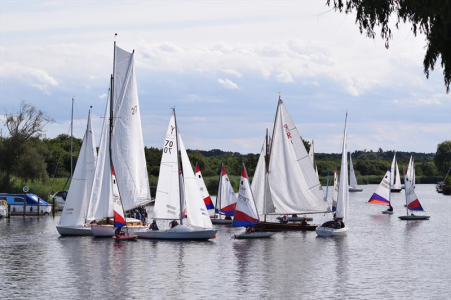
Rules opinion would be appreciated.

Sorry to belabour this but I'm still a bit confused.
Recap; I'm approaching mark A close hauled on port and will just lay mark B when I tack. Another boat has rounded B and is broad reaching back to A.
I understand that I must give room when overlapped (I did), but when is that overlap established?
A/ from when he rounds B, about 1/2 mile away.
B /When I enter the zone.
C / When he gets within the prescribed distance from me ( is that 2 or 3 lengths?).
All purely academic, we discussed this over beer later.
As I understand the rules Dan, you are mixing up two things. The overlap starts from when his bow hits the imaginary like formed by your transom. But its irrelevant until for example you come to something like a mark where one of you has to give way. If the other boat has an overlap just before the three boat lengths from the mark you give way. If he hasnt then he gives way.

But I am no expert and there are experts on here
 
As I understand the rules Dan, you are mixing up two things. The overlap starts from when his bow hits the imaginary like formed by your transom. But its irrelevant until for example you come to something like a mark where one of you has to give way. If the other boat has an overlap just before the three boat lengths from the mark you give way. If he hasnt then he gives way.

But I am no expert and there are experts on here
Getting off topic, but overlap is absolutely fundamental to a huge number of rules. For example it defines when windward must keep clear of leeward. Without an overlap there is no windward and leeward, there is just clear astern and clear ahead.
 
Sounds like you and the other yacht are on different legs of the course.
Yes..... I dont think he can ask for water at the mark as you are not heading for the same mark. I think it's a straightforward port tack/starboard tack, or windward boat, situation.

I think he can ask for water if he will be forced onto an obstruction, or aground, if you dont give it.
 
My understanding of RRS is out of date.
Mast abeam! :p

This past summer I encountered another geriatric racer who believed that the zone was two boat lengths. She also believed that it’s possible to exonerate a foul by doing turns at any time prior to finishing. That was also changed, years ago.

About 95% of mark rounding related protests are dismissed. Many people don't understand this rule.
I agree with the second sentence, but not the first.
 
The first is a quote from John Doerr, AC jury member. It surprised me too. Obviously it’s not that neither party is at fault, it’s just impossible to say who’s in the right so often. The protests are apparently overwhelmingly people complaining that the undeserving have taken room when they had no rights, it’s very hard to show they have not.
 
I think if you are going to assert your right to room or deny someone else's, especially if it is crowded, then it helps to be proactive and vocal. So , as approach the three lengths try to get agreement on who has and hasn't got an overlap and as the rounding approaches loudly, but politely, explain who is getting ,or not, room and who you are going to want room from.
Allowing a situation to quietly evolve and then arguing about it amongst the chaos or, even worse, in the protest room is not good.
 
I think if you are going to assert your right to room or deny someone else's, especially if it is crowded, then it helps to be proactive and vocal. So , as approach the three lengths try to get agreement on who has and hasn't got an overlap and as the rounding approaches loudly, but politely, explain who is getting ,or not, room and who you are going to want room from.
Allowing a situation to quietly evolve and then arguing about it amongst the chaos or, even worse, in the protest room is not good.
Agree.

I find that the first mark rounding overlapped with someone you don't know is always a lot more stressful. By the time you've sailed against a boat a few times you get to know who you can trust to give you mark room without having to point it out, and who you need to "assert your rights" to.
 
Let's assume you arrive at the mark together and that you have given them mark room as has been reported. What happens if his course is to the right on the diagram to go to the finish? Does your room need to extend to let him go where he wants and prevent you from turning toward B?
 
Let's assume you arrive at the mark together and that you have given them mark room as has been reported. What happens if his course is to the right on the diagram to go to the finish? Does your room need to extend to let him go where he wants and prevent you from turning toward B?
Nope.

Have been in that situation a few times when the fast boats are finishing lap 2 and want to reach to the finish, and you're finishing lap 1 and want to go upwind. Suddenly them diving up the inside looks very shortsighted as you're not taking them up and their competition who went round the outside is sailing straight at the finish....

Cue lots of yelling "our finish is over there" and "I don't care, my windward mark is that way".

Which is the other general point. Just because you can get the inside berth at the mark, doesn't always make it a good idea. Overall situational awareness is key.
 
I agree with flaming, it's a common occurrence at our club, we have 6 class starts at 5 minute intervals so there are boats all over the course. There is a mark hundred yards short of the finishing line. This is so boats not finishing don't cross the line, causing confusion with the timekeepers . An Oppie could be hidden behind a 45ft yacht .
So you often hear people asking" are you going on or rounding" well before the mark, so everyone can be on the right side of each other.
Said mark
1719492390225.png

217 is likely to be coming straight on, the camera is at the finishing line, the rest are trying to round the mark seen under 70's bow, the boat on the left of the picture has got it wrong and will have to do a quick 360 to turn round behind 217.
 
There are two relevant elements for this question. First note that the definition of mark-room includes proper course to the mark, but does not mention an entitlement for the inside boat to sail her proper course after the mark:

MARK-ROOM:
Room for a boat to leave a mark on the required side. Also,
(a) room to sail to the mark when her proper course is to sail close to it, and
(b) room to round or pass the mark as necessary to sail the course without
touching the mark.

Secondly to see when mark-room ends we need Rule 18.2 d:

Rules 18.2(b) and (c) cease to apply if the boat entitled to mark-room passes head to wind or leaves the zone.

So given we are at a leeward mark the outside boat is free to luff up to head to wind (or her proper course depending on how the overlap was established), and the inside boat being windward must keep clear, so long as she has space to avoid the mark.

NB the rules for team racing are different in this scenario.
 
Top