
Roll pins replacement

zoidberg

Well-Known Member
Joined
12 Nov 2016
Messages
6,937
Visit site
I need some informed guidance on selection and use of 'roll pins/coiled spring pins' used to hold a prop shaft to the gearbox.

When I swopped 'old-for-new' engine, I removed an old pin, then later replaced with another new one. That didn't go as well as I'd hoped.... for I knew nothing of how that ought to be done.
The replacement pin protrudes by almost half an inch. It clearly hasn't seated adequately/fully through the prop shaft and now I need to do the job properly - starting with removal.
'Tight-as-possible' mole grips have failed to budge it. I'll need to tap it out, and access is severely restricted.

I've recently learned that the hole through the prop shaft ought to be 'off-centre'....

I haven't found anything directly relevant on Youtube. Any input on A: removal, and B: replacement with a right-sized pin.... will be most welcome.
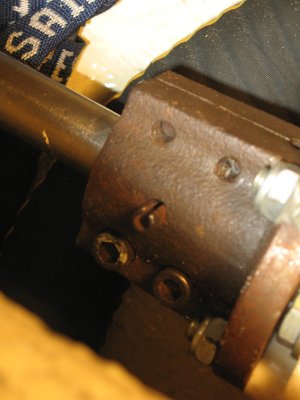
IMG_6686.JPG
 
It's a roll pin; you batter them in with a hammer. Ideally/normally it's a through hole so you use a pin punch to follow it through for removal, also using topical application of a hammer. If the hole is slightly off-axis and if it's assembled back-to-front and the pin inserted then it may well end up stuck neither in nor out. Marking the clamp/coupling sections and the relative position of the prop shaft with tippex or similar helps reassembly and avoids back-to-front misery.
 
Go the opp side & drill a much bigger hole through until you get to the end of the roll pin. ( bigger hole less likely to snap in offset hole with care). The hole should not be miles out, so with a bit of luck it will locate on the hole the other end. Then knock it out from the other side with a drift. Then drill the big hole right through & insert a large roll pin or small bolt
 
I need some informed guidance on selection and use of 'roll pins/coiled spring pins' used to hold a prop shaft to the gearbox.

When I swopped 'old-for-new' engine, I removed an old pin, then later replaced with another new one. That didn't go as well as I'd hoped.... for I knew nothing of how that ought to be done.
The replacement pin protrudes by almost half an inch. It clearly hasn't seated adequately/fully through the prop shaft and now I need to do the job properly - starting with removal.
'Tight-as-possible' mole grips have failed to budge it. I'll need to tap it out, and access is severely restricted.

I've recently learned that the hole through the prop shaft ought to be 'off-centre'....

I haven't found anything directly relevant on Youtube. Any input on A: removal, and B: replacement with a right-sized pin.... will be most welcome.
The rollpin drilling does not have to be off centre, but it helps when reinserting a pin because it is obvious if you are 180 degrees out. I would never, on a boat propshaft, use a hammer. Make yourself a clamp for inserting and removing.

Www.solocoastalsailing.co.uk
 
Drilling a hole through the centre of the shaft is the simplest way to weaken it although I don’t think that I have ever seen on break
ideally if you are fitting pin then it should be through the edge of the as in a bicycle pedal and a use a taper pin
the only good thing with the vertical hole in the coupling is to tap a thread and fit an Allen screw into a dimpled spot on the shaft as I was taught!
 
Drilling a hole through the centre of the shaft is the simplest way to weaken it although I don’t think that I have ever seen on break
ideally if you are fitting pin then it should be through the edge of the as in a bicycle pedal and a use a taper pin
the only good thing with the vertical hole in the coupling is to tap a thread and fit an Allen screw into a dimpled spot on the shaft as I was taught!
On a previous boat I did the calculations. 50HP diesel on a 25mm shaft with a 5mm diameter roll-pin through the centre and i still had a 4:1 safety factor. Worked perfectly for 15 years before i sold the boat. The OP's coupling is a split clamp type, which mine was not, so i was relying solely on the pin for drive.

www.solocoastalsailing.co.uk
 
Last edited:
In the photo in post#1 the collar is split and clamps onto the shaft with screws.

That is how the torque is transmitted to the shaft. By friction.

If it were transmitted by the pin, then there would be no need for a split collar; a simple plain sleeve would do and that is obviously not the case.

The pin is there simply to locate the collar on the shaft.
 
Last edited:
A hammer is exactly the tool to fit and, with a punch, remove a pin. If I buggered about making custom tools to press them out every time I met a pin in an assembly I'd never get anything done.
I'll find a suitable size of punch*, and I'll start with a small hammer of the 'toffee' variety. Should that prove insufficient, I can work up in grades to my 2kg club hammer..... There isn't room to swing my 'sledge'...! ;)


*and some penetrating oil.
 
I'll find a suitable size of punch*, and I'll start with a small hammer of the 'toffee' variety. Should that prove insufficient, I can work up in grades to my 2kg club hammer..... There isn't room to swing my 'sledge'...! ;)


*and some penetrating oil.
Provided you have a through hole removing it with a hammer and punch from the other side should be straightforward.
 
There is probably a groove on the side of the shaft into which which the pin should locate. I imagine the pin was not in line with the groove when you tried to refit it and is now up against the edge of the shaft and that is why it will not tap in any further and will mean you do not have access to it to tap it back out either. A friend of mine got one out by heating the end of the pin with a welding rod ( low amperage) which makes the metal softer and then screwed a set screw or similar into the pin. He was then able to turn the pin at the same time as pulling it out. Good luck!
 
Despite it being a very tight 'wriggle' and actually painful, I've managed to make a much closer and more detailed inspection, from both sides. Here's what I've found.
The drilled holes in the two-part coupling clamp are aligned centrally at 180 degrees, The hole through the propshaft is eccentric i.e. it is NOT through the centre.
Consequently, the slotted spring pin runs through the hole in one part of the coupling clamp and through the hole in the shaft, but does not quite align with the hole in the other part of the coupling clamp, so cannot pass all the way into and through the second section of coupling clamp.

I can see this by peering down the hole.

I've tried several tools to squeeze/compress the pin, without success. It is very firmly jammed and possibly bent a little as the hole through the shaft is eccentric.
I'm now tempted to leave it. There's an implication for 'imbalance' and if vibration results, I'll consider bonding a small section of pin into the vacant hole to effect a balanced rotation.
 
Last edited:
Years ago servicing an Austin Maxi gearbox I had to extract a rollpin in a blind hole. There was, by design, enough protruding to attach an impact extractor which I had to buy (or hire?). Rather slow going but it worked.
 
Provided you have a through hole removing it with a hammer and punch from the other side should be straightforward.
I'd be knocking the pin out, rotating the shaft 180 relative to the clamp(I suspect the holes will then align, although it's possible the orientation is correct barring a lack of final alignment, it will be easier to tell once the pin is out) and fitting a new pin, but it's your train set.
 
Looking at the photo.

If you rotate the coupling 180 degrees you will see an empty hole where the pin would be, had it been driven all the way through. Is that right?

What I would try next is to :

1. Get a decent quality parallel pin punch; but narrower in diameter than the slotted pin. You want one that would pass right through the mis-aligned holes if there was no pin there.

2. Slacken the 4 clamping screws.

3. Turn the shaft so the pin hole is vertical, with the pin downwards

4. Bung the lower end of the hole.

5. Fill the hole with penetrating oil, eg PlusGas (not WD40).

6. Leave it to soak overnight.

7. Insert the pin punch in the hole so it is resting on the edge of the pin. Hold it firmly.

8. While reciting the mantra "If the bugger went in, it will come out!", knock the out the pin downwards.
 
If you rotate the coupling 180 degrees you will see an empty hole where the pin would be, had it been driven all the way through. Is that right?
That's right.
What I see is represented by this image:

52975467600_88f19bf8bd_t.jpg


The white crescent represents the segment of shaft which is visible.
The 'crude' grey line represents the inboard edge of the pin. The wall thickness seems about 1.5mm.
The black segment represents the hole within the pin. if I shine a light up this, the light is visible.

I've found the hex key which fits the clamping screws - which are presently immovable. I'll need to find an extension tube for more 'grunt'.
I've soaked everything in penetrating oil, and will try again tomorrow.
 
That's right.
What I see is represented by this image:

52975467600_88f19bf8bd_t.jpg


The white crescent represents the segment of shaft which is visible.
The 'crude' grey line represents the inboard edge of the pin. The wall thickness seems about 1.5mm.
The black segment represents the hole within the pin. if I shine a light up this, the light is visible.

I've found the hex key which fits the clamping screws - which are presently immovable. I'll need to find an extension tube for more 'grunt'.
I've soaked everything in penetrating oil, and will try again tomorrow.
Good sketch. Makes it very clear.

So what you need is a pin punch of diameter equal to the distance from the left hand edge of the hole in the coupling to the right hand edge of the hole in the shaft.

Do try and get a good quality one with a nice sharp corner, ie not rounded off.


A second thought after seeing your sketch. If, after loosening the 4 clamping screws, the shaft was able to move to the right a little so that the full diameter of the pin is visible in the coupling hole, it should make it easier to drive out the pin.

Good luck!
 
And another thing...... 😁

(Assuming the boat is out of the water)

After slackening the 4 coupling screws, and soaking with penetrating fluid, with the engine in gear, you could try rotating the propeller to and fro with your hands to loosen tbings up a bit.
 
Top