Rocna's bad press by video - anchor thread don't read if you don't like anchor threads!

I am the first to agree the amount of time and effort in making the videos across a range of seabeds and then editing the videos is a huge investment. It shows extraordinary dedication and patience. Sadly that investment is completely wasted if the test protocols are not valid. Of course if the tests are valid then the results are invaluable. The problem is that the results are contradicted by the comments here, for example Vyv's post, as the photographs Vyv provided, I recall, are indicative there are flaws in the protocols. Generalising if Rocna was a s 'bad' as indicated in the spread sheet I find it extraordinary that there are not more negative posts of Rocna performance over, say, the last 10 years. In general posts here on YBW over the last 10-15 years have all been favourable - though there is the thought people are so sensitive to anchor threads they don't like to raise their head too high above the parapet. But it is not only posts on YBW, there are other sailing forum. :) , and though I don't invest much time in other forum I think I would detect some concern of Rocna performance were it aired. Basically both UK and N American owners all seem unconcerned at any issues with Rocna (and no-one would equate its performance with a CQR).

Interestingly though people praise and rave over the Panope work - no-one raises the contradiction that Rocna, the previous darling, now comes at the bottom of the pack. This seems to be indicative that NormanS' comment has merit - its about fashion (and a lack of discernment). Historically the previous hero was 'Pictures of Anchors setting' where convex anchors were canned - now the convex anchor, Excel is top of the pack. People have short and selective memories - and or - don't question.

There are other contradictions which may be as a result of definition of 'mud' or 'soft'. Fortress Chesapeake tests underlined that most anchors are a complete waste of time in soupy mud - this is not distilled in the spread sheet above and I can confirm from my own experience that an Excel, CQR and Spade are unreliable in soupy mud and only Fortress instills a measure of confidence in the hold developed. Mantus M1 was one of the best of a bad bunch in soupy mud but you would need a huge model to be reliable (size does matter in this seabed) - but then it is simply a fluke anchor (like Fortress/Danforth with a fixed shank/fluke). This does underline that anchors are a compromise - there is no one perfect anchor and some anchors work exceptionally well in some seabeds and are average, or poor, in others.

I personally think the protocols are flawed - the test procedure is swift , aggressive and dramatic and this does not reflect reality. Winds do vary by 180 degrees but seldom does this occur in seconds (say 60) it takes minutes (many). Sadly to test for a realistic wind shift would lead to really tedious videos and would demand days of work not a few hours. You are not going to be a hero making videos of grass grown, paint drying or filming a realistic simulation of a wind shift on an anchor :(

I also find it extraordinary that ultimate hold has been discarded in favour of video and the chosen test protocols (without question). There is a thought that an anchor that develops good hold will be more secure in a wind shift and the Forum evidence does suggest that anchors that develop good hold, Rocna, Spade are also reliable under 'real' weather. Ultimate hold lifted Rocna and Spade to the top of the pack in 2006 and in subsequent tests, Voile et Voileurs (also reported by YM or YW) - they are the same anchor now as then - if ultimate hold is flawed - I'd like to see a bit more repeatable evidence.

I find it difficult to deduce that aluminium anchors are not as good as their steel counterparts - the difference between a steel and aluminium Spade in terms of performance is undetectable (on the spreadsheet above) and the difference between the steel and aluminium Excel on the spreadsheet is large (and does not reflect our hands on experience (and the aluminium Excel is not much different in performance to the Rocna 2020).

Another example of questionable evaluation is the galvanising column. Chipping of gal on sharp edges can be minimised by not having sharp edges but galavanising does not only protect the area covered but also protects surrounding areas. Galvanising life is a function of galvanising thickness -a thin gal coating will abrade more quickly - but no mention of gal thickness. So have a thick, well adhered gal coating and you are not given credit......

It is easy to be critical of test protocols much more difficult to offer constructive comment. I think the procedure need considerable refinement and the variation in load direction (on which much of the conclusions are based) needs to be conducted at much slower speeds - and then the initial slow veer tests compared with the current results - to identify if the changes are sensible. But to continue the work with the same protocols where results are in total contradiction to the 'real world' - seems a complete waste of time (and money).


Take care, stay safe

Jonathan
 
I thought I might add

When I consider buying a new anchor.....

I want to know the anchor engages quickly and then sets and 'locks up' quickly (in such a way it spills my chardonnay), Commonly people suggest their modern anchor engages and sets in a shank length and/or within 1 metre. Photo evidence suggests this is typical ( and now unremarkable). I want to know that if the chips are down the anchor will hold, at least, at maximum revs (which for us is a less than stellar 400kg tension from our engines). I also want to know it has high potential hold - its Ultimate Hold under a 'static' anchor test (by someone or an organisation that is independent - a reputable magazine test, to me, is fine ).

Currently most modern anchors Spade, Rocna, Supreme, Excel, Ultra, SARCA, Knox are all rated as Super High Holding Power anchors in comparison with Delta, Bruce and CQR rated as HHP anchors. This seems to equate roughly to a 15kg SHHP having hold of 2,000kg, and HHP around 1,000kg based on multiple tests in a 'decent sand' seabed. Fortress also has the same or similar rating as SHHP - but hold is a bit higher than 2,000kg. To be awarded SHHP the anchor is also Proof Tested - which evaluates the integrity of the strength of the anchor.

One data point of note - for whatever reason HHP anchors are notorious for dragging (regularly) and SHHP anchors are 'more' reliable and reports of dragging notable by their absence. The absence of dragging may be a function of ease of setting - rather than Ultimate hold - and ultimate hold might be over rated.

For us I also want the anchor to be light - as our experience is that weight is not important - its design that matters.

I conducted some veering tests on a range of anchors, Anchor Resetting Tests - Practical Sailor and concluded that anchors that retained a clot of mud could drag and would continue to drag until the clot washed out. Morgans Cloud withdrew their recommendation for Rocna (and by association, Supreme) due to yachts dragging and ending on a beach. Since then - though Rocna sales must have increased factorially - I don't recall any yachts dragging when a Rocna anchor (or Supreme) was conclusively at fault. I stand by the work I did - but maybe modern anchors breaking out (for whatever reason, veering, horsing, 180 degree wind shift) is simply not a common occurrence.

Take care, stay safe

Jonathan
 
FWIW, have a Rocna, used in a number of anchorages I'd say around 700 (looking at time spent on the boat between sailing and anchoring). I see no reason to change it as I have found it perfectly satisfactory, as other anchors are of course but I have not directly used them so I cannot comment.
If an anchor works well and does not cause any problem, what would be a "better anchor"?
Under different operating conditions I think "better" to me is a light alloy anchor, as I can bring it on the dinghy, or swim with fenders, weigh by hand, etc etc. Another "better" anchor type are those cheap enough I can afford to loose in very foul bottoms, when maximum holding is very very secondary, it's "better" cheap polypropylene rode and welded rods/plate, once it's stuck leave it there, that's another type of "better". But they are of course all different purposes from a bower.
Incidentally, a significant number of anchorages we made have been on rivers/inlets with strong current and reversals at every tide cycle, never seen the anchor move from its place. Whatever tests Panope did, or if boats ended up on rocks because of a tide reversal, all I can deduce is we have different ways of anchoring, somehow. My personal statistical sample as to the anchor overall efficiency is good enough for me.
Ask directly, in person, real world, anyone you know has a significant anchoring experience, when you average there are two three four different setups which work well, they are different and keep people equally safe, so what would be "the best"?
Thanks.
I think I would go by a fellow sailor's experience every time when choosing anchors . Not that other data can not be brought into the mix. If I ever had to leave my boat anchored in a strange place I would consult the locals first.
 
Constructive criticism should always be welcome but I find the suggestion that Steve’s work is technically flawed and therefore of no value hard,to accept. Steve is a layman, he’s not a boffin nor a scientist, he readily states that in his narrative. He’s doing what a layman might do in attempting to draw some conclusions about different anchor offerings. He does say that his testing methodology is extreme - particularly the 180degree veer tests at speed, he’s giving the anchors an over-zealous testing regime in the hope/belief that a real world user will never inflict such abuse on an anchor.

I have recently had cause to purchase a new anchor, a not insignificant investment, and in the buying process what quickly becomes clear is that there is a complete dearth of independent anchor testing from which one can draw a purchase conclusion. Some of the manufacturers have videos of their anchors being dragged along a sandy beach by a 4x4 (talk about unrepresentative of the real world conditions!) yet I see no criticism of that, why not?

So, I’m a layman, just like Steve, and whilst the manufacturers of anchors continue not to provide useful performance data/analysis of their products I am grateful for what Steve does. I believe that I am able to draw useful conclusions from his work by forming my own opinion whilst not necessarily slavishly using his table as the only means of assessment.
 
Perhaps there is value in an 'industry study' where criteria is set and many people are asked to measure their anchoring against that criteria, say over 2 seasons, then the results collated and observations made. This is not such an uncommon thing to do, with methods used to normalise the data to make comparisons, and many industries participating in such studies. Is there an appetite for such a thing, I doubt it. The internet is awash with anchor tests already and as this thread shows, nothing gets resolved to a definitive answer. Carry on as you are, appears to be the message.
 
Here is my Knox 18kg (40lb), the fluke is to the left, so you are looking at the anchor approximately in elevation. The anchorage is Puilladobhrain, just south of Oban, Scotland. Bottom is mud, clay, consolidated, well used anchorage, anchor was set in 5m water depth and power set, little wind all night. On retrieval when straight up and down, it took a pause with tension on the chain, to break free. The mud was cleared after 5 dunks by releasing the clutch to free fall from about 1.75m into the sea, about 2 meters water depth. Interestingly the anchor flies forward of the boat on an obvious glide path that is far from vertical. Obviously at some point the weight of chain will drag the stock down. I would not normally drop the anchor chain in free fall. Anyway, this is just for information and to support the claims earlier on of anchors bringing up big clumps of mud.

51413241218_2acb4d988e_4k.jpg
 
I conducted some veering tests on a range of anchors, Anchor Resetting Tests - Practical Sailor and concluded that anchors that retained a clot of mud could drag and would continue to drag until the clot washed out. Morgans Cloud withdrew their recommendation for Rocna (and by association, Supreme) due to yachts dragging and ending on a beach. Since then - though Rocna sales must have increased factorially - I don't recall any yachts dragging when a Rocna anchor (or Supreme) was conclusively at fault. I stand by the work I did - but maybe modern anchors breaking out (for whatever reason, veering, horsing, 180 degree wind shift) is simply not a common occurrence.

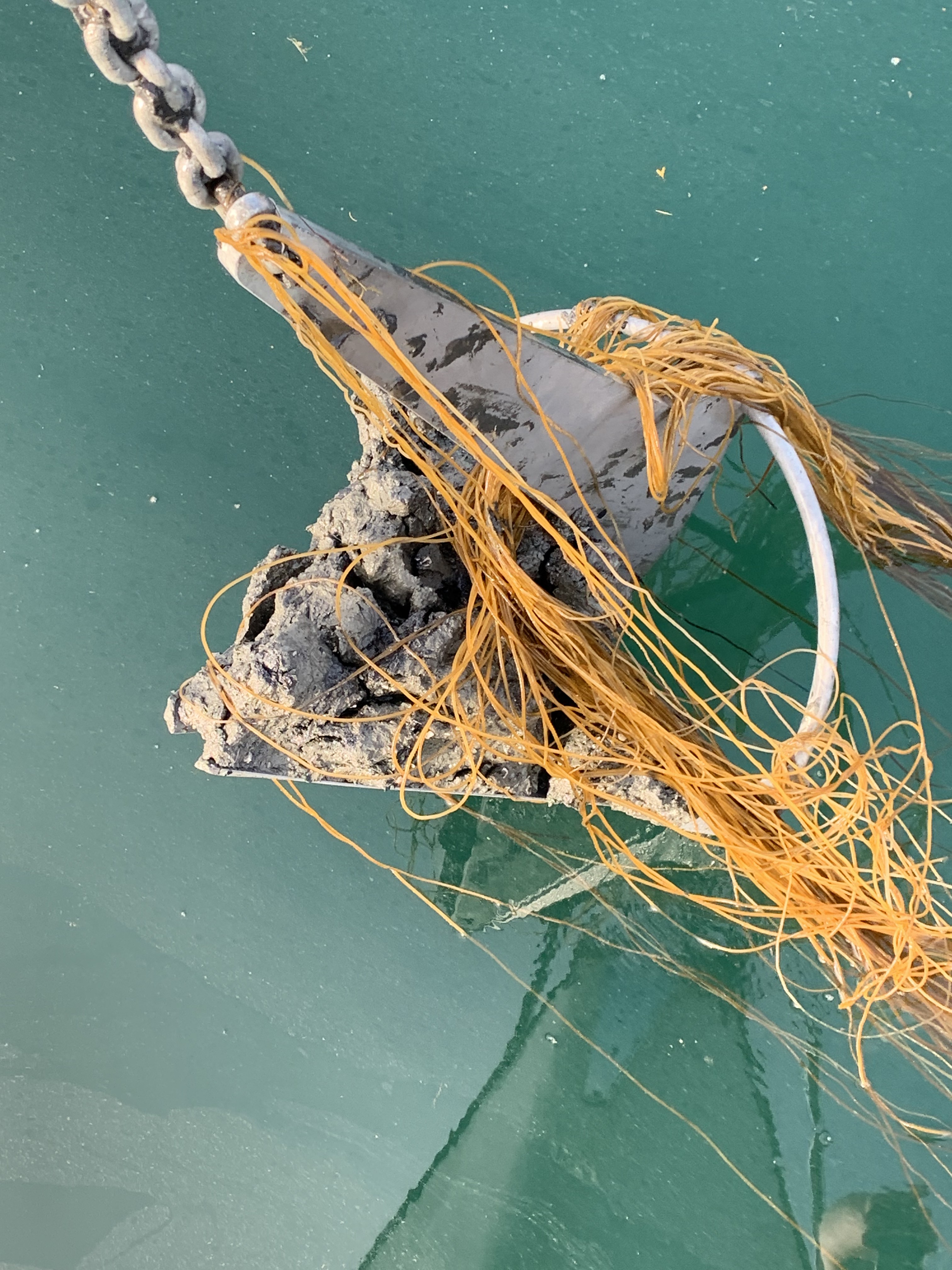
In sheltered anchorages on the west coast of Scotland and Shetland our Rocna would often come up with a large lump of thick mud or clay on the fluke. We use a hand windlass for complete reliability so are very aware of the loads required to break the anchor out. The larger the lump of mud/clay the greater the break out load. At times we have had to bring the chain vertical and depress the bows with the windlass and my weight on the bowsprit, then return to the cockpit and wait for a few minutes for the buoyancy of the bows to break the anchor out for us.

My interpretation is that the anchor had to dig deep to completely fill the above fluke volume with this high density material and was probably completely buried. In this situation the chances of a break out even with a 180 degree wind or tide shift is very slight. I have not experienced a Rocna break out once firmly set.

I have, however, experienced a couple of slow controlled drags in strong winds with a concave fluke anchor from the Spade family when anchored in a thin layer of soft sediment over a rock substrata or possibly on small gravel. The anchor did not retain a sediment sample at the surface so can not be definite.

I am not contradicting other people's experiences as I was not in their anchorages at the same time, just adding my observations so that other skipper/owners can make their own informed decisions.
 
Last edited:
I'm quite happy when my anchor comes up with a large sample of the seabed That's what my deckwash hose is for. The knowledge gained has helped me to store lots of information about anchorages, in my head. Like others, we often have to shorten up to vertical with the bow down a bit, and give it time. When an anchor is in like that, I know it wasn't going to go anywhere.
 
Fortress said, in the past - when Brian@Fortress was employed, that if a Fortress was well set then in a change of tide, or 180 degree wind shift, it would take considerable effort to break out a Fortress. In their Chesapeake mud tests the operators on the Rachel Carson (the vessel they used for the tests) suggested that break out loads were similar to hold tensions (this was a gut feel by the operators). This has some logic as the Flukes when set at 45 degrees present the same working area in the vertical, retrieval, as the horizonta (determining ultimate hold).

The general consensus is that roll bar anchors will clog when the seabed is being compressed between roll bar and fluke - so to develop a compact clot - the roll bar must be buried/submerged or near same. To support the idea - a Spade has very similar geometry to a Rocna and it does not develop the clot to the same degree, if at all. Similarly a Viking or Mantus that have huge roll bars do not develop the same clot. I've never used a Bugel, nor seen one in use (at retrieval, it has a small roll bar and a flat fluke plate - but a Fortress does collect mud

This is a photo of a Rocna in the Caribbean. Not particularly deepset - and I don't know how much power was used (but no matter). Notice that as the anchor has set it has driven seabed into the slight heap under the roll bar. This is normal of most anchors - the anchor is being dragged forward (that finite setting distance, say a shank length) and the fluke acts a bit like a bull dozer shovel or snow plough it forces some of the seabed forward. As the anchor dives more deeply, engine power or wind, and the anchor dives further that lump of seabed has to pass under the roll bar and there will be some compression. Anchors without as roll bar still develop that lump of seabed, lifted as the anchor sets - but there is no constriction. This is not my photo, taken by a friend, Canadian, who used to crew for me in HK and who now owns a 43' cat which he sails with his wife (who was also on the crew)
DSC00357 (2).JPG
If you look at a drawing of a Rocna and superimpose the drawing onto the picture (or other pictures) you will find that the fluke is at an angle of 25-35 degrees to the horizontal, the seabed surface. Fluke angle for Rocna is fairly easy to define as the fluke is almost a flat plate. Note also that the shackle end of the shank is well buried - meaning the chain is also buried. The tension angle is not longer the scope but the shackle angle.

Any anchor can be fouled to the point its just a dead weight
IMG_7557.jpeg
IMG_7571.jpeg
 
Last edited:
The property that doesn't get mentioned in the table, which probably makes the Rocna such a popular choice, is that it is so easy to set.
I think that the single biggest improvement in NG anchors is the ability to set easily and deeply. They do this reliably time after time. The best ones set in their own length and thereby minimise the risk of dragging something into the anchor that might foul it. The best ones set deep. If all anchors could do this reliably there would be a lot less dragging boats about. I can't remember the last time I saw somebody drag with an NG anchor. We have seen plenty of old anchors drag recently
 
The property that doesn't get mentioned in the table, which probably makes the Rocna such a popular choice, is that it is so easy to set.
Not forgetting probably the weakest link in the chain (pun intended ?), the user. From my own observations, there is a tendency to just arrive, drop and engine off. Maybe I’m just overly cautious and take my time in locating a spot, dropping, slow set and check before the G&Ts are poured.
 
Not forgetting probably the weakest link in the chain (pun intended ?), the user. From my own observations, there is a tendency to just arrive, drop and engine off. Maybe I’m just overly cautious and take my time in locating a spot, dropping, slow set and check before the G&Ts are poured.
I do the same as you unless it is a really short stay.
 
Dear Johnathan,

I have found your advice to me to be excellent so here is some in return:

Try getting out of bed on the other side.

You have had a go at Paul Rainbow and now at Panope.

The desire to go against the weight of received opinion may be admirable but it may also give rise to a great deal of needless trouble.

Don’t ask me how I know this.?

Édited to add - an illustration from a country that I regard as a second home, so to speak:

A lady whom I know slightly, as a friend of friends, has just won the Nobel Peace Prize. Another friend, literally a very old friend as he’s 96, is a novelist who knows that he has been short listed for the Nobel Prize for Literature at least twice, but hasn’t won.

He chose to attack her in his regular newspaper column, which is repeated on Facebook. Not a good look and he has lost a lot of friends including me.
 
Last edited:
Re the clogged Rocna. I expect mud or sand to be in the shovel part of the anchor because it’s a shovel. It should bring up debris, the fact that it brings up enough to clog the hoop just means it’s a highly effective. But while it’s resting on the seabed does it clog? And if it does, does it matter as it’s infused with water? The angle of a set anchor and one that is changing direction is different from the angle of it when it’s lifted upward. And the consistency of sand and mud is different when it’s at depth and when it hits air and immediately drains.
 
Good anchors set in a reasonable substrate nearly always remain buried and rotate or shuffle rather than breaking out in response to a change in wind/current. As the anchor remains buried and other than rotating does not move, there is no concern with clogging. I have observed many anchors that have responded to wind shift and in practice good anchors almost never break out and reset.

This is just one example showing the response of my Mantus M1 to a change in wind direction of about 160°. You can see the sweep mark as the shank has been dragged around just under the surface of the sand. (The two stones in the photo were placed by me underwater after the initial set to provide a reference point).

img_1659645_1_cca0aeefdcc265ed0e6fea1d9c9bb358.jpg
 
Last edited:
Good anchors set in a reasonable substrate nearly always remain buried and rotate or shuffle rather than breaking out in response to a change in wind/current. As the anchor remains buried and other than rotating does not move, there is no concern with clogging. I have observed many anchors that have responded to wind shift and in practice good anchors almost never break out and reset.

This is just one example showing the response of my Mantus M1 to a change in wind direction of about 160°. You can see the sweep mark as the shank has been dragged around just under the surface of the sand. (The two rocks in the photo were placed by me underwater after the initial set to provide a reference point).

img_1659645_1_cca0aeefdcc265ed0e6fea1d9c9bb358.jpg
Nice Pic. Proof that anchors are capable of burying themselves and also able to realign themselves accordingly. Comforting.

Would be fun to buoy the anchor and then lower a combined weighted camera/light to see what's going on.
 
Good anchors set in a reasonable substrate nearly always remain buried and rotate or shuffle rather than breaking out in response to a change in wind/current. As the anchor remains buried and other than rotating does not move, there is no concern with clogging. I have observed many anchors that have responded to wind shift and in practice good anchors almost never break out and reset.

This is just one example showing the response of my Mantus M1 to a change in wind direction of about 160°. You can see the sweep mark as the shank has been dragged around just under the surface of the sand. (The two stones in the photo were placed by me underwater after the initial set to provide a reference point).

img_1659645_1_cca0aeefdcc265ed0e6fea1d9c9bb358.jpg

Noting Kukri's copmments

Here we have the contradiction. Panope admits his veering routine is exceptionally aggressive and here we have evidence of how anchors actually veer in the real world. Vyv has a similar picture on one of his posts from a few months ago - its not an uncommon observation.

Yet knowing that the testing protocol is not reality it makes up a significant proportion of the results (and in the specific case) Rocna, results in the anchor being no better than a CQR.

As also mentioned by a number of people - the popularity of NG anchor, which includes the damened Rocna, are popular because they set quickly and reliably (not mentioned in the spread sheet at all) and evidence of NG anchors dragging (again including a Rocna) is notable by its absence (whereas simple observation underlines older models are still used and do drag). Based on the spreadsheet results one would expect Rocna to drag with a frequency similar to a CQR - after all - that is why people don't buy CQRs, Deltas and Bruce - they can drag. Its also why they do buy Rocna - they do not drag.

People buy a Rocna because there are few reports of them dragging, at all, and as yachts do veer - it, Rocna, is up there with the best - not down there with a now rejected 90 year old design.

Thank you for the advice Kukri - Sadly I have strong views on right and wrong and when, in this case, I see protocols that result in some results that are clearly nonsense (and recognised by others, read some posts on this thread) as nonsense) I feel there is a need to air the inconsistencies. I hope you are not suggesting we should allow the results to go unchallenged. In this case challenging the results does imply a query over the protocols - which are unique and not used by anyone else of whom I'm aware to evaluate anchors (which is a message in itself).

There is no suggestion Panope's work does not show commitment nor that the videos are rubbish. The videos are accurate - its just they are taking 'moving' images of events that do not happen in the real world. The world is in raptures over the work and rates the results highly - I am suggesting, in common with others (I am not alone - see above), the results are questionable. Finally as Rocna is damned (and I have mentioned I am not a fan - so my defence of Rocna goes against my personal and subjective views on Rocna) I wonder how many anchors are overrated on the spreadsheet - as this latter is potentially dangerous.

No-one is going to watch 100 videos to ascertain which anchor to buy, or not buy. They are going to look at the spread sheets.

The spread sheets are powerful - I and others question the validity, accuracy of the spread sheets and the summary conclusions drawn.

Take care, stay safe

Jonathan

Edit

Again declaring our interest we use an Excel No 4 (aluminium), Spade A80 (aluminium), Fortress and are trialling a Viking 10 as our primary. Our anchors enjoy a cross section of scores from stellar to questionable - but in terms of the Spade and Excel (cannot seriously differentiate between them) but the larger Fortress is outstanding in soupy mud (and Excel/Spade - a complete waste of time). Not forgetting we are using 6mm chain on a 38' cat.
 
Last edited:
Well here's what I actually did. I had an opportunity to buy two new anchors rather cheaply - an unused 15 year old CQR 75lbs being sold by a very expert couple building their own boat who had decided that it was too small and an unused 40kg Delta being sold by a builder of big power yachts.

I looked up Panope’s videos of anchors like these, watched them, and made up my mind
 
Top