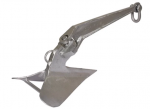
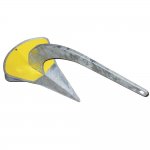
Rocna Vulcan 15kg vs Spade S80?

Status
Not open for further replies.
So which anchor apart from the UK spade, (Hope I'm right about the small s), Lewmar CQR or their Bruce copy has a direct, not an equivalent Lloyds approval for offshore use.

There is no UK spade, nor Spade - unless you visit a garden centre - and then the spade may be made in China - and primarily designed to dig your garden (or a hole in case you want to hide from Forum criticism.

You need to read the posts - Lewmar's Epsilon has Lloyds approval for SHHP (or that is what Lewmar has said). There was a post on YBW about 6-8 weeks ago saying Knox was Lloyds approved - I cannot verify this - but its a very good anchor. Classification Society does not differentiate between inshore of offshore use - but most of us anchor - inshore (no refection on our anchors - it just tends to be a bit more comfortable. The genuine CQR, Delta and the original Bruce were Lloyds High Holding Power (HHP) approved. We have moved beyond HHP, about 20 years ago, and Rocna, Manson's Supreme, Epsilon, Spade, Excel, Ultra, Fortress, Knox (?) (sorry if I missed something) are all Super High Holding Power, SHHP, approved. SHHP has twice the hold per kg of HHP. Anchors are tested 3 times in the three different seabeds against a SHHP or HHP anchor. They must also pass a Proof Test

I have been involved in Classification Society Proof Testing these are 3 different anchor subject to testing. Basically the shank or fluke is restrained and the fluke or shank tensioned against a tension criteria set by anchor size (weight) and then not deforming.

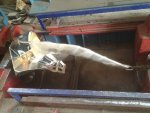
Black Maria 8.JPEG
IMG_1003.jpeg

robertson test anchors 09 002.jpeg
All anchors I list under SHHP will have been tested.

The testing protocol is not cheap so small companies making good anchors can struggle to justify the costs.

Jonathan
 
So which anchor apart from the UK spade, (Hope I'm right about the small s), Lewmar CQR or their Bruce copy has a direct, not an equivalent Lloyds approval for offshore use.
I am somewhat surprised that you once again pop up out of the blue and make so many untrue statements. You clearly have no idea about this subject.
 
Stewth cobber, you really do get some nit pickers in some threads, OK I should have used a small s, not a big one, but I did think Jersey was in the UK. One demerit to myself for not checking where it is made. Tunisia is a village near Sheffield:
Quote from the Spade UK web site for those interested in where something is made:

Alain was a retired engineer and was turned away by anchor manufacturers when he tried to sell his patents to fund his cruising life, so he set up a factory in Tunisia himself and his anchor is now famous the world over. He became the “Dyson” of the anchor world.
So it says (correctly) it is made in Tunisia. You clearly never studied geography as Tunisia is nowhere near Sheffield, but in N Africa and Alain is French (spelling is a giveaway) not a Yorkshireman.
 
There is no UK spade, nor Spade - unless you visit a garden centre - and then the spade may be made in China - and primarily designed to dig your garden (or a hole in case you want to hide from Forum criticism.

You need to read the posts - Lewmar's Epsilon has Lloyds approval for SHHP (or that is what Lewmar has said). There was a post on YBW about 6-8 weeks ago saying Knox was Lloyds approved - I cannot verify this - but its a very good anchor. Classification Society does not differentiate between inshore of offshore use - but most of us anchor - inshore (no refection on our anchors - it just tends to be a bit more comfortable. The genuine CQR, Delta and the original Bruce were Lloyds High Holding Power (HHP) approved. We have moved beyond HHP, about 20 years ago, and Rocna, Manson's Supreme, Epsilon, Spade, Excel, Ultra, Fortress, Knox (?) (sorry if I missed something) are all Super High Holding Power, SHHP, approved. SHHP has twice the hold per kg of HHP. Anchors are tested 3 times in the three different seabeds against a SHHP or HHP anchor. They must also pass a Proof Test

I have been involved in Classification Society Proof Testing these are 3 different anchor subject to testing. Basically the shank or fluke is restrained and the fluke or shank tensioned against a tension criteria set by anchor size (weight) and then not deforming.

View attachment 137975
View attachment 137976

View attachment 137977
All anchors I list under SHHP will have been tested.

The testing protocol is not cheap so small companies making good anchors can struggle to justify the costs. How does Loyds to the all important bend sideways and

Jonathan
The Rocna is not Lloyds approved, it's RINA and although they say Lloyds will accept it that is just not true. If Lloyds were not responsible for the tests they are not to be trusted. Same goes for most of the bendable anchors.

I will continue to use UK spade to make sure readers don't think I'm talking about a Rocna or other weak anchor that failed the 180 degree trip test in a big way., or bends too easily.

I like the ABS system more than Lloyds but I can't find any of the modern spades listed. From the following PBO article it seems Lloyds are not testing their anchors as well as the Americans are. If anyone wants to check the ABS status, this seems to work: Type Approval PDA Details (eagle.org)

I can only find approvals for the Bruce and Lewmars version of a Fortress, (Alloy Danforth). Can't seem to locate the Delta or new CQR yet.
Anchor Loads (langleysquadron.com)

This one really is worth reading, as 180 degree shifts or wind vs current changes are common as a low passes overhead.
Rocna Resetting Failures and evaluation of Vulcan and Mantus (morganscloud.com)
 
Last edited:
I will continue to use UK spade to make sure readers don't think I'm talking about a Rocna or other weak anchor that failed the 180 degree trip test in a big way., or bends too easily.

Could you provide a link to details of the "UK spade"?
 
All the Classification Societies accept each other's testing. I have spoken with Lloyds, RINA and ABS - what you state is incorrect. They all use the same protocols. It may be true that parts of the Commonwealth prefer Lloyds and others parts of the world prefer ABS - but if an item meets certification from ABS it will be accepted as if it were certificated by RINA or Lloyds.

Rina made the mistake of assuming that the then 'front' representing Rocna was honest and was completely unaware that production had been moved from NZ to China - how would you know? I was heavily involved in the 'investigation, resulting in articles in YM and PS et al - and in conversations I had with RINA we simply did not understand each other as I was unaware they did not know production had been moved to China and they did not know of this change and simply could not fathom why I kept talking about China. The penny clicked when the furore started and they were acquainted with reality. It was at that point when they had verified the changes that certification was dropped - what has happened since - I don't know. The world works in mysterious ways but I have all the files from the Rocna 'front' which defined exactly how many anchors were bendy and where they were sold. But for most of us here, if not all (except you)) - that was the past, its finished. There is no interest now.

The trouble with you using the term 'UK spade' is that no-one has any idea what you are talking about. A spade to all of us is a implement to move sand, or snow. There is only one Spade anchor, no other anchor would be described by any here as a spade. We might say a Vulcan looks like Spade - but that does not make it either a spade or a Spade - its simply a Vulcan. So as Tranona asks - please elaborate.

As far as I know there is only one anchor now made in the UK and that is the Knox - which looks nothing like a Spade, nor a spade - and it is certainly not made by Spear and Jackson.

Take care - and you will win some friends,

Jonathan
 
The Rocna is not Lloyds approved, it's RINA and although they say Lloyds will accept it that is just not true. If Lloyds were not responsible for the tests they are not to be trusted. Same goes for most of the bendable anchors.

I will continue to use UK spade to make sure readers don't think I'm talking about a Rocna or other weak anchor that failed the 180 degree trip test in a big way., or bends too easily.

I like the ABS system more than Lloyds but I can't find any of the modern spades listed. From the following PBO article it seems Lloyds are not testing their anchors as well as the Americans are. If anyone wants to check the ABS status, this seems to work: Type Approval PDA Details (eagle.org)

I can only find approvals for the Bruce and Lewmars version of a Fortress, (Alloy Danforth). Can't seem to locate the Delta or new CQR yet.
Anchor Loads (langleysquadron.com)

This one really is worth reading, as 180 degree shifts or wind vs current changes are common as a low passes overhead.
Rocna Resetting Failures and evaluation of Vulcan and Mantus (morganscloud.com)
This post really is nonesense
 
That is the UK distributor/Dealer for the FRENCH Spade anchor. Cannot understand why you think that is a "UK spade".

You do really seem to have very little understanding of the subject of yacht anchors - design, certification, testing, commercial etc.

UK Spade Ltd is the company, not the market. As far as I'm aware they are still made in Tunisia.

I have no idea about anchors even after 75,000 miles and 1.5 circumnavigations, (One singlehaded), plus years as crew and captain of a Spanish fishing boat way down South. That's why I post links and articles of interest, but alas very few spadeaholics can read, so I tend to post pictures like the wonderful Lewmar CQR, made in Sheffield, a village in India. For some reason they have increased the side area for the hinge and welded the trip hook in a slighlty different place.
1657024666040.png
 

Attachments

  • Spade-S80-Galvanised-Anchor-15kg.jpg
    Spade-S80-Galvanised-Anchor-15kg.jpg
    126 KB · Views: 3
UK Spade Ltd is the company, not the market. As far as I'm aware they are still made in Tunisia.

I have no idea about anchors even after 75,000 miles and 1.5 circumnavigations, (One singlehaded), plus years as crew and captain of a Spanish fishing boat way down South. That's why I post links and articles of interest, but alas very few spadeaholics can read, so I tend to post pictures like the wonderful Lewmar CQR, made in Sheffield, a village in India. For some reason they have increased the side area for the hinge and welded the trip hook in a slighlty different place.
View attachment 137992
You are great at avoiding the question. You claimed there was an anchor called a "UK spade" saying you were using lower case to avoid confusion with "Rocna or other weak anchors" but now you tell us that you are actually talking about Spade which is a brand. No idea where Sheffield comes into it although you now say it is not the Sheffield we all know but a village in India.

Your first entry to this debate was to drag out of the ark a 13 year old issue of shanks bending which has absolutely nothing to do with this thread. Not sure why you think any of the articles or links you posted might be of interest as most of what you say is either wrong or irrelevant.

You may well have a lot of sea miles, but you do seem very confused about the debates on anchor development and use over the last 20 years or so.
 
UK Spade Ltd is the company, not the market. As far as I'm aware they are still made in Tunisia.

I have no idea about anchors even after 75,000 miles and 1.5 circumnavigations, (One singlehaded), plus years as crew and captain of a Spanish fishing boat way down South. That's why I post links and articles of interest, but alas very few spadeaholics can read, so I tend to post pictures like the wonderful Lewmar CQR, made in Sheffield, a village in India. For some reason they have increased the side area for the hinge and welded the trip hook in a slighlty different place.
View attachment 137992
What incoherent babble.
Lewmar makes anchors in a village in India, really?
 
This is one of the gentler ones - so far. The discussion in relation to the original question (choice between 2 brands of anchor) is positive with good information. The new entrant is offering a diversion that has little to do with anchors per se but around the veracity and relevance of what is posted!
 
Yachting-Monthly-Nov-09.pdf (fortressanchors.com)

Thar aticle has test results that show the S 80 is a real good spade. I've had a look in Goggle search to see if any S80's failed or bent, but can't find any. Lots of articles, strudies and pictures of the other modern anchors like the Rocna series all bent.

YM are in the business of advertising companies that want boaters to buy new anchors, so they failed to include a test of a CQR, Bruce claw or even a steel Danforth, only the Fortress, which is the best in terms both holding and fast setting, or resetting, right up until the moment it falls apart of gets bent.

One thing I learnt today that has put me right off asking Santa for a small stainless Lewmar Claw, (Copy of a Bruce), is that a good quality galvanised steel is 70 % stronger than a typical stainless.
 
Last edited:
Yachting-Monthly-Nov-09.pdf (fortressanchors.com)

Thar aticle has test results that show the S 80 is a real good spade. I've had a look in Goggle search to see if any S80's failed or bent, but can't find any. Lots of articles, strudies and pictures of the other modern anchors like the Rocna series all bent.

YM are in the business of advertising companies that want boaters to buy new anchors, so they failed to include a test of a CQR, Bruce claw or even a steel Danforth, only the Fortress, which is the best in terms both holding and fast setting, or resetting, right up until the moment it falls apart of gets bent.
Why do you persist in spouting such nonsense? There is no such thing as a "spade" type anchor. Only one design that is called a Spade, and it is very different in design from the other types you mention.

If you really have looked at all the tests and articles that have been published about anchors over the last few years you will know that the CQR, Bruce, Danforth and Btitany have been extensively tested alongside firtress and all the newer designs. They mostly score poorly both on holding power, and ease of setting,/resetting compared with the newer designs.

The development of new designs is absolutely nothing to do with YM advertising but the result of an enormous amount of research and development into the subject and a demand by many of today's cruising sailors for a better performing anchor than the previous types.

Might I suggest that if you want to engage with this subject you get yourself up to date on what is happening in today. Relying on an old 2009 article just shows how little you know. That article is just about holding power on different seabeds and at straight pull and at 2 angles which is simplistic, but even then you beloved CQR is ranked last out of the 12 tested. It is poor in every mode and particularly poor when the pull is not straight. If you you knew anything about the behaviour of anchors in real life you will understand why people were looking for anchors that were better.
 
Why do you persist in spouting such nonsense? There is no such thing as a "spade" type anchor. Only one design that is called a Spade, and it is very different in design from the other types you mention.

If you really have looked at all the tests and articles that have been published about anchors over the last few years you will know that the CQR, Bruce, Danforth and Btitany have been extensively tested alongside firtress and all the newer designs. They mostly score poorly both on holding power, and ease of setting,/resetting compared with the newer designs.

The development of new designs is absolutely nothing to do with YM advertising but the result of an enormous amount of research and development into the subject and a demand by many of today's cruising sailors for a better performing anchor than the previous types.

Might I suggest that if you want to engage with this subject you get yourself up to date on what is happening in today. Relying on an old 2009 article just shows how little you know. That article is just about holding power on different seabeds and at straight pull and at 2 angles which is simplistic, but even then you beloved CQR is ranked last out of the 12 tested. It is poor in every mode and particularly poor when the pull is not straight. If you you knew anything about the behaviour of anchors in real life you will understand why people were looking for anchors that were better.

The OP is asking about the 2 different anchors, but I did need to include old but good test results that include the S80 and Rocna Vulcan. The latter has lost in my opinion, but drifting off topic slightly, why do you show an interest in any anchor that can break or bend ??

Also the 180 degree veer test should not be ignored, unless you always set 2 anchors to cover the fact the modern spades are a real disaster in a 180 shift:
Rocna Resetting Failures and evaluation of Vulcan and Mantus (morganscloud.com)

Pity that test did not include the Rocna Vulcan, but at least in includes the S80 spade.

I was once told by a very good trick cyclist in the USN when I was contracting for them as a test pilot, that when an adult who is either not very intelligent or who has been brain washed will never, ever change their minds once they have formed an opinion about an important subject, (We were talking about a lecture I was doing about Afghanistan and the US mining industry). A few weeks later after I had finished testing a new aircraft, he called me back and I had to admit he was correct, as the best I ever got from a member of the audience who attended my lectures and was presented with all the facts to prove they were wrong and the Brits were right about the causes of that war, was one USAF pilot saying, "OK, but it's my side, right or wrong". It's very like that with anchors, you can present all the right data about performance and failures, but no one in any forum will change their minds and admit their main anchor is no good in a storm, or if compared with another type.
I don't know who wrote the Morgan test article, BUT they are very intelligent indeed, as when presented with the 180 veer test results actually published what is in effect an appolgy to the old timers like myself, who really did know how good the CQR and Bruce anchors are.
 
Last edited:
Status
Not open for further replies.
Top