Rocna Style Anchor or Delta?

Thanks for so many reply's. Lots of great info here, I'm leaning towards just getting the Rocna 20kg, comparatively it's not actually the most expensive new gen anchor. I'm tempted to post some of my other issues on the forum and see if everyone can help me shave some money off in other places that might be easier or safer to be more budget minded.

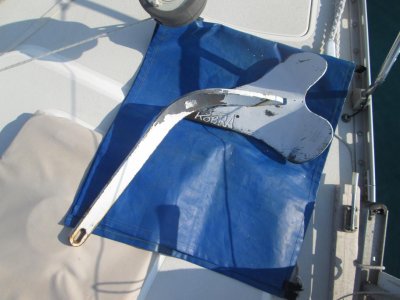
My last question regarding the Rocna anchor is can I use on my current roller? I'm not likely to want to upgrade to this anchor if it means 3-500£ of roller upgrade work as well as the anchor.

These are the only images I have at the moment of the current roller. I've attached the best images I have at the moment as I'm not on the yacht.

If it's going to be substantial costs I'd probably look at buying the Kobra instead.

Here's the current prices of all the anchors (I couldn't find the Lewmar Epsilom in 20kg)

Original rocna 20kg £579 free ship (marine super store)

Rocna Vulcan 20kg £700

Lewmar Delta 20kg £220

Knox 18kg £570 + £60shipping

Plastimo Kobra2 20kg £380 +30 shipping

Mantus M1 20kg £514

Spade 20kg £840

Mansion supreme 20kg £499

If you decide what you want, and are patient,

Plastimo Kobra Anchor 20 kg | eBay
 
Hey,

Thanks that's a great find. Is it yours? That could be a great option for now as my guess is it would make a good spare anchor if I go for Rocna later.

Why's it bright orange though lol? Also what do you mean be patient?
Not mine. No idea why its orange. Patient? Because what you want doesn't immediately pop up on ebay or Facebook marketplace but usually does eventually.
 
Hey,

Thanks that's a great find. Is it yours? That could be a great option for now as my guess is it would make a good spare anchor if I go for Rocna later.

Why's it bright orange though lol? Also what do you mean be patient?

If you are trying to determine how well your anchor is set, or not - painting it bright orange is a good idea. Dark coloured anchors disappear into the background, bright orange anchors stand out, they also stand out on bow rollers - which may of may not be aesthetic and might be useful if you keep your yacht in a marina and your bow overhangs, impinges on, the walkway between pontoons.

Painting an anchor stops it rusting for a few days - and maybe that's the paint the original owner had left over from another project.

Who knows, too many options.

But painting an anchor is transitory it soon wears off, if you use it, or the rust continues underneath the paint and the paint joins the rest of microplastics in the oceans.

Jonathan
 
On a more serious note:

The reason shanks bend is part because the fluke is immobilised and aggression is used to retrieve the anchor. As is implied modern anchors do hold tenaciously and often the rode is taut and vertical and the fluke takes time to be released from the seabed. This tenacity was never a remarkable feature of older styles of anchor, CQR, Delta, Bruce (and especially clones). This tenacity is a common feature of newer designs and is a characteristic that is remarked on - the patience needed when retrieving a well set modern anchor. Tenacity of hold is a negative if your yacht is aggressively subject to snatch loads - common place in many isolated anchorages - the fluke has no time to swivel to the new wind direction - its simply tenaciously held.

Modern flukes are so well designed, by chance or design (it does not matter which) that if well set they will hold (and take time to be released from the seabed)

And they hold so well that if patience is not employed and the shank is insufficiently strong - the shank will bend. One of the downsides of Fortress.....sometimes the flukes of a Fortress are driven sufficiently deep, in strong wind events, that owners have had to cut their losses - and abandoned the anchor and some rode (to be claimed by Neptune). Historically Fortress would replace the anchor under their 'no questions asked' warranty - though whether this is still the case, unknown.

The shank may also bend if the fluke is caught between 2 rocks or a sunken hull - that's a different story.

Rocna on introduction 20years ago made a feature of the Bisalloy 800 MPa shank, it was part of their promotion, but came undone when it was thought a good idea to dispense with Q&T HT steels (Bis80 and others) and use a mild steel - leading to the bendy shanks saga - which should have been a lesson to all (but wasn't). Now that the bendy shank saga is being lost in the mists of time - its is a bit of a worry that many anchor makers no longer define the steel used in their shanks.

One reason for the bendy shank saga is that HT Q&T steels accept galvanising differently to mild steel, so the galvanised Rocna looked a bit piebald - the shank, fluke and roll bar were all remarkably different, the HT steel did not look galvanised at all. Replacing the Q&T steel with a milder steel returned the anchor to look as if it was all 'one piece'.

Why would you not want to extol the integrity of your anchor.......?

Jonathan
 
In regards to the supposedly bendy shank of the Kobra: I can state that on multiple occasions and after a good blow, the retrieval of the anchor was only possible by running it over with the boat. This, once the chain had come bar tight and it could not be hauled up with the winch.
To note: the shaft is still as straight as the day we bought it.

I do not know what grade of steel or Anchor is made of, but to date at least, it has shown itself to have been sufficiently strong.

I'm not sure at all whether these discussions are much based in reality. I have had endless debates with folk who proudly assure me that their ground tackle has safely weathered a blow of 20 kts and what fantastic loads it must have withstood in the process. Well, until I point out that in reality and at 20 kts, this tremendous load would have been somewhat less than their own body weight.

For an American company to offer a "life time" guarantee on their anchor products would seem a pretty safe bet. Considering that, according to an US own study, the average a boat is moved on three days a year. Chances that you will be anchoring in hurricane force wind on those particular days are just about nil.
 
For an American company to offer a "life time" guarantee on their anchor products would seem a pretty safe bet. Considering that, according to an US own study, the average a boat is moved on three days a year. Chances that you will be anchoring in hurricane force wind on those particular days are just about nil.

A safe bet....

If that were the case all anchors sold in America could safely have a lifetime guarantee, which would include anchors made by Lewmar or CMP in China. The Fortress 'no questions asked' warranty was international - I bent a shank testing I received a new shank. I'm not aware that Plastimo have a presence in the US.

However I'm not sure that yacht usage in the US would be much different to yacht usage in the UK, Europe or Australia (though 3 days a year seems - questionable - for the average boat. I'd suspect that people who upgrade anchors might be outside the average.

You don't need hurricane force winds to potentially damage an anchor - you just need a hurricane force. If you retrieve your anchor and are about to wait patiently for the fluke to release and a cowboy on a big MoBo goes past - the wash can create huge snatch loads. If you were paying attention you could mitigate the damage, perhaps, by quickly attaching a snubber one, with significant elasticity - but I'm not sure it would work. :(

Jonathan
 
Last edited:
There was a link on that ebay post to a china made roll bar anchor, seemed very cheap.
Pardon our interruption...

I had a dog that used to make a mess like the welds on that anchor :) . More seriously, it could be good to try one for a dinghy or tender anchor. It sort of reflects all those pattern "Bruce" anchors you see at knock down prices.

Don't think I would be happy on a big boat, except, maybe for short daytime stops.
 
I had a dog that used to make a mess like the welds on that anchor :) . More seriously, it could be good to try one for a dinghy or tender anchor. It sort of reflects all those pattern "Bruce" anchors you see at knock down prices.

Don't think I would be happy on a big boat, except, maybe for short daytime stops.
Its a few years ago now since i posted about an anchor i had welded up, it was around the same time that 30boat (i think) posted similar, anyway i took an old danforth type copy, cut the shank off and separated the two flukes with an angle grinder, i then welded the two flukes together, welded the shank on i think it was 30 degrees ish angle, and welded on a roll bar, it was very similar to a bugle, i used it in my 16ft fishing boat and it held very well, but i can stick weld far better than the ebay anchor:D
 
There was a link on that ebay post to a china made roll bar anchor, seemed very cheap.
Pardon our interruption...
As Jonathan has said, the easiest and cheapest way to make an anchor is to use mild steel. China produces structural steel with no alloying elements and carbon content about 0.2% by the thousands of tonnes every day. I see a 15 kg anchor from this supplier costs £74.50, of which the material cost is probably less than a quarter. Its UTS is probably about 350 MPa but could be less.

The shank of a Rocna has a UTS of 800 MPa and a Viking has a yield strength, lower than its UTS, of 1250 MPa. Not only does heat treatment costs money, there are technical difficulties in fabricating high strength materials that also add cost. Plus, their welders are trained!
 
As Jonathan has said, the easiest and cheapest way to make an anchor is to use mild steel. China produces structural steel with no alloying elements and carbon content about 0.2% by the thousands of tonnes every day. I see a 15 kg anchor from this supplier costs £74.50, of which the material cost is probably less than a quarter. Its UTS is probably about 350 MPa but could be less.

The shank of a Rocna has a UTS of 800 MPa and a Viking has a yield strength, lower than its UTS, of 1250 MPa. Not only does heat treatment costs money, there are technical difficulties in fabricating high strength materials that also add cost. Plus, their welders are trained!
So in this case, you get what you pay for!

How do Lewmar manage to make the Delta so cheap compared to similar sized anchors from reputable manufacturers? And you could say the same for the Kobra. Is there something inherent to the design that allows a thicker shank made of lower grade steel, perhaps?
 
I don’t think it’s a case of how do they make Delta cheap, I think it’s a case of what extra do you get with the others. There was a big price bump when new gen appeared and most of that bump was differentiation and development cost/IP. I doubt the material or manufacturing costs are wildly different, you’re just paying for a premium product.
 
So in this case, you get what you pay for!

How do Lewmar manage to make the Delta so cheap compared to similar sized anchors from reputable manufacturers? And you could say the same for the Kobra. Is there something inherent to the design that allows a thicker shank made of lower grade steel, perhaps?
The Delta uses a manganese steel with few other elements, it is stronger than mild steel but does not approach the Rocna or Viking level.

I suspect that Kobra use relatively weak steel, maybe only slightly better than 0.2% carbon mild steel, Their website only says 'galvanised steel'. I have quite a collection of bent anchor photos: even the best materials will bend if pressed hard enough. But the only ones bent in this manner and to this extent are cheap copies and the infamous Rocna soft shanksBent Kobra.jpg
 
There is hardly another subject that generates more passion, if not hysteria, than anchoring, mostly from folk who appear to have done very little of it.

A great many have either no idea, or , if at all, a highly exaggerated one, of what any of the potential anchor loads for a given situation might be.

I have done some 70,000 miles and must have anchored many, many hundreds, if not thousands of times. Last year we did 3000 miles, de facto circumnavigating the UK from Brittany over Scandinavia and the high North, in a boat many would consider, if not improbable, then at least unsuitable, for a sailing voyage. The weather, for a large portion, was downright dreadful. We anchored a lot and in places where there was no one else and, apparently, most yachts rarely go. Here we would have had to wait for months, if not years for someone to come by, pulling a proper displacement wake, to help us retrieve our hook. Now that I have been advised on how to properly retrieve an anchor, I'll keep it in mind for future exploits.

Of course you can destroy any piece of equipment and to prove it, we have pics of mangled Ultras, Spades, Rocnas and, yes Kobras as well. If our Kobra were to bend, so what? I have spares to tide me over until I get a new one. If my $2500.- Ultra had gotten mauled, I'd be sorely pi$$ed. Not only would it have cost five times as much, but it was thoroughly trounced in a test and on a variety of sea beds by our, supposedly, vastly inferior hook.

Not all anchors handle different sea beds equally well. Rollbars like to collect rocks and mud balls, as do Bruce types. Many are just terrible in weed, including the much vaunted Fortress, which does not do well on ( I was going to say in, but for that it actually has to penetrate) hard sand or clays either. Concave types like to hang on to their mud, which can hinder a reset.

However, if you stay close to home, on a a decent mud bottom, most anchors will do just fine. It's when travelling further afield and thus experience many different types of sea bed, that you should be looking for something with more universal characteristics, rather than just plain, ultimate holding power. It might be noted that the general, ultimate and purported holding power will probably exceed anything you will, sensibly, demand of it.

Not that many years ago, the Scillies experienced a rather brutal storm. A number of yachts decided to ride it out at anchor; not all succeeded.
I noted, with some satisfaction, that one of the survivors managed to do so on their 16 kg Kobra, without problems. The report did not state whether the anchor had been damaged in the process. In regards to the potentially catastrophic consequences prevented, that would have been irrelevant in any case.
 
Laminar Flow,

You make a good case for carrying multiple anchors, either as spares or for different seabeds.

One failure of anchor threads is that people who contribute to threads don't provide sufficient information, or the information is questionable. As you have mentioned people think 20 knots of wind in an anchorage can be described as a gale (because that is the wind speed outside the anchorage). The strongest wind we have survived was measured at 70 knots but it was not more than 10 knots where we were anchored - but suggesting we survived a, well and accurately forecast Storm, 70 knot storm was correct but is grossly misleading.

The simple detail of anchor size vs vessel size and/or the anchor size vs the recommended anchor size is often missing. Similarly people omit to mention the rest of the ground tackle used, snubbers/length, chain/size and scope.

No wonder anchor threads last for ever and become repetitious and become a. bit of a waste of time


What is the point of advocating the design you are using currently when the anchor is not sized correctly for the yacht and you choose your anchorages with care such that winds are never challenging.

I know, or knew, our anchors bordered on the small size - but we mitigated the tension in the rode by use of good snubbers (which are much cheaper and lighter than a big anchor). But I did try to emphasise the use of decent snubbers (to the point of boring forum members :) ).

Jonathan
 
Last edited:
Jonathan, you are remarkably fortunate with your anchorages. Nowadays we sail exclusively on the West Coast of Scotland and the Islands. The further west and north you go, the less vegetation there is, so there are often no trees to absorb and reduce the strength of the wind. Many of these natural anchorages have all round protection from the sea, but little from the wind. Some even accentuate the wind affect, and these are obviously places to avoid in windy weather.
If I say that I'm anchored in 60 knots of wind, I mean 60 knots measured at the boat, not at some Coastal Station, many miles away. With my present boat, the anemometer is mounted at the head of the mizzen mast, and I accept that the wind speed at deck level will be a little less.
My previous boat's anemometer was mounted just above the wheelhouse roof, and the maximum sustained wind observed at anchor was 74 knots. This was in what would normally be considered to be a sheltered bay in Loch Seaforth, Isle of Lewis. Needless to say, the wind was at its worst at about three in the morning. It was not very pleasant. The wind was blowing up the length of the loch, and bending into the bay, which I had expected to be sheltered.
We have had several blows of about 60 knots, one of which lasted for about three days. In these days our boat, a 60' ketch rigged converted fishing boat was equipped with a 140lb CQR type anchor with 5/8" chain. In these sort of conditions, I never wished that my anchor and chain were lighter.
 
The strongest wind we have survived was measured at 70 knots but it was not more than 10 knots where we were anchored
:unsure: Surely this cannot be accurate. I cannot image an anchorage with this level of protection.
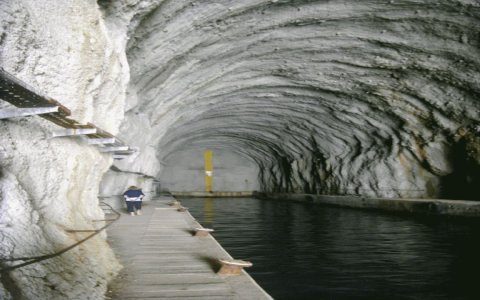
Edit: Maybe I can. This submarine cave we visited in Croatia may just qualify, but we would need to unstep our mast. As a bonus we would also be safe from bombs :).

IMG_7709.jpeg
 
Last edited:
:unsure: Surely this cannot be accurate. I cannot image an anchorage with this level of protection.

Edit: Maybe I can. This submarine cave we visited in Croatia may just qualify, but we would need to unstep our mast. As a bonus we would also be safe from bombs :).

View attachment 189463

You need to get out more.

Its not something you need to imagine - you just need to have the desire to visit Tasmania and listen to the weather forecasts. It might help that we only drew 1m, you can get right upto the shore and if there is one thing much of Tasmania does not lack - its trees (excepting the extreme SW of the island, see pic below, which is surprisingly similar to Norman's sailing grounds in Scotland)). But even the SW of the Island can offer perfect shelter - the Gordon River is navigable for miles and the trees are 100' high - some of them being Huon Pine Gordon River Cruises | Gordon River Cruise Tasmania. 70 knot winds don't enjoy much impact. Our images are on an older laptop - not easily accessible.

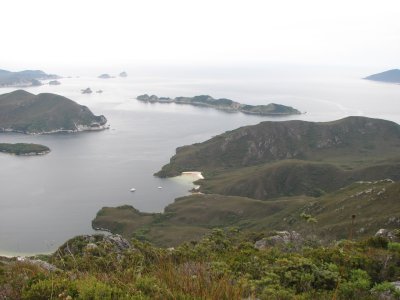
This is SW Tasmania - a bit like the west coast of Scotland - head due west and the next land mass is Patagonia. This is Bramble Cove, named after the survey ship HMAS Bramble, looking toward Breaksea Island
IMG_0022.jpeg

The Gordon River is almost unique. the weather outside simply does not impinge. Its really not for walking - too many trees but the fishing is to die for, boneless fresh water eels. SW Tasmania is a walkers dream - not too much bush and steep rugged hills (and very few people - access is a single prop plane (there is a gravel landing strip) or your own yacht - and the crayfish are to die for.

When we sheltered from a well forecast 70 knot storm we anchored at The Duck Pond, Bruny Island, Orr the Entrecasteau Channel. The Duckpond, North Bruny Island - this rough magic. Its a well know safe anchorage sheltered by low wooded hills. When 70 knots and maybe even a few knots less :) are forecast we don't challenge weather - we sail for pleasure not point scoring.

Bragging rights in the Scillies storm, see Laminar's posts, resulted in lost yachts and helicopter rescues.

Jonathan
 
Last edited:
Top