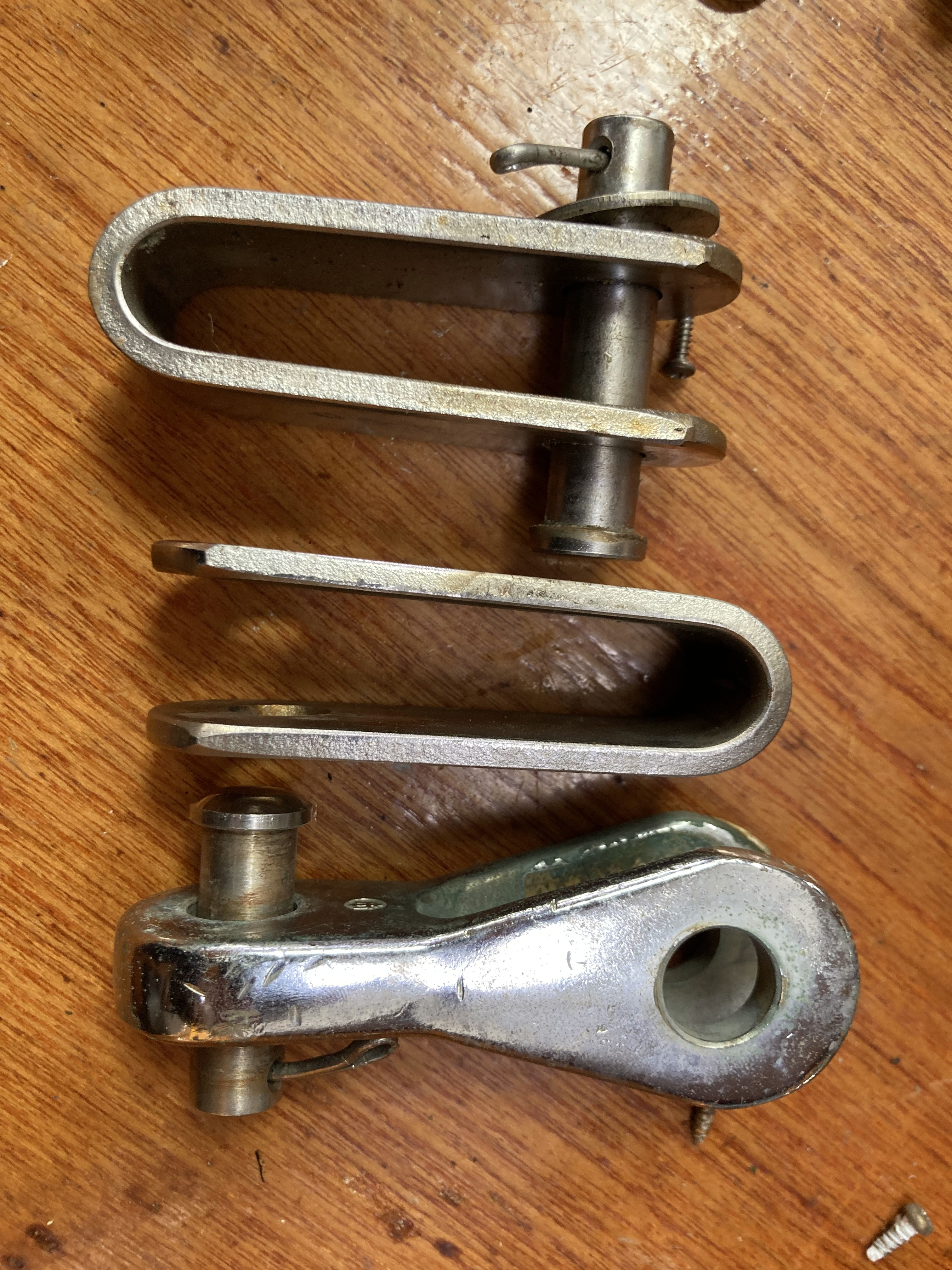
Rigging Toggles - replace (@ £300!) or reuse?

dankilb

Well-Known Member
Joined
23 Jan 2008
Messages
1,538
Visit site
We'll soon be re-stepping our mast with new standing rigging and new chainplates. In drawing up the final shopping list of last 'bits and pieces', I was shocked to find that replacement toggles / forks / eye for our 10mm forestay and backstay come to over £300 with VAT and delivery!

So the question is - should I just re-use the originals?
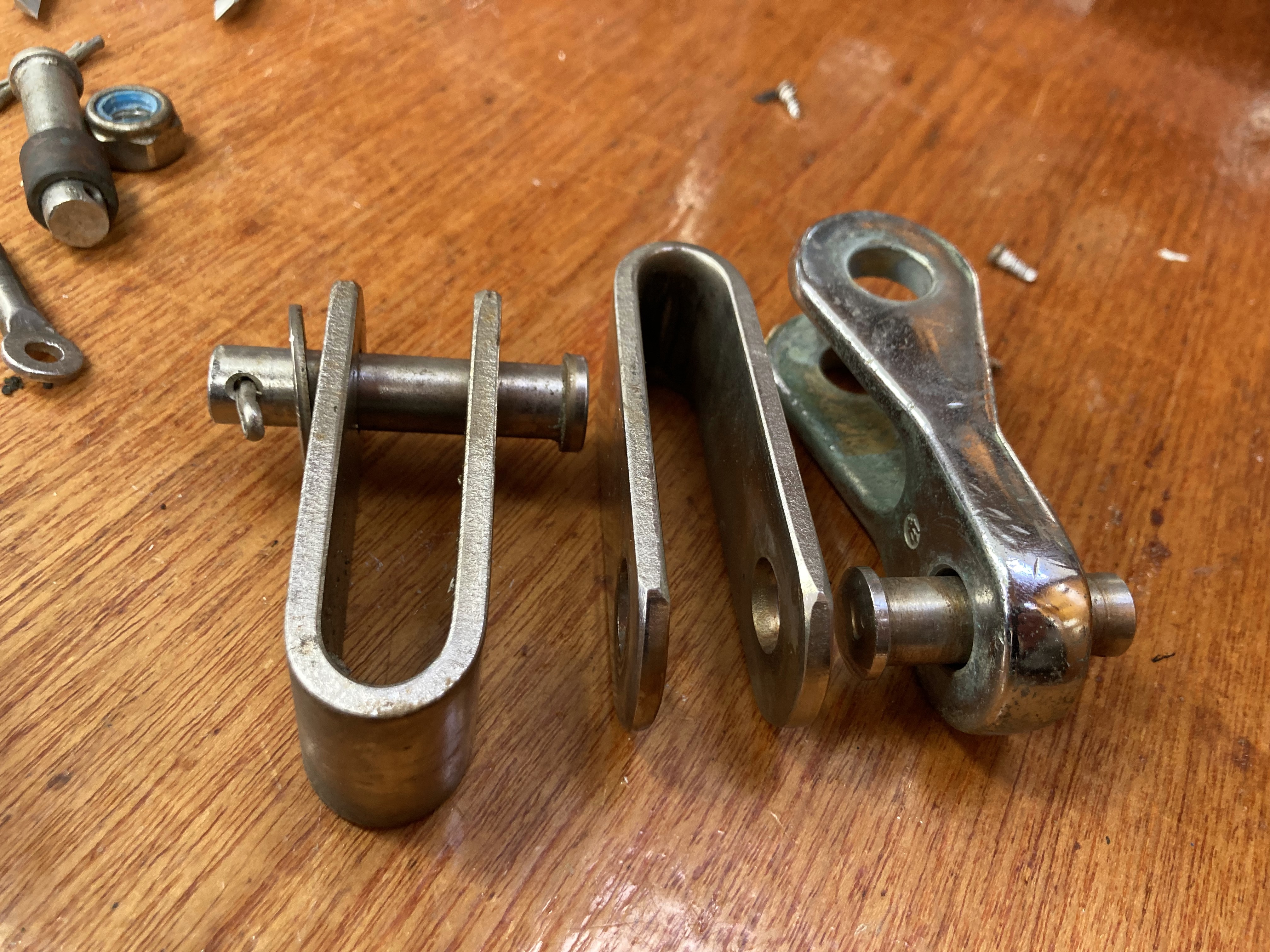
IMG-5833.jpg

IMG-5834.jpg
IMG-5832.jpg

They all show some slight discolouration around the bearing surfaces and the eye toggle is a bit pitted/discoloured all over. There are no cracks or noticeable physical damage/flaws/serious wear. All have had 30 years' service.

The intention was never to replace everything by default. The rigging was overdue and of dubious quality (assortment of various different DIY/swaged fittings). The shroud chainplates showed crevice corrosion and wastage around the studs on removal.

I would normally be open to replacing bits like this, especially at the top of the mast, but the forks alone are £100 each for a bit of bent flat bar! On the other hand, I think the newer-style eye toggles machined from thick rod seem like an 'upgrade' (also at £100 but for a more 'complex' part) so only replacing that is currently my preferred compromise.

TIA!
 
Last edited:
When I checked my rigging a few years ago the toggles at the masthead had cracked where crevice corrosion had taken hold due to stamping by Selden of the part number straight across where the metal was bent...

I may dye test my chain plates this year.

Personally if a fault is not identifiable I'd reuse old tested stuff before replacing with new un proven stuff.

You might consider testing of the parts, lots of engineering companies routinely have tests done and if you knew one they might get your lot tested for small money
 
Thanks both. I'll definitely have a look around for a local testing outfit. We're in the North West so plenty of useful trades around! I could have them do the forestay/backstay chainplate hardware, which is also visually perfect bar a few scuffs/scratches on the outside faces.

Failing that, I'll clean up the 'fork' toggles with the rest of the bits we're using as best I can and make a final decision then.

The eye toggle looks like it might be cast, to me, and I think can see the value in replacing that (@£99 inc. plus del!) for a newer-style type that is machined. The equivalent dimensions are identical, which also helps persuade...!

I would apply that rule to bottle screws, too.

It wasn't much of a decision with our old rig, because the bottle screws didn't even all match (and with no discernible pattern/logic!). The decision to replace was easy.

Otherwise all being fair, and especially given current prices (those are 8mm for us), I'd be minded to re-use too.
 
Is the one on the right chrome coated bronze?
I did think that. I'm not great on metallurgy (especially things that outwardly appear silvery and shiny!). It has a tiny trident mark stamped on one side. It certainly has yellowish/gold discolouration (that wasn't just an effect of the photo)...
 
The replacement of the 'jaw' type (masthead) toggles seems further complicated by the fact I cannot find an equivalent size/shape.

Our setup has the U-shape part of the toggle captured via a pin through the masthead. It fits just right, with a little clearance either side.

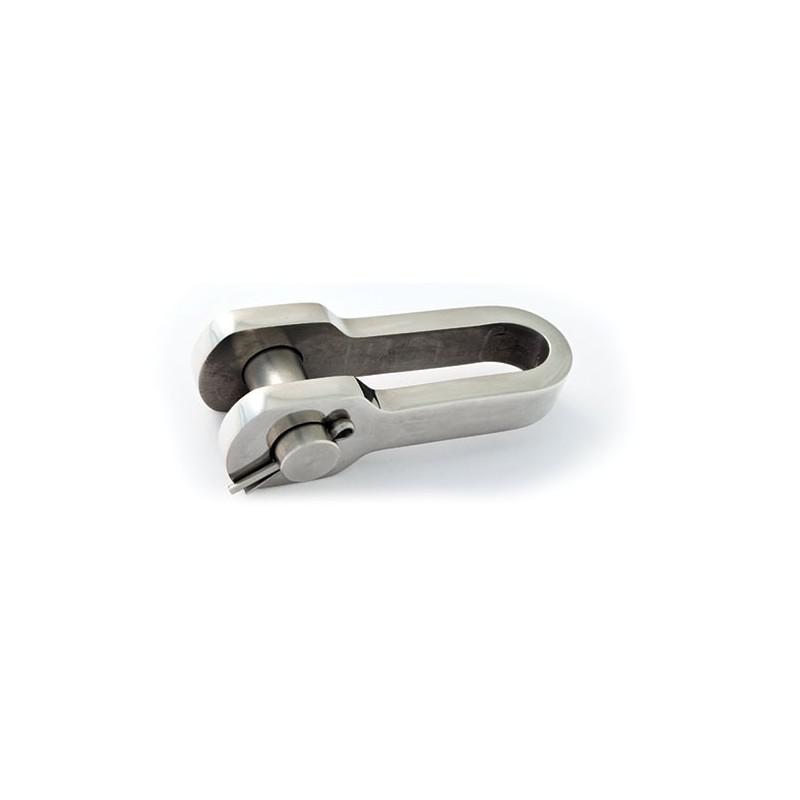
The closest I can find, in terms of forming a continuous 'strap', is this (Petersen) one:
petersen-stainless-steel-eye-jaw-toggle.jpg

But the U-shaped end could flap around a lot more either side of the pin. The width is in fact the same as the pin (16mm). So that's a lot less bearing surface than the originals. The above are also considerably longer, although we could accommodate this.

The alternative is the design with a gap in the strap (presumably intended for the eye?):

petersen-stainless-steel-double-jaw-toggles.jpg

With this shape, it might work better to have the pin-end (on the left, above) at the masthead (this would be a tighter fit than the previous design) and the eye through the U-end (on the right, above).

But overall, I'm even less comfortable with the idea of replacing these, knowing this would be a modification of sorts on the original. Is the type shown immediately above seen as an 'upgrade'?
 
You could test for cracks yourself. This test kit will cost you just under £20 including postage.

Weld Crack Detector Aerosols Dye Penetrant, Developer & Cleaner or full set of 3 | eBay
Thanks Concerto. That's helpful because my quick search only revealed larger tins @ £50 ea!

I suppose that either having them professionally tested, or even DIYing it (with some photos as evidence), might help allay any insurance queries in the event of a failure? Especially so if the argument was that the options were between re-use and a modified solution?
 
Having done a fair bit of dye penetrant inspection, I think it would be difficult to get meaningful indications with small items such as these toggles. Visual inspection at about x8 magnification, a good quality eyeglass would be good enough, should give you the required information.
 
Having done a fair bit of dye penetrant inspection, I think it would be difficult to get meaningful indications with small items such as these toggles. Visual inspection at about x8 magnification, a good quality eyeglass would be good enough, should give you the required information.
If this is the best way, then how can a rigging company inspect a rig properly for £50? That is what one local one company listed on a leaflet. Maybe it is more payment for getting an estimate for a complete set of rigging, rather than physically checking in depth.
 
Thanks Concerto. That's helpful because my quick search only revealed larger tins @ £50 ea!

I suppose that either having them professionally tested, or even DIYing it (with some photos as evidence), might help allay any insurance queries in the event of a failure? Especially so if the argument was that the options were between re-use and a modified solution?
With no direct requirement for a specific timescale for rigging change specified by my insurance company, you must maintain your boat to a serviceable condition. Checking the rig is a critical part of the boat as a failure can result in the loss of the mast and sails. The most basic check is to see if there are any fractured strands of wire at any of the terminals, if so immediate replacement is necessary. As to bottlescrews and toggles, these are more difficult to check and as vyv cox suggests a close inspection under magnification should spot any potential faults. The dye test may aid this by making them more visible.

Photographing every fitting at least twice, making sure it can be clearly identified, should satisfy an insurance company that you have taken inspection of the rig to a high standard and any failure could not be predicted.

Just as an aside, I have been on a boat that lost a rig. It was only because we managed to haul it back onboard that the cause of the 2 year old mast was found. It was a manufacturing fault and the company had to replace the whole rig. This was back in the early 1970's when internal halyards were in their infancy with exits on the side of the mast to lead the halyard directly to the mast mounted halyard winch. The specification was for the top of the exit slot for the genoa halyard to be at least 12" below the bottom of the main halyard exit slot, so a 12" band of solid metal separated each slot. Someone cut the slots so the top and bottom of the slots lined up, this resulted in the mast folding across this weak point. Having lost a mast once, I certainly never want to repeat the event. That is one reason all my bottlescrews have split pins inserted and slightly opened and never taped over, ready for easy removal to ditch the mast if it ever failed again. Do not rely on bolt cutters as they can take a lot of effort to operate and without a rig, the boat moves a lot more violently than you would expect.
 
With this shape, it might work better to have the pin-end (on the left, above) at the masthead (this would be a tighter fit than the previous design) and the eye through the U-end (on the right, above).
Sounds like a very bad idea to me. I think it would create a bending force on the item that is 90 degrees out from where it should be. (Assuming this is for the forestay).

But overall, I'm even less comfortable with the idea of replacing these, knowing this would be a modification of sorts on the original. Is the type shown immediately above seen as an 'upgrade'?
Fully agree and no.
 
Thanks for all the insightful and reassuring responses.

I've taken a closer look at the U-shaped 'jaw' toggles, cleaning them up with some Scotch pad, and they look good. The discolouration was easily removed with a microfibre and cream cleaner.

There are a few very small striations running lengthways in a few places on the bearing surface (inside the 'U'). The biggest is maybe 2-3mm long. They don't look like corrosion. To my untrained eye, it looks like wear from the clevis pins (bits of dirt/material trapped, perhaps?). They really are tiny and only appear in the relatively small area where the pin/toggle made contact. I might try to rub them out with some wet/dry.

I also had an interesting chat with a local engineers about what I thought was signs of cracking/corrosion on our backstay adjuster (around the toggle eye). The chap immediately thought it was in the chroming (I thought it was polished!) and then showed me how they disappeared after a touch with a file. He too recommended that I gently clean up any other questionable areas with a flap disc on the die grinder or wet/dry by hand and re-inspect. He also independently and without prompting recommended the DIY die sprays for added peace of mind. He reckoned that would be enough to aid a visual inspection.

Given the effort and cost of getting new rigging, why keep the old links and maintain that nagging doubt????

Well, I did mention cost in the OP, so it would be disingenuous to say this isn't a factor at all - although it is a small proportion of the overall expense of replacement/re-stepping. However, my main reasoning now is the fact you cannot seem to get an equivalent/identical replacement for the jaw toggles. If it were just £100 a pop for new ones that were exactly the same, with no more consideration required, I'd be far more tempted. As it stands, I'm less convinced by the new type with a gap in the strap-part of the 'U'. Even with a tiny bit of wear, the old ones seem to be from good quality stock. (In contrast, the pins themselves were quite visibly worn and will be getting replaced).
 
Some of the prices I have seen for simple engineering products, tricked out as marine rigging items, are ludicrous. I think you are on the right track dankilb, FWIW I have done the similar.
 
If you are considering keeping stainless steel parts, my advice is to polish them thoroughly then inspect for any cracks, which will show up better. As an aside I learned this when rebuilding a Velocette Venom motorcycle many years ago. The rockers in the cylinder head were steel forgings and I almost put them back as they were, but then decided to polish them, which revealed that one had a crack in it.
 
Top