Rigging Cutters

Neeves, This morning (quiet one on site!) after reading your post and finding it unlikely in the extreme I put a slit disc in a washing up bowl of water. An hour later, I cut through a waste scaffold bar using that disc. They really DO NOT disintegrate in water. Try it for yourself and then post back. I’m only banging on about this because a fair few respondents to this thread have stated they would use an angle grinder to cut rigging in an emergency, and after reading your post they might lose faith in that plan of action. Rather than spending precious time arguing with me re this - just chuck a disc in water and then try it.
 
Last edited:
Fred,

Easy

I did not realise I had a picture.

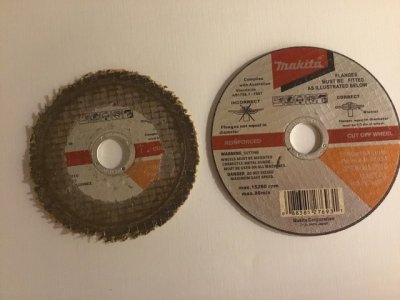
I was cutting a copper pipe to attach a compression fitting and had little space. The pipe was used (had been used), had water in it, but not much, the water was turned off. The water destroyed the cut off disc and the grinder became unbalanced.

There would be potentially more water about if you were trying to chop up rigging on a yacht.

Guess which disc was used to cut the damp pipe :). The ragged edge of the disc is a characteristic I would expect when the bonding medium failed. The failure of the disc was consistent with Makita's email reply to my query. I sadly would not use a disc to cut rigging - unless the yacht was very stable and the water was retained in the sea (or ocean) and not sluicing down the deck - maybe you use better discs than my Makita's
IMG_9661.jpeg


Jonathan
 
Last edited:
A hacksaw and lots of blades, cutting the turnbuckles would probably be my best bet.

Having had to liberate an anchor by cutting the chain with a junior hacksaw a couple of years ago, I immediately bought a full size hacksaw and packet of 32tpi blades in case I had to do something similar again. I also have a battery angle grinder on board with metal cutting discs so this post re water is very interesting.
 
Knipex 95 77 600
or similar high quality brand.
Expensive but works also if used repeatedly.
Unfortunatela I am too daft to get the link posted here.
 
Fred,

Easy

I did not realise I had a picture.

I was cutting a copper pipe to attach a compression fitting and had little space. The pipe was used (had been used), had water in it, but not much, the water was turned off. The water destroyed the cut off disc and the grinder became unbalanced.

There would be potentially more water about if you were trying to chop up rigging on a yacht.

Guess which disc was used to cut the damp pipe :). The ragged edge of the disc is a characteristic I would expect when the bonding medium failed. The failure of the disc was consistent with Makita's email reply to my query. I sadly would not use a disc to cut rigging - unless the yacht was very stable and the water was retained in the sea (or ocean) and not sluicing down the deck - maybe you use better discs than my Makita's

View attachment 190123


Jonathan
I find it very suspicious that you just happened to have a photo of that!

Look, I work with these things all the time - honestly! See below for a video of me (filmed today) a proper inox slit disc that’s sat in water before cutting steel tube.

Edit: here you go, who says I have too much time on my hands:
 
Last edited:
Slitting discs have a similar diameter, when I retire them, to biscuits for cheese - there are no other similarities.

Quote from Makita

Unfortunately, the bonded abrasive cutting or grinding discs are not designed to be used near any moisture, even though there was minimal water present, any moisture has a detrimental effect on the bonding holding the discs together, hence the reason for the detrimental effect you have experienced.

All bonded abrasive cutting & grinding discs must be stored in such a way that they do not absorb any moisture, as this will start to breakdown the bonding of the discs.

end quote

One should not make these things up.

Jonathan

I never doubted you Jonathan!

You'll notice discs now have a "use by" date on the metal centre. Any disc without a date is so old it should be thrown away.
 
I find it very suspicious that you just happened to have a photo of that!

Look, I work with these things all the time - honestly! See below for a video of me (filmed today) a proper inox slit disc that’s sat in water before cutting steel tube.

Edit: here you go, who says I have too much time on my hands:
Nothing suspicious on having a photo.

I've learnt to have a 'camera', now that I've grown used to it - a mobile handy as I write for sailing magazines (and get paid for same). Articles without pictures are autmatically rejected. I actually prefer old fashioned SLRs, with a small variety of lenses, but mobile pictures seem to be acceptable to the media - as long as Hi Res. Mobile - its usual a case of remembering to take the pictures - even though they seem irrelevant. Mobile phones are very handy - and its surprising the number of irrelevant pictures that become relevant in a totally unrelated context.

I wish more people posted pictures instead of using inadequate scripts to describe their 'topic'.

The adage - 'a picture is worth a thousand words' is still true - especially when describing the innards of a morse cable, a wiring issue etc

Just recall how the Panope videos were such a revalation.

When I shredded the disc, through cutting a 'damp' copper pipe I took a picture and sent it to Makita. As a result of this thread I posted that discs disintegrate when damp/wet. Because your experience was different and you were questioning my integrrty I then posted the Makita reply in full. Later I checked again the complete thread with Makita and found the photo at the end of the email string and I posted the picture. The thread is a few years old and I forgot I had sent the picture to Makita.

If you want - I can post the complete email string with the embedded photos.

I originally sent the emails to Makita because of the recommendation to use an angle grinder to cut rigging on the occasion of losing a mast. Masts commonly fail at sea - and being at sea is the last place you really want to use an angle grinder - one hand on the boat, one hand for the angle grinder, a moving piece of rigging, water down the decks, soon to be sodden gloves and cutting rigging is a danger even in a workshop (wires everywhere) ........its a serious accident waiting to happen.

If you mast falls down in a marina - go for the angle grinder.

I've lost 2 masts on ocean races - been there, done that. We pulled split pins

Members can make their own conclusions I just provide fullest information, I don't sell angle grinders nor blades. I will not be on their yacht when the mast falls down (I have plenty of experience of losing masts) I don't mind if members ignore my conclusions - its still a free world. I don't mind contradictory evidence (that's what the Forum commonly delivers) - just read anchor threads :) !!

I do use angle grinders a lot as I process, with slitting discs, High Tensile steels, 800MPa and high tensile aluminium, 600MPa, and am now processing 1450 MPa steel (which eventually destroys the gear box in angle grinders, I've destroyed 2 so far, good devices made by Bosch (and I've take them apart to determine what fails). I'm now using a, cheaper, Costco angle grinder - which is, surprisingly working well. The gear boxes are dry but are otherwise very similar to a windlass gearbox. I almost never use grinding discs - but I am currently using resin impregnated discs, I think sold to strip paint, to remove a layer of resin on a fibre glass, 15m x 3m, sky light preparatory to adding a new layer of a speciality paint.

Jonathan
 
I might recommend that anyone wanting to carry a battery powered angle grinder on a yacht, carried specifically to cut rigging after the loss of a mast, looks at the discs used by fredrussel and use those discs exclusively. They might like to note that Makita accepts that their slitting discs are not to be used in a wet/damp environment as the resin that bonds the discs is not intended to be waterproof.

Makita discs are not cheap, Makita is a reputable brand - assume cheaper discs might have a shorter life than those from Makita.

Having experience a mast loss in big seas then a mast belting the hull repetitively induces a degree of panic engendering carelessness as one fear amongst all others is that the mast might hole the hull, making a disaster into something life threatening. When we lost a mast we were lucky, we lost the forestay and the mast cracked at the deck, it was keel stepped, but stayed roughly upright. We secured the mast at the break, used a halyard as a forestay, and limped to the race finish line under engine. In our second mast loss we lost a shroud and the top of the mast simply fell overboard at the lower spreader. We were on the start line in Causeway Bay, HK, and retrieving the main part of the mast just took coordination and raw strength. Most of the damage to the hull gel coat was caused during retrieval, chop in The Harbour, and securing the mast to the deck (masts are heavy). If you are cutting rigging you need to bind the wires together, (for obvious reasons) gaffer tape or maybe amalgamating tape, - you don't 'just' need an angle grinder. It will be easier if the task is conducted by 2 people - both wearing safety kit

In the first mast loss we arranged to be supplied with an internal mast sleeve, sort of 'U' cross section, (it was about 2m long), sized for the location of the break. The sleeve was hammered in, wooden mallet, and further secured with pop rivets. We then sailed JoXephine from Manilla back to HK (only 550nm), using the repaired mast. The new mast, insurance paid, took some time to ship to HK and in the interim we raced as normal.

My fault - but unknown to me - when the new mast was installed the old rigging was not replaced which may have resulted in the loss of the shroud (who would know) when we lost the second mast. The forestay loss was a failed 'T' fitting. The loss occurred to a number of the yachts in the same class and eventually the 'T' fitting was, quietly, replaced on newer yachts.

After this I always carried pop rivets and a decent rivet gun as part of the maintenance kit (and never needed them for anything serious). I still have, one part of, the broken 'T' fitting.

Jonathan
 
I never doubted you Jonathan!

You'll notice discs now have a "use by" date on the metal centre. Any disc without a date is so old it should be thrown away.
I'd never seen a use by date - I'll now have a look - thanks.

In the grand scheme of things slitting discs are not expensive, throwing old ones away seems sensible.

Jonathan
 
I wish more people posted pictures instead of using inadequate scripts to describe their 'topic'.
When this exact subject came up a year or two ago, you came out with the exact same warning words of crumbly wet discs.

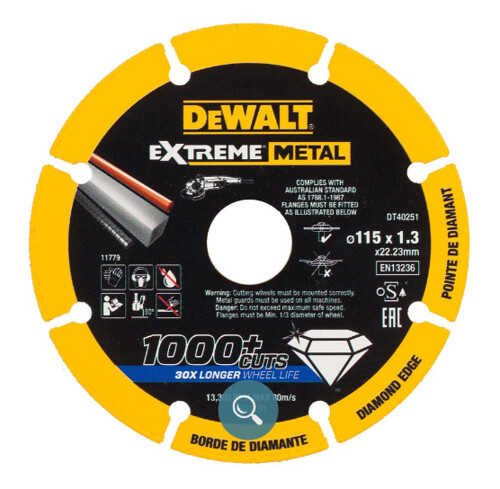
At that time, I was surprised you hadn't heard DeWalt offer a metal, diamond-edged cutting disc.

So, no need for expiry-afflicted conventional fibre discs, whether or not they go floppy when wet.

I attached a photo, too...I wish more people would look at posted pictures. 😄

53426682735_9c74277871.jpg
 
Angle grinders are a valuable tool for cutting away rigging in the event of a mast failure. The electrical components are obviously vulnerable to saltwater damage, but the discs?

My understanding is that the only concern is long-term storage of the cutting discs in a damp environment. This will damage the disc. Short term use in wet environment will not cause similar problems. There is considerable heat that will be generated while cutting. It is hard to imagine that the cutting disc could remain damp for long periods.

A quick Google search reinforces this opinion, but Google also suggested a precaution:

"Never use a grinder between your legs while sitting on the floor."

Sounds like good advice to me :).
 
Last edited:
Neeves. I’ve left a disc in water for an hour then cut a 50mm scaffold bar. I’ve put a disc in water and cut through a 14mm threaded bar and filmed it for you. Not sure what other proof I can give you to prove my point. I work in the construction industry (in a rainy country) where tools get mistreated and battered and cutting discs do not crumble in water.

There’s a funny thing going on here. Do you remember that thread where you advocated using threadlock on anchor shackles and allowing it to dry/harden/go off underwater. I had emailed Loctite’s tech dept to see if this was ok for a project of mine (folding prop) - they said (to summarise) it’s not a good idea. In response to this you said (to summarise) never mind the small print, it works. So which is it? Take the companies advice or not? To give you your credit, I did try allowing loctite to go off underwayer and it did work, you live and learn eh?

The disc in my video is a cheap and cheerful type but that’s building sites for you. If you want extra reassurance Bosch discs have a much better rep in the trade than Makita, which is weird when with the tools it’s the other way round.

…and apols to OP for thread drift.
 
Neeves. I’ve left a disc in water for an hour then cut a 50mm scaffold bar. I’ve put a disc in water and cut through a 14mm threaded bar and filmed it for you. Not sure what other proof I can give you to prove my point. I work in the construction industry (in a rainy country) where tools get mistreated and battered and cutting discs do not crumble in water.

There’s a funny thing going on here. Do you remember that thread where you advocated using threadlock on anchor shackles and allowing it to dry/harden/go off underwater. I had emailed Loctite’s tech dept to see if this was ok for a project of mine (folding prop) - they said (to summarise) it’s not a good idea. In response to this you said (to summarise) never mind the small print, it works. So which is it? Take the companies advice or not? To give you your credit, I did try allowing loctite to go off underwayer and it did work, you live and learn eh?

The disc in my video is a cheap and cheerful type but that’s building sites for you. If you want extra reassurance Bosch discs have a much better rep in the trade than Makita, which is weird when with the tools it’s the other way round.

…and apols to OP for thread drift.
I only describe my experiences and a response I had from a manufacturer.

If I was being paid for this I'd take a series of discs from different manufacturers and test them - I'm not being paid and I'm not convinced that an angle grinder is the way to go when you lose a mast in rough seas - so I lack motivation. (and don't recommend it).

My limited experience is to suggest, remove the cotter pin, knock out the clevis pin. If you fear mast loss - check that your cotter pins are actually accessible and add a hefty punch and hammer to your servicing kit

I just quote, verbatim what the disc manufacturer said and my experience - you and others can draw you own conclusions.


On serated discs.

I've used them - in an early life when I worked in the steel industry we used similar, but much bigger blades to wet cut industrial ceramic samples. The blades are lethal, they will rip inadequate gloves and your hands to shreds. I would never use them in a hand held angle grinder on a heaving deck. We had a dedicated cutting room with the blades water cooled/lubricated. The samples were cut in a 'metal box' on a sort of sliding table and the samples were big, the smallest would be about 200mm x 15mm x 15mm, big enough to hold the samples one hand at each end and the blade cutting in the middle. The cut was clean - much better than dry cut (which used blades a bit like the slitting blades but much bigger, 400mm diameter.
When this exact subject came up a year or two ago, you came out with the exact same warning words of crumbly wet discs.

At that time, I was surprised you hadn't heard DeWalt offer a metal, diamond-edged cutting disc.

So, no need for expiry-afflicted conventional fibre discs, whether or not they go floppy when wet.

I attached a photo, too...I wish more people would look at posted pictures. 😄

53426682735_9c74277871.jpg

I acknowledge my experience, with mast loss and separately my experience with angle grinders and their blades has not been subject to peer review - but is subject to the experience of others - so we have a balance or cross section of reviews. The members can weight up the information themselves and make their own decisions. I will not be there when the event happens - but I hope my experiences are clear.

Jonathan
 
I acknowledge my experience, with mast loss...I will not be there when the event happens
I don't envy your dismasting experience, but surely you will be there if you lose a third mast?

Using a handheld cordless grinder with the earlier-pictured 1.3mm-thick diamond-edged 115mm (4.5") serrated disc (made from steel) unquestionably needs care and close attention - any grinder does, in any environment, because its power comes from that 80mph+ grinding edge.

But reasonable care is also a matter of scale. Comparing the 115mm serrated DeWalt disc with one used in a 400mm (16") grinder, and associating the fearful power of that item, with a serrated metal-cutting disc on a 115mm grinder, is simply misguided.

I bought three of those metal 115mm DeWalt discs when I needed to cut up a boat trailer some years back. The job had destroyed several Bosch fibre discs, which didn't even outlive one 4 or 5Ah Bosch battery each. I've just checked the diameter of the only DeWalt diamond disc I unpackaged, and it has not reduced from new, still 115mm. It's a remarkable product with no expiry date.

Let's not have any more of this grinding disc wet disintegration worry - if it was ever relevant, progress has left it in the past. Just as the wise skipper would keep his rigging-cutting grinder battery topped up, he'd be sure to keep a metal disc fitted.

No hard feelings - if you give me an address I'll send you one of the unused DeWalt discs and you can see how good it is. ;)
.
 
I find it very suspicious that you just happened to have a photo of that!

Look, I work with these things all the time - honestly! See below for a video of me (filmed today) a proper inox slit disc that’s sat in water before cutting steel tube.

Edit: here you go, who says I have too much time on my hands:
I get your point about the disc but what happens if you put the grinder in a bucket of salt water before using it?
 
I have a normal pair of bolt croppers on board. Stored on the panel next to the engine so they do not suffer from damp as they stay dry from engine heat. when I bought them i told the shop what they were for. i was told they would not cut wire & to prove it the chap got a piece of 6mm wire. He cut it with ease & was amazed himself.
I have adjusted the jaws to ensure that they close tight when the handles are closed as a small gap will allow the compressed strands to escape cutting. I NEVER use the croppers for anything else so the jaws are as sharp as the day I bought them. They only need to cut 8 wires then the job is done.
As for battery angle cutters getting wet. That is not really a problem. One just holds the tool around the vents & it keeps virtually all the water out long enough to use the tool. same with the discs. Just do not try cutting the wire under water. Hold it where it is above the water where possible. The blade will only take a few seconds & the tool can be lifted clear.. As for hacksaws. try cutting strands whilst holding the wire in one hand & the teeth binding on the strands as one cuts with the other hand. Then balance on the boat at the same time. It is not in the least bit as easy as some make out.
 
Top