Adios
...
I have a MK3 Odeo LED Flare but I consider it for "homing in on me" use rather than a "raising alarm" item. When single handed or at night I carry the LED flare and a DSC handheld VHF but I liked the pocket size and the belt and braces idea of having a laser flare as well so I looked at what info was out there.
The older Odeo laser flare was tested by PBO and pretty unimpressive; "it twinkled like a star" at only 3 miles.
This is about the same range as the later MK3 LED version I have. Even with the fan shaped beam they dismissed the Greatland Laser Flare as being "too directional to be of use on a boat" when PBO tested that. LED and laser flares tested - Practical Boat Owner
But the Greatland laser flares have been unchanged in more than a decade and much more powerful lasers are available now, could any be more useful for actually attracting attention?
Inherently required in a device for raising alarm is that it must distract someone who isn't looking for you. The commonly used marketing phrase "can be seen up to" x number of miles is relying on a pilot or watch on a ship looking where you are at just the right moment to see a faintly twinkling light in the distance. That isn't good enough.
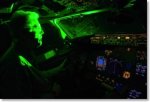
As lasers have proved a menace to aviation when in the wrong hands there is quite a lot of information out there. This image is supposed to show "flashblinding" level of light but you get the idea. Turning a cockpit window green will be noticed and reported. If it happens over the sea alarm bells should ring.
This graphic shows the different amount of glare at different distances. We'd want something that causes at least distraction but no more. A 5mW laser is only capable of distraction to 2 miles and that's a green laser which is considerably more visible than red lasers of the same power. The fanning of the light with a lens must also reduce the 5mW Greatland laser's power.
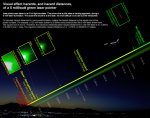
There's no point using something that can only just do its job. So what power would be ideal? Eye damage isn't an issue at distances over 160m even with a 500mW light, likewise nor is causing flashblindness as long as over half a mile away, even causing a disrupting glare isn't a problem over 2.3 miles, half the distance to a ship on the horizon. But it will provide a distraction for a plane at 40,000ft off at a distance, as low as 20 degrees from the horizon.

This was an interesting clip, especially talk of the difference between red and green. Of course a helicopter could be as little as 100m away and close enough to cause eye damage so isn't the intended use. But even then some of the talk on this issue does seem somewhat exaggerated when compared to the facts in the table above, over a certain distance a laser is just a small bright light incapable of causing eye damage. But the video shows the way it would light up a window and bounce around a ships bridge. Should be impossible even for the most half awake watch to miss. And as they say it makes homing in on the person very easy.
On the issue of aiming, a 3mm wide beam with a typical divergence of 1 milliradian will be 100 meters in diameter at 20 miles. Here is the best demonstration I could find of a powerful 400mW laser. Of course video can never be more bright than your screen so we're not seeing a realistic picture but what it does show is that even at that distance once he has something to aim at its not that hard to hit the target. The visible beam heading out will help to aim and the increasing width of the beam will mean it doesn't get much harder the further the target is. As both beams show the visible beam itself is a powerful signal on a bigger laser while the small 5mW lights are a much less visible fine beam, probably barely any use. For homing in purposes pointing the beam straight up well away from approaching rescuers seems like another useful function.
In terms of personal safety the 500mW laser can cause skin damage and set fire to things but is far less risky than setting off a pyrotechnic flare. I also wouldn't look directly into the light of a pyrotechnic. Some lasers are available with a key to lock the switch making them more child safe but of course not what we want for emergency situations. Some have a button which could be pressed in the pocket but others are twist base which would be better for us.
I looked into the legal side of pointing lasers at planes and found since 2012 in the USA the law allows an exception for use in an emergency. Interestingly some states specify "using a laser emergency signalling device to send an emergency distress signal" while others say "using a laser pointing device AS and an emergency signalling device" But still the point is clear that lasers are a legitimate means of signalling distress. Some countries ban owning them, Aus, NZ, Canada, maybe others. But at least in the UK they are legal to own for responsible use.
I'd be interested to hear others views on this but I'm quite tempted by the idea. 500mW, with a twist base. Powered by a 18650 lithium rechargeable to keep it compact. Will need to find one that is waterproof but they seem to be available and at half the cost of the Greatland Laser Flare.
The older Odeo laser flare was tested by PBO and pretty unimpressive; "it twinkled like a star" at only 3 miles.
This is about the same range as the later MK3 LED version I have. Even with the fan shaped beam they dismissed the Greatland Laser Flare as being "too directional to be of use on a boat" when PBO tested that. LED and laser flares tested - Practical Boat Owner
But the Greatland laser flares have been unchanged in more than a decade and much more powerful lasers are available now, could any be more useful for actually attracting attention?
Inherently required in a device for raising alarm is that it must distract someone who isn't looking for you. The commonly used marketing phrase "can be seen up to" x number of miles is relying on a pilot or watch on a ship looking where you are at just the right moment to see a faintly twinkling light in the distance. That isn't good enough.
As lasers have proved a menace to aviation when in the wrong hands there is quite a lot of information out there. This image is supposed to show "flashblinding" level of light but you get the idea. Turning a cockpit window green will be noticed and reported. If it happens over the sea alarm bells should ring.
This graphic shows the different amount of glare at different distances. We'd want something that causes at least distraction but no more. A 5mW laser is only capable of distraction to 2 miles and that's a green laser which is considerably more visible than red lasers of the same power. The fanning of the light with a lens must also reduce the 5mW Greatland laser's power.
There's no point using something that can only just do its job. So what power would be ideal? Eye damage isn't an issue at distances over 160m even with a 500mW light, likewise nor is causing flashblindness as long as over half a mile away, even causing a disrupting glare isn't a problem over 2.3 miles, half the distance to a ship on the horizon. But it will provide a distraction for a plane at 40,000ft off at a distance, as low as 20 degrees from the horizon.
This was an interesting clip, especially talk of the difference between red and green. Of course a helicopter could be as little as 100m away and close enough to cause eye damage so isn't the intended use. But even then some of the talk on this issue does seem somewhat exaggerated when compared to the facts in the table above, over a certain distance a laser is just a small bright light incapable of causing eye damage. But the video shows the way it would light up a window and bounce around a ships bridge. Should be impossible even for the most half awake watch to miss. And as they say it makes homing in on the person very easy.
On the issue of aiming, a 3mm wide beam with a typical divergence of 1 milliradian will be 100 meters in diameter at 20 miles. Here is the best demonstration I could find of a powerful 400mW laser. Of course video can never be more bright than your screen so we're not seeing a realistic picture but what it does show is that even at that distance once he has something to aim at its not that hard to hit the target. The visible beam heading out will help to aim and the increasing width of the beam will mean it doesn't get much harder the further the target is. As both beams show the visible beam itself is a powerful signal on a bigger laser while the small 5mW lights are a much less visible fine beam, probably barely any use. For homing in purposes pointing the beam straight up well away from approaching rescuers seems like another useful function.
In terms of personal safety the 500mW laser can cause skin damage and set fire to things but is far less risky than setting off a pyrotechnic flare. I also wouldn't look directly into the light of a pyrotechnic. Some lasers are available with a key to lock the switch making them more child safe but of course not what we want for emergency situations. Some have a button which could be pressed in the pocket but others are twist base which would be better for us.
I looked into the legal side of pointing lasers at planes and found since 2012 in the USA the law allows an exception for use in an emergency. Interestingly some states specify "using a laser emergency signalling device to send an emergency distress signal" while others say "using a laser pointing device AS and an emergency signalling device" But still the point is clear that lasers are a legitimate means of signalling distress. Some countries ban owning them, Aus, NZ, Canada, maybe others. But at least in the UK they are legal to own for responsible use.
I'd be interested to hear others views on this but I'm quite tempted by the idea. 500mW, with a twist base. Powered by a 18650 lithium rechargeable to keep it compact. Will need to find one that is waterproof but they seem to be available and at half the cost of the Greatland Laser Flare.
Last edited: